Department of Business Administration, School of Economics and Management, Jiangxi University of Science and Technology, Ganzhou, China.
Front Public Health. 2022 Jun 14;10:906106. doi: 10.3389/fpubh.2022.906106. eCollection 2022.
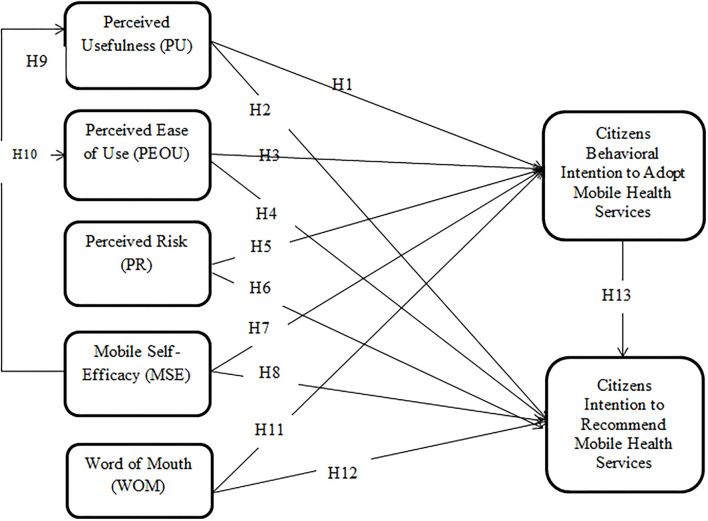
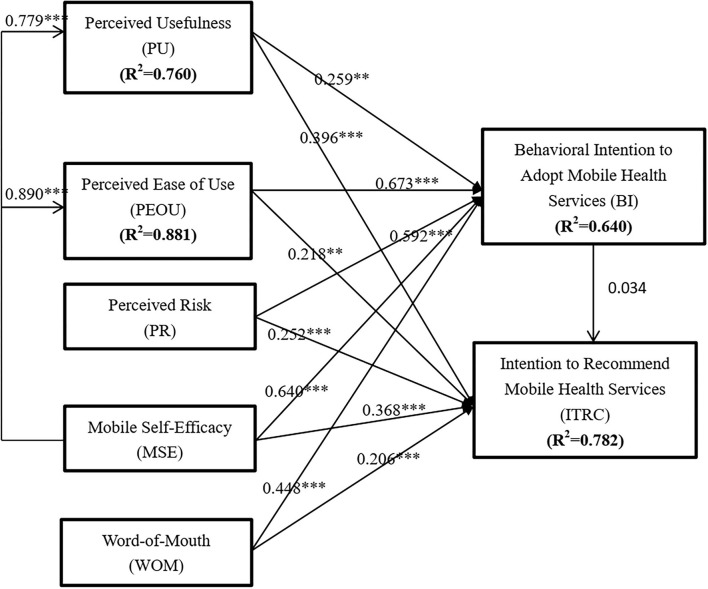
Mobile health (m-health) application development and diffusion in developing countries have always been a challenge; therefore, research that seeks to provide an elucidation of the drivers of m-Health adoption is vital. Mobile health information systems and applications can contribute to the delivery of a good healthcare system. This study examined the factors influencing citizens' adoption of mobile health services. The Technology Acceptance Model (TAM) was used as the research underpinning for this study, while the data gathered were analyzed with SmartPLS through the use of the structural equation modeling technique. The results showed that perceived usefulness and ease of use were both significant predictors of the behavioral intention to use and recommend the adoption of mobile health services. Also, perceived risk was negative but significant in predicting the intention to use and recommend adoption. Mobile self-efficacy was found to significantly determine the behavioral intention to use, intention to recommend, perceived usefulness, and perceived ease of use of mobile health services. Besides, word-of-mouth showed a positive impact on both the intention to use and recommend. Contrary to expectations, the intention to use had no significant impact on the recommendation intention. The theoretical and practical implications of these findings are thoroughly examined.
移动健康 (m-health) 应用在发展中国家的开发和推广一直是一个挑战;因此,寻求阐明 m-Health 采用的驱动因素的研究至关重要。移动健康信息系统和应用程序可以为提供良好的医疗保健系统做出贡献。本研究考察了影响公民采用移动健康服务的因素。技术接受模型 (TAM) 被用作本研究的基础,而通过使用结构方程建模技术,使用 SmartPLS 分析收集的数据。结果表明,感知有用性和易用性都是使用移动健康服务的行为意向和推荐采用的重要预测因素。此外,感知风险对使用和推荐采用的意图具有负但显著的预测作用。移动自我效能感被发现可以显著决定使用、推荐使用、感知有用性和感知易用性的行为意向。此外,口碑对使用和推荐意图都有积极影响。与预期相反,使用意图对推荐意图没有显著影响。这些发现的理论和实际意义进行了深入探讨。