Thorat Sachin Ashok, Kaniyassery Arya, Poojari Poornima, Rangel Melissa, Tantry Shashikala, Kiran Kodsara Ramachandra, Joshi Manjunath B, Rai Padmalatha S, Botha Anna-Maria, Muthusamy Annamalai
Department of Plant Sciences, Manipal School of Life Sciences, Manipal Academy of Higher Education (MAHE), Manipal, India.
Manipal School of Life Sciences, Manipal Academy of Higher Education (MAHE), Manipal, India.
Front Plant Sci. 2022 Jun 14;13:917770. doi: 10.3389/fpls.2022.917770. eCollection 2022.
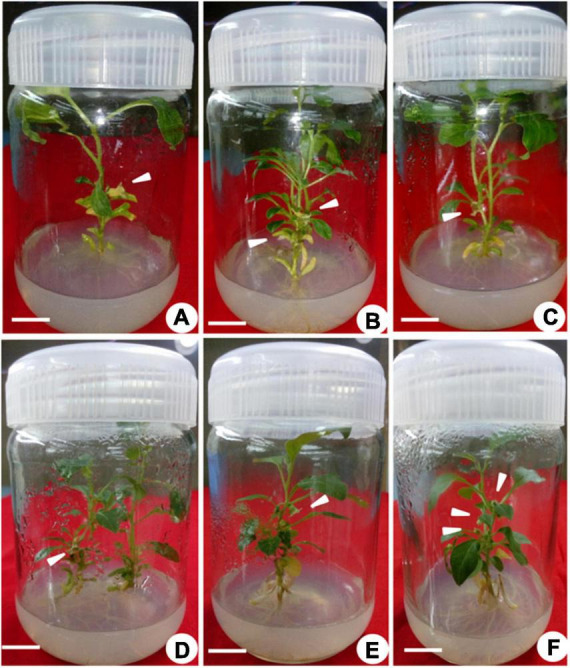
Ashwagandha ( L. Dunal) is a medicinally important plant with withanolides as its major bioactive compounds, abundant in the roots and leaves. We examined the influence of plant growth regulators (PGRs) on direct organogenesis, adventitious root development, withanolide biosynthetic pathway gene expression, withanolide contents, and metabolites during vegetative and reproductive growth phases under and conditions. The highest shooting responses were observed with 6-benzylaminopurine (BAP) (2.0 mg L) + Kinetin (KIN) (1.5 mg L) supplementation. Furthermore, BAP (2.0 mg L) + KIN (1.5 mg L) + gibberellic acid (GA) (0.5 mg L) exhibited better elongation responses with flowering. Half-strength MS medium with indole-3-butyric acid (IBA) (1.5 mg L) exhibited the highest rooting responses and IBA (1.0 mg L) with highest fruits, and overall biomass. Higher contents of withaferin A (WFA) [∼8.2 mg g dry weight (DW)] were detected in the reproductive phase, whereas substantially lower WFA contents (∼1.10 mg g DW) were detected in the vegetative phase. Cycloartenol synthase () ( = 0.0025), sterol methyltransferase () ( = 0.0059), and 1-deoxy-D-xylulose-5-phosphate reductase () ( = 0.0375) genes resulted in a significant fold change in expression during the reproductive phase. The liquid chromatography-mass spectrometry (LC-MS) analysis revealed metabolites that were common (177) and distinct in reproductive (218) and vegetative (167) phases. Adventitious roots cultured using varying concentrations of indole-3-acetic acid (IAA) (0.5 mg L) + IBA (1.0 mg L) + GA (0.2 mg L) exhibited the highest biomass, and IAA (0.5 mg L) + IBA (1.0 mg L) exhibited the highest withanolides content. Overall, our findings demonstrate the peculiarity of withanolide biosynthesis during distinct growth phases, which is relevant for the large-scale production of withanolides.
南非醉茄(L. Dunal)是一种具有重要药用价值的植物,其主要生物活性化合物为含甾醇内酯,在根和叶中含量丰富。我们研究了植物生长调节剂(PGRs)对直接器官发生、不定根发育、含甾醇内酯生物合成途径基因表达、含甾醇内酯含量以及营养生长和生殖生长阶段代谢产物的影响,研究是在[具体条件1]和[具体条件2]条件下进行的。在添加6-苄基腺嘌呤(BAP)(2.0 mg/L)+激动素(KIN)(1.5 mg/L)时观察到最高的芽诱导反应。此外,BAP(2.0 mg/L)+KIN(1.5 mg/L)+赤霉素(GA)(0.5 mg/L)在开花时表现出更好的伸长反应。含有吲哚-3-丁酸(IBA)(1.5 mg/L)的1/2强度MS培养基表现出最高的生根反应,而IBA(1.0 mg/L)处理下果实最多,且总体生物量最高。在生殖阶段检测到较高含量的睡茄素A(WFA)[约8.2 mg/g干重(DW)],而在营养阶段检测到的WFA含量显著较低(约1.10 mg/g DW)。环阿屯醇合酶([具体基因1])(P = 0.0025)、甾醇甲基转移酶([具体基因2])(P = 0.0059)和1-脱氧-D-木酮糖-5-磷酸还原酶([具体基因3])(P = 0.0375)基因在生殖阶段的表达导致了显著的倍数变化。液相色谱-质谱(LC-MS)分析揭示了在生殖阶段(218种)和营养阶段(167种)常见(177种)和不同的代谢产物。使用不同浓度的吲哚-3-乙酸(IAA)(0.5 mg/L)+IBA(1.0 mg/L)+GA(0.2 mg/L)培养的不定根表现出最高的生物量,而IAA(0.5 mg/L)+IBA(1.0 mg/L)处理下含甾醇内酯含量最高。总体而言,我们的研究结果证明了含甾醇内酯生物合成在不同生长阶段的特殊性,这与含甾醇内酯的大规模生产相关。