Xia Siwen, Zhang Mingxing, Li Meng, Song Xianmin, Chen Donghui, Zhu Minhui, Zheng Hongliang, Chen Shicai
Department of Otolaryngology Head & Neck Surgery, The Second Affiliated Hospital and Yuying Children's Hospital, Wenzhou Medical University, 109 Xueyuan West Road, Wenzhou, Zhejiang 325027, China.
Department of Otolaryngology Head & Neck Surgery, Changhai Hospital, Navy Medical University, Shanghai 200433, China.
Dis Markers. 2022 Jun 21;2022:8942985. doi: 10.1155/2022/8942985. eCollection 2022.
The study is aimed at exploring the effect of the controlled release of the glial-derived neurotrophic factor (GDNF) on nerve regeneration.
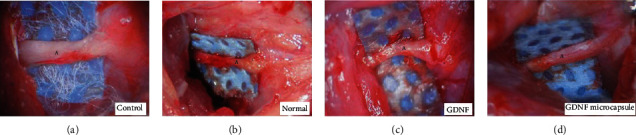
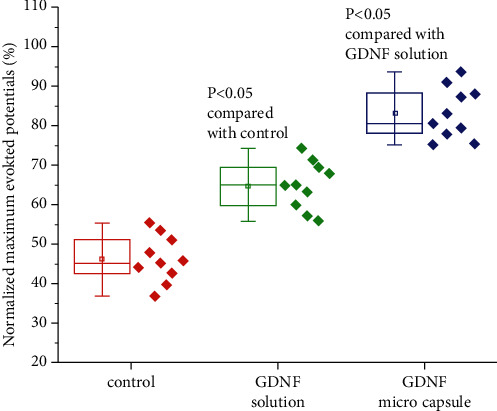
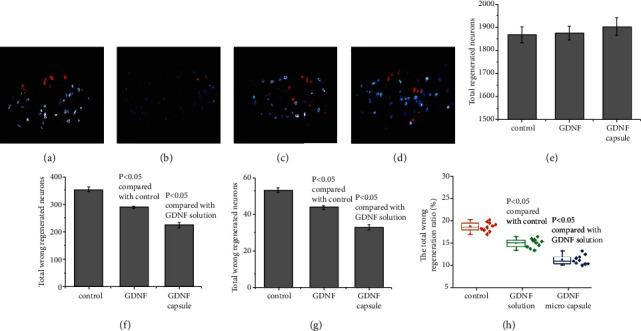
The PLGA/chitosan composite nerve conduit was used to bridge the dissected trunk of the rat facial nerve. GDNF microcapsules were loaded into the nerve conduit. Nine weeks after surgery, the facial nerve zygomatic and buccal branches were labeled with fluorescent indicators. The incorrectly grown facial neurons were reversed and counted. The facial nerve functional recovery was assessed by measuring the maximum evoked potential.
The nerve conduit was filled with different regenerating factors, such as the GDNF, GDNF microcapsules, or saline (control). The number of incorrectly regenerated neurons was lower with the nerve conduits filled with GDNF microcapsules than with those supplied with just the GDNF. However, neither the GDNF nor GDNF microcapsules affected the number of regenerated neurons. The functional recovery of the facial nerve was the best, with the nerve conduit filled with GDNF microcapsules closest to the healthy uncut facial nerve.
The stable slow-release GNDF microcapsule inside the biodegradable nerve conduit can reduce the extent of incorrect growth of the facial nerve neuron when bridging the dissected rat facial nerve trunk. The technique has a good effect on functional nerve recovery.
本研究旨在探讨胶质细胞源性神经营养因子(GDNF)控释对神经再生的影响。
采用聚乳酸-羟基乙酸共聚物/壳聚糖复合神经导管桥接大鼠面神经离断主干。将GDNF微胶囊载入神经导管。术后9周,用荧光指示剂标记面神经颧支和颊支。对生长错误的面神经神经元进行逆向计数。通过测量最大诱发电位评估面神经功能恢复情况。
神经导管内填充有不同的再生因子,如GDNF、GDNF微胶囊或生理盐水(对照)。填充GDNF微胶囊的神经导管中生长错误的神经元数量低于仅填充GDNF的神经导管。然而,GDNF和GDNF微胶囊均未影响再生神经元的数量。填充GDNF微胶囊的神经导管使面神经功能恢复最佳,最接近未切断的健康面神经。
在可生物降解神经导管内稳定缓释的GNDF微胶囊在桥接大鼠面神经离断主干时可减少面神经神经元生长错误的程度。该技术对神经功能恢复有良好效果。