Molecular Pharmacology Research Center, School of Pharmaceutical Sciences, Wenzhou Medical University, Wenzhou, 325035, China.
School of Chemistry, Sun Yat-sen University, Guangzhou, 510275, China.
Acta Pharmacol Sin. 2020 Oct;41(10):1289-1300. doi: 10.1038/s41401-019-0338-1. Epub 2020 Mar 2.
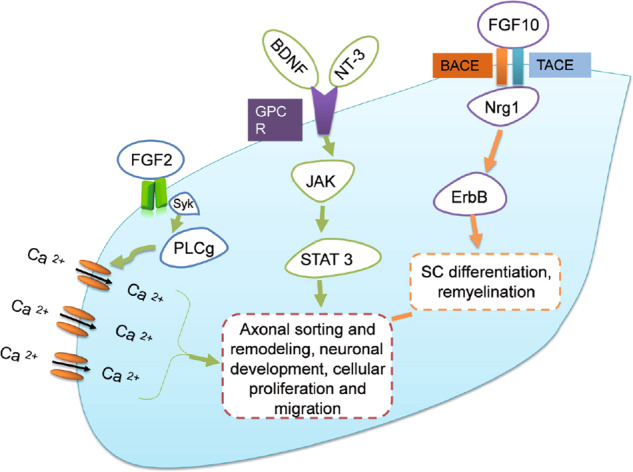
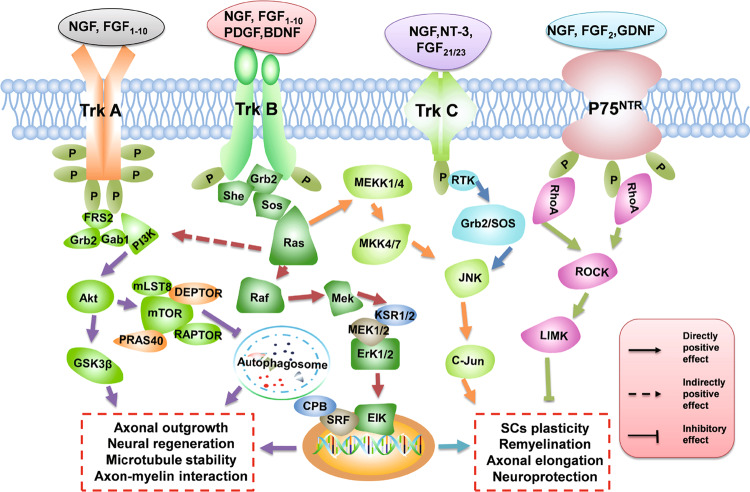
Peripheral nerve injury (PNI), one of the most common concerns following trauma, can result in a significant loss of sensory or motor function. Restoration of the injured nerves requires a complex cellular and molecular response to rebuild the functional axons so that they can accurately connect with their original targets. However, there is no optimized therapy for complete recovery after PNI. Supplementation with exogenous growth factors (GFs) is an emerging and versatile therapeutic strategy for promoting nerve regeneration and functional recovery. GFs activate the downstream targets of various signaling cascades through binding with their corresponding receptors to exert their multiple effects on neurorestoration and tissue regeneration. However, the simple administration of GFs is insufficient for reconstructing PNI due to their short half‑life and rapid deactivation in body fluids. To overcome these shortcomings, several nerve conduits derived from biological tissue or synthetic materials have been developed. Their good biocompatibility and biofunctionality made them a suitable vehicle for the delivery of multiple GFs to support peripheral nerve regeneration. After repairing nerve defects, the controlled release of GFs from the conduit structures is able to continuously improve axonal regeneration and functional outcome. Thus, therapies with growth factor (GF) delivery systems have received increasing attention in recent years. Here, we mainly review the therapeutic capacity of GFs and their incorporation into nerve guides for repairing PNI. In addition, the possible receptors and signaling mechanisms of the GF family exerting their biological effects are also emphasized.
周围神经损伤(PNI)是创伤后最常见的问题之一,可导致感觉或运动功能的严重丧失。受伤神经的修复需要复杂的细胞和分子反应,以重建有功能的轴突,使它们能够准确地与原来的靶标连接。然而,PNI 后完全恢复没有优化的治疗方法。外源性生长因子(GFs)的补充是促进神经再生和功能恢复的一种新兴的、多功能的治疗策略。GFs 通过与其相应的受体结合,激活各种信号级联的下游靶标,对神经修复和组织再生发挥多种作用。然而,由于 GFs 在体内的半衰期短且迅速失活,简单地给予 GFs 不足以重建 PNI。为了克服这些缺点,已经开发了几种源自生物组织或合成材料的神经导管。它们良好的生物相容性和生物功能性使它们成为递送多种 GFs 的合适载体,以支持周围神经再生。在修复神经缺损后,导管结构中 GFs 的控制释放能够持续改善轴突再生和功能结果。因此,近年来,生长因子(GF)递送系统的治疗方法受到了越来越多的关注。在这里,我们主要综述了 GFs 的治疗能力及其在修复 PNI 中的应用。此外,还强调了 GF 家族发挥其生物学效应的可能受体和信号机制。