Li Hongxiao, Wang Jigang, Li Zaibo, Dababneh Melad, Wang Fusheng, Zhao Peng, Smith Geoffrey H, Teodoro George, Li Meijie, Kong Jun, Li Xiaoxian
Department of Mathematics and Statistics, Georgia State University, Atlanta, GA, United States.
Institute of Biomedical Engineering, Chinese Academy of Medical Sciences and Peking Union Medical College, Tianjin, China.
Front Med (Lausanne). 2022 Jun 14;9:886763. doi: 10.3389/fmed.2022.886763. eCollection 2022.
Oncotype DX Recurrence Score (RS) has been widely used to predict chemotherapy benefits in patients with estrogen receptor-positive breast cancer. Studies showed that the features used in Magee equations correlate with RS. We aimed to examine whether deep learning (DL)-based histology image analyses can enhance such correlations.
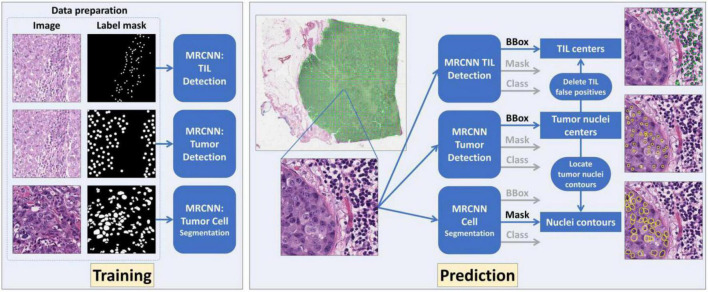
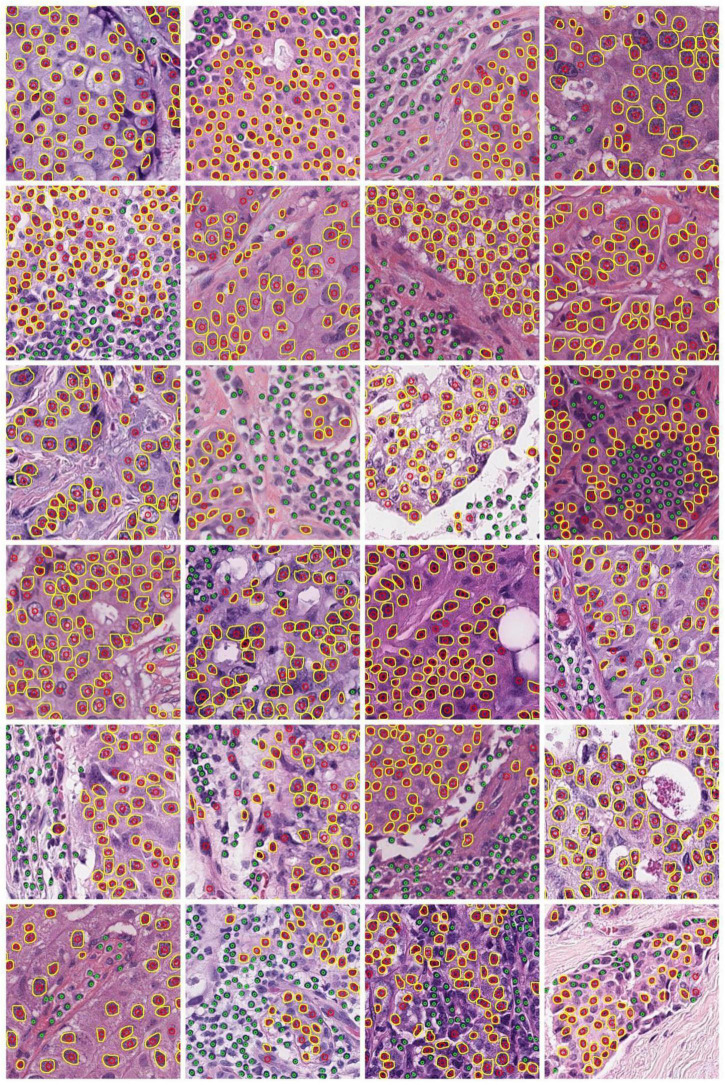
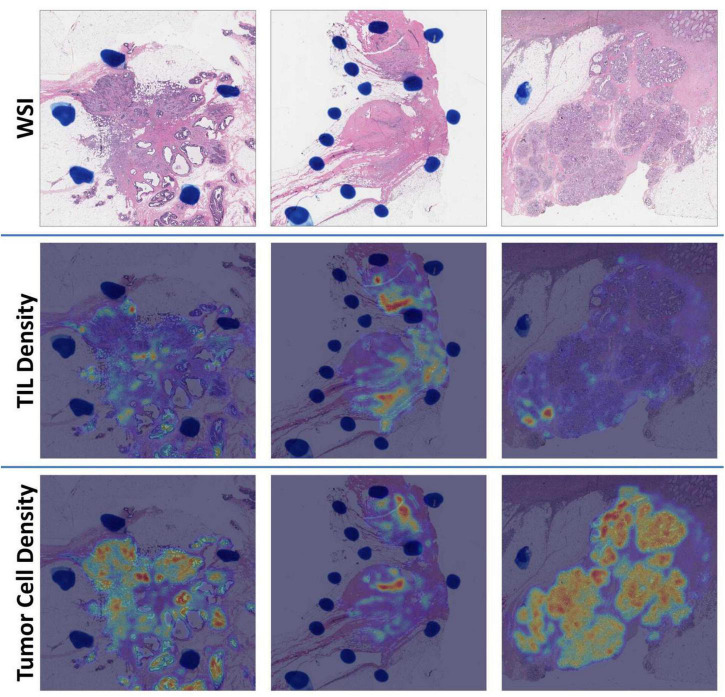
We retrieved 382 cases with RS diagnosed between 2011 and 2015 from the Emory University and the Ohio State University. All patients received surgery. DL models were developed to detect nuclei of tumor cells and tumor-infiltrating lymphocytes (TILs) and segment tumor cell nuclei in hematoxylin and eosin (H&E) stained histopathology whole slide images (WSIs). Based on the DL-based analysis, we derived image features from WSIs, such as tumor cell number, TIL number variance, and nuclear grades. The entire patient cohorts were divided into one training set (125 cases) and two validation sets (82 and 175 cases) based on the data sources and WSI resolutions. The training set was used to train the linear regression models to predict RS. For prediction performance comparison, we used independent variables from Magee features alone or the combination of WSI-derived image and Magee features.
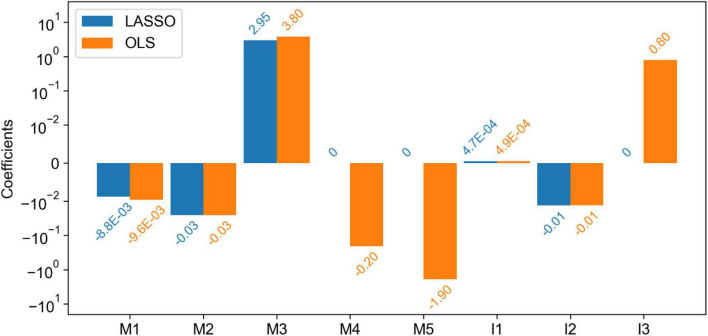
The Pearson's correlation coefficients between the actual RS and predicted RS by DL-based analysis were 0.7058 (-value = 1.32 × 10) and 0.5041 (-value = 1.15 × 10) for the validation sets 1 and 2, respectively. The adjusted values using Magee features alone are 0.3442 and 0.2167 in the two validation sets, respectively. In contrast, the adjusted values were enhanced to 0.4431 and 0.2182 when WSI-derived imaging features were jointly used with Magee features.
Our results suggest that DL-based digital pathological features can enhance Magee feature correlation with RS.
Oncotype DX复发评分(RS)已被广泛用于预测雌激素受体阳性乳腺癌患者的化疗获益。研究表明,Magee方程中使用的特征与RS相关。我们旨在研究基于深度学习(DL)的组织学图像分析是否能增强这种相关性。
我们从埃默里大学和俄亥俄州立大学检索了2011年至2015年间诊断出RS的382例病例。所有患者均接受了手术。开发DL模型以检测苏木精和伊红(H&E)染色的组织病理学全切片图像(WSIs)中的肿瘤细胞核和肿瘤浸润淋巴细胞(TILs),并分割肿瘤细胞核。基于DL分析,我们从WSIs中提取图像特征,如肿瘤细胞数量、TIL数量方差和核分级。根据数据源和WSI分辨率,将整个患者队列分为一个训练集(125例)和两个验证集(82例和175例)。训练集用于训练线性回归模型以预测RS。为了比较预测性能,我们单独使用Magee特征的自变量或WSI衍生图像和Magee特征的组合。
验证集1和验证集2中,基于DL分析的实际RS与预测RS之间的Pearson相关系数分别为0.7058(P值 = 1.32×10)和0.5041(P值 = 1.15×10)。在两个验证集中,单独使用Magee特征的调整后R²值分别为0.3442和0.2167。相比之下,当WSI衍生的成像特征与Magee特征联合使用时,调整后R²值分别提高到0.4431和0.2182。
我们的结果表明,基于DL的数字病理特征可以增强Magee特征与RS的相关性。