Division of Sciences, Krea University, Sri City, India.
Department of NMR Based Structural Biology, Max Planck Institute for Multidisciplinary Sciences, Göttingen, Germany.
Nat Commun. 2022 Jul 1;13(1):3792. doi: 10.1038/s41467-022-31374-5.
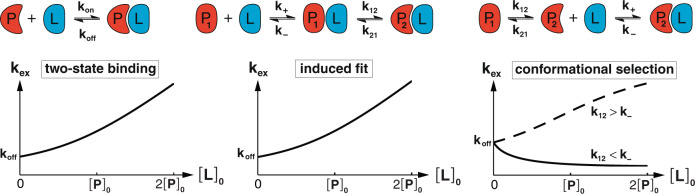
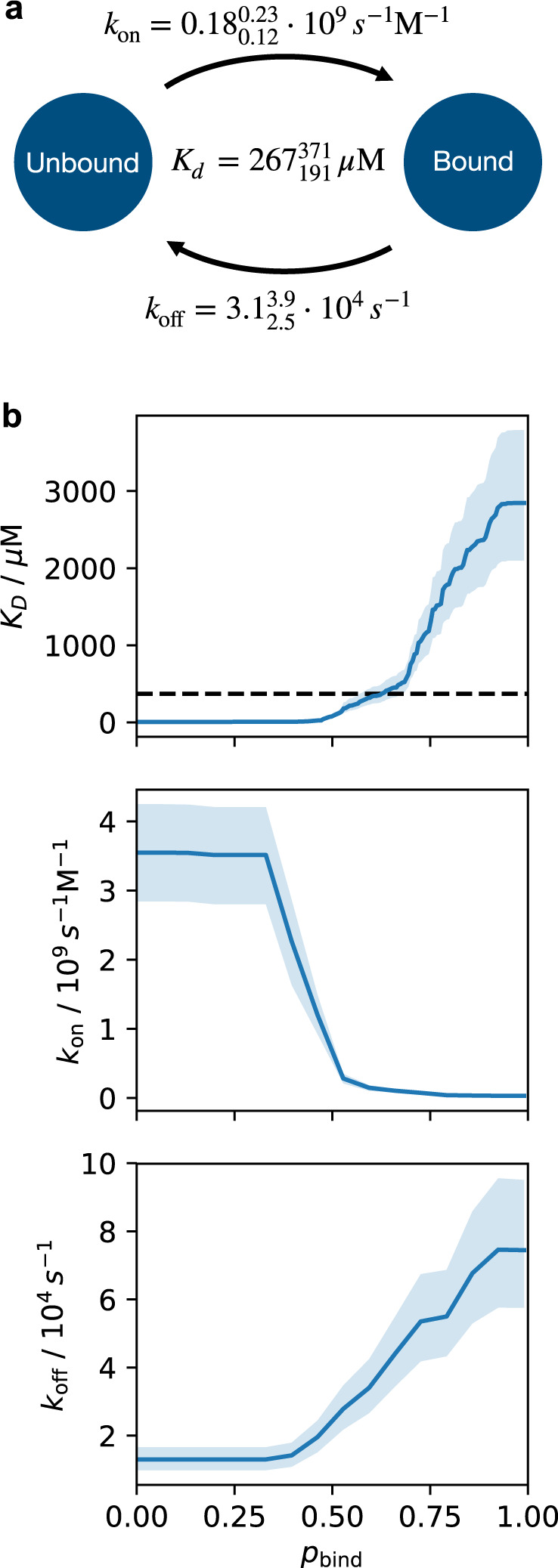
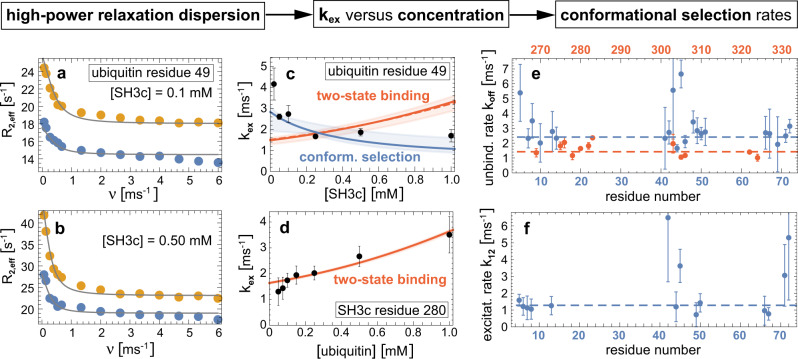
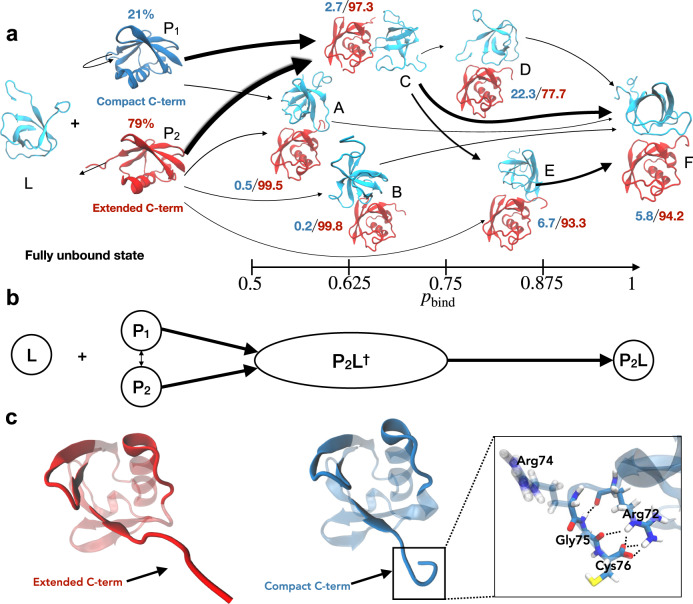
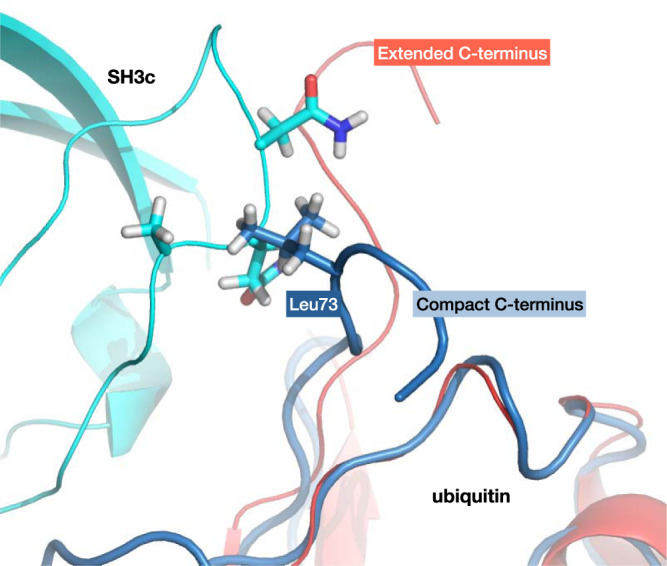
Partner recognition in protein binding is critical for all biological functions, and yet, delineating its mechanism is challenging, especially when recognition happens within microseconds. We present a theoretical and experimental framework based on straight-forward nuclear magnetic resonance relaxation dispersion measurements to investigate protein binding mechanisms on sub-millisecond timescales, which are beyond the reach of standard rapid-mixing experiments. This framework predicts that conformational selection prevails on ubiquitin's paradigmatic interaction with an SH3 (Src-homology 3) domain. By contrast, the SH3 domain recognizes ubiquitin in a two-state binding process. Subsequent molecular dynamics simulations and Markov state modeling reveal that the ubiquitin conformation selected for binding exhibits a characteristically extended C-terminus. Our framework is robust and expandable for implementation in other binding scenarios with the potential to show that conformational selection might be the design principle of the hubs in protein interaction networks.
蛋白质结合中的伴侣识别对于所有生物功能都至关重要,但阐明其机制具有挑战性,尤其是当识别发生在微秒内时。我们提出了一个基于简单的核磁共振弛豫分散测量的理论和实验框架,用于研究亚毫秒时间尺度上的蛋白质结合机制,这超出了标准快速混合实验的范围。该框架预测,构象选择在泛素与 SH3(Src 同源 3)结构域的典型相互作用中占主导地位。相比之下,SH3 结构域以二态结合过程识别泛素。随后的分子动力学模拟和马科夫状态建模表明,选择用于结合的泛素构象表现出特征性的延伸 C 末端。我们的框架是稳健的,并且可以扩展到其他结合情况中,有可能表明构象选择可能是蛋白质相互作用网络中枢纽的设计原则。