Department of Epidemiology, University Medical Center Groningen, University of Groningen, PO Box 30.001, 9700 RB, Groningen, The Netherlands.
Department of Planning, Faculty of Spatial Sciences, Urban & Regional Studies Institute, University of Groningen, Groningen, The Netherlands.
Int J Health Geogr. 2022 Jul 1;21(1):7. doi: 10.1186/s12942-022-00302-7.
A better understanding of lifestyle behaviours of children < 7 years and the relation with childhood overweight is needed. The aim of our prospective study was to examine how lifestyle patterns in young children are associated with the development of childhood overweight. As ecological models suggest focusing on not only the child as an individual, but also their environment, we also considered the role of socio-economic status (SES) and spatial clustering of lifestyle and body mass index (BMI).
In 1792 children (aged 3-6 years) participating in the GECKO Drenthe cohort, diet, screen time, outdoor play and sleep were assessed by questionnaires and moderate-to-vigorous physical activity and sedentary time by accelerometry (Actigraph GT3X). At 10-11 years, height and weight were measured to calculate age- and sex-specific standardized BMI z-scores (zBMI). Lifestyle patterns were identified using principal component analysis. To assess spatial clustering for the lifestyle patterns and zBMI, we calculated the Global Moran's I statistic. Linear- and logistic regression models, taking into account SES, were performed to examine the association between the lifestyle patterns and the development of overweight. For the spatial analyses, we added spatial terms for the determinants, the outcome, and the error term.
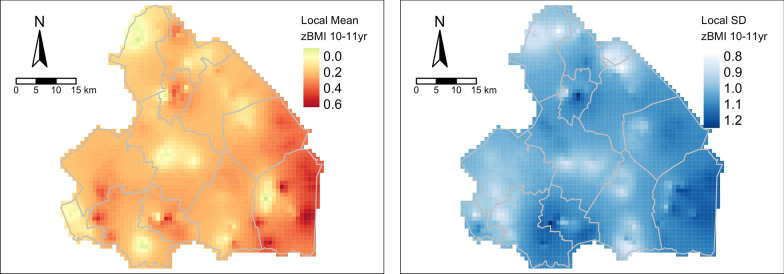
Three lifestyle patterns were identified: (1) 'high activity', (2) 'low screen time, high sleep and healthy diet', and (3) 'high outdoor play'. No associations were observed between the 'high activity' or 'high outdoor play' patterns at young age with the development of childhood overweight (all p > 0.05). In contrast, children who adhered to the 'low screen time, high sleep and healthy diet' pattern had lower odds to become overweight and a lower zBMI at 10-11 years (odds ratio [95% CI] = 0.766 [0.65; 0.90]). These findings remained similar after taking SES into account. Regarding the spatial analyses, we found spatial clustering of zBMI, but no spatial clustering of the lifestyle patterns.
Low screen time, high sleep duration and a healthy diet cluster into a pattern that seems favourable in the prevention of childhood overweight, independent of individual SES. The spatial analyses suggest that there are likely other neighbourhood factors that contribute to the spatial clustering of childhood overweight.
需要更好地了解 7 岁以下儿童的生活方式行为及其与儿童超重的关系。我们前瞻性研究的目的是探讨幼儿的生活方式模式如何与儿童超重的发展相关。由于生态模型表明不仅要关注儿童个体,还要关注其环境,我们还考虑了社会经济地位 (SES) 以及生活方式和体重指数 (BMI) 的空间聚类的作用。
在参加 GECKO 德伦特队列的 1792 名儿童(年龄 3-6 岁)中,通过问卷调查评估饮食、屏幕时间、户外活动和睡眠,通过加速度计(Actigraph GT3X)评估中等到剧烈的身体活动和久坐时间。在 10-11 岁时,测量身高和体重以计算年龄和性别特异性标准化 BMI z 分数 (zBMI)。使用主成分分析确定生活方式模式。为了评估生活方式模式和 zBMI 的空间聚类,我们计算了全局 Moran's I 统计量。线性和逻辑回归模型考虑 SES,以检查生活方式模式与超重发展之间的关联。对于空间分析,我们为决定因素、结果和误差项添加了空间项。
确定了三种生活方式模式:(1)“高活动”,(2)“低屏幕时间、高睡眠和健康饮食”,和 (3)“高户外活动”。在年幼时,“高活动”或“高户外活动”模式与儿童超重的发展之间没有关联(均 p > 0.05)。相比之下,坚持“低屏幕时间、高睡眠和健康饮食”模式的儿童超重的几率较低,10-11 岁时 zBMI 也较低(比值比 [95%CI] = 0.766 [0.65; 0.90])。考虑到 SES 后,这些发现仍然相似。关于空间分析,我们发现 zBMI 存在空间聚类,但生活方式模式没有空间聚类。
低屏幕时间、高睡眠时间和健康饮食聚类成一种模式,似乎有利于预防儿童超重,独立于个体 SES。空间分析表明,可能还有其他邻里因素导致儿童超重的空间聚类。