School of Information Management, Sun Yat-Sen University, East Campus, Guangzhou, 510006, Guangdong, China.
Department of Geography, The University of Hong Kong, Pokfulam RD, Hong Kong, China.
Int J Health Geogr. 2021 Mar 3;20(1):12. doi: 10.1186/s12942-021-00266-0.
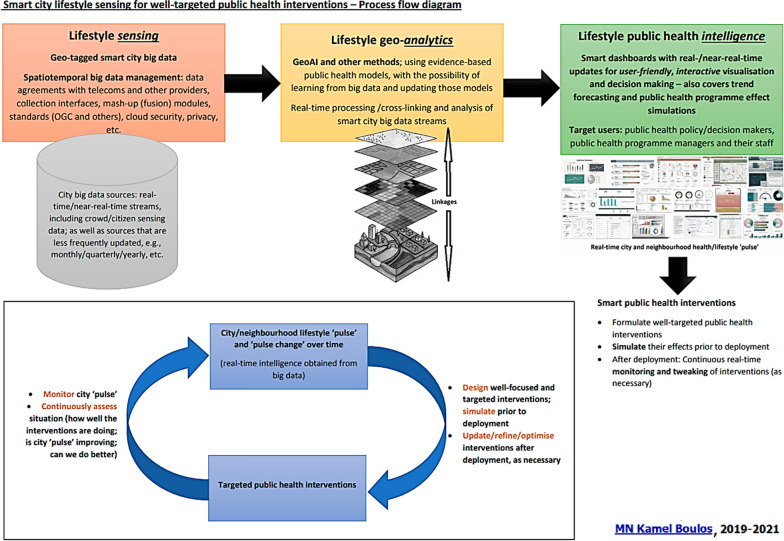
The public health burden caused by overweight, obesity (OO) and type-2 diabetes (T2D) is very significant and continues to rise worldwide. The causation of OO and T2D is complex and highly multifactorial rather than a mere energy intake (food) and expenditure (exercise) imbalance. But previous research into food and physical activity (PA) neighbourhood environments has mainly focused on associating body mass index (BMI) with proximity to stores selling fresh fruits and vegetables or fast food restaurants and takeaways, or with neighbourhood walkability factors and access to green spaces or public gym facilities, making largely naive, crude and inconsistent assumptions and conclusions that are far from the spirit of 'precision and accuracy public health'. Different people and population groups respond differently to the same food and PA environments, due to a myriad of unique individual and population group factors (genetic/epigenetic, metabolic, dietary and lifestyle habits, health literacy profiles, screen viewing times, stress levels, sleep patterns, environmental air and noise pollution levels, etc.) and their complex interplays with each other and with local food and PA settings. Furthermore, the same food store or fast food outlet can often sell or serve both healthy and non-healthy options/portions, so a simple binary classification into 'good' or 'bad' store/outlet should be avoided. Moreover, appropriate physical exercise, whilst essential for good health and disease prevention, is not very effective for weight maintenance or loss (especially when solely relied upon), and cannot offset the effects of a bad diet. The research we should be doing in the third decade of the twenty-first century should use a systems thinking approach, helped by recent advances in sensors, big data and related technologies, to investigate and consider all these factors in our quest to design better targeted and more effective public health interventions for OO and T2D control and prevention.
超重、肥胖(OO)和 2 型糖尿病(T2D)给公共卫生带来的负担非常巨大,并且在全球范围内还在持续增加。OO 和 T2D 的病因非常复杂,涉及多种因素,而不仅仅是能量摄入(食物)和消耗(运动)失衡。但此前有关食物和身体活动(PA)周边环境的研究主要集中于将身体质量指数(BMI)与靠近售卖新鲜水果和蔬菜的商店或快餐店和外卖店的距离、周边步行环境因素以及接近绿地或公共健身设施的程度联系起来,从而做出了大量简单、粗糙且不一致的假设和结论,这些结论与“精准和准确公共卫生”的精神相去甚远。由于个体和人群的独特因素(遗传/表观遗传、代谢、饮食和生活方式习惯、健康素养特征、屏幕观看时间、压力水平、睡眠模式、环境空气和噪声污染水平等)以及这些因素之间及其与当地食物和 PA 环境之间的复杂相互作用,不同的人和人群对相同的食物和 PA 环境的反应各不相同。此外,同一家食品店或快餐店往往既可以销售健康食品,也可以销售非健康食品/份量,因此应避免简单地将其分为“好”或“坏”的商店/店铺。此外,适当的体育锻炼虽然对身体健康和疾病预防至关重要,但对于保持或减轻体重的效果并不明显(尤其是仅依赖于体育锻炼时),也不能抵消不良饮食的影响。我们在 21 世纪第三个十年应该采用系统思维方法,并借助传感器、大数据和相关技术的最新进展,研究和考虑所有这些因素,以设计出针对超重和 2 型糖尿病控制和预防的更有针对性、更有效的公共卫生干预措施。