Department of Obstetrics and Gynecology, PEDEGO Research Unit, Medical Research Center Oulu, University of Oulu and University Hospital of Oulu, Oulu, Finland.
Department of Pediatrics, Oulu University Hospital, Oulu, Finland.
Acta Obstet Gynecol Scand. 2022 Oct;101(10):1093-1101. doi: 10.1111/aogs.14413. Epub 2022 Jul 1.
Thyroid diseases in pregnancy are relatively common and are associated with adverse pregnancy and perinatal outcomes, increasing a neonate's risk of admission to the neonatal intensive care unit (NICU). The aim of this study was to evaluate the indications for increased risk of NICU admission among the neonates of hypothyroid and hyperthyroid mothers.
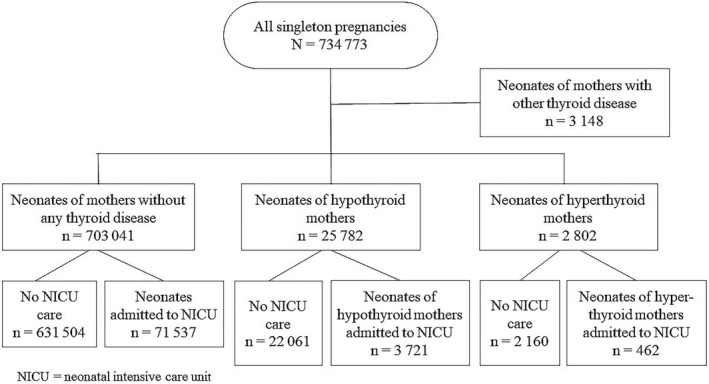
The study data consisted of all singleton deliveries (n = 734 773) between 2004 and 2016 in Finland collected from the Finnish Medical Birth Register. The odds of NICU admission (with 95% confidence intervals) were compared between the neonates of hypothyroid or hyperthyroid mothers and of mothers without any thyroid diseases by specified neonatal characteristics and morbidities using logistic regression analysis. The studied neonatal characteristics were preterm birth (<37+0 gestational weeks), low birthweight (<2500 g), the rate of small- and large-for-gestational age infants, and eight disease-specific neonatal outcomes: asphyxia, respiratory distress syndrome, meconium aspiration syndrome, pneumothorax, cardiovascular problems, infections, jaundice and hypoglycemia.
The most common indications for NICU care were principally the same in the neonates of the mothers with and without thyroid disease: respiratory distress syndrome, infections, preterm birth, low birthweight and neonatal hypoglycemia. The preterm neonates, neonates with low birthweight, and large-for-gestational-age infants had increased odds of NICU admission if their mother had hypothyroidism. Also neonates with cardiovascular problems, jaundice or hypoglycemia associated with maternal diabetes had increased odds of NICU admissions if their mother had hypothyroidism. Further, the preterm neonates, large-for-gestational-age infants, and term infants with jaundice had increased odds of NICU admission if their mother had hyperthyroidism.
The most common indications for NICU care were similar for the neonates of the mothers with and without thyroid disease. However, the neonates of the mothers with thyroid diseases were more likely to need NICU care. The neonates of the mothers with thyroid diseases had higher odds of NICU treatment in cases of preterm birth, large for gestational age, and hypoglycemia.
妊娠期间甲状腺疾病较为常见,与妊娠不良结局和围生儿不良结局相关,增加新生儿入住新生儿重症监护病房(NICU)的风险。本研究旨在评估甲状腺功能减退和甲状腺功能亢进母亲的新生儿入住 NICU 的风险增加的指征。
研究数据来自芬兰于 2004 年至 2016 年间收集的芬兰医疗出生登记处的所有单胎分娩(n=734773)。通过逻辑回归分析,比较甲状腺疾病母亲和无甲状腺疾病母亲的新生儿之间,以及特定新生儿特征和合并症与 NICU 入住率(95%置信区间)的关系。所研究的新生儿特征包括早产(<37+0 孕周)、低出生体重(<2500g)、小于胎龄儿和大于胎龄儿的比例,以及 8 种特定的新生儿结局:窒息、呼吸窘迫综合征、胎粪吸入综合征、气胸、心血管问题、感染、黄疸和低血糖。
母亲有或无甲状腺疾病的新生儿,NICU 治疗的主要指征基本相同:呼吸窘迫综合征、感染、早产、低出生体重和新生儿低血糖。患有甲状腺功能减退的母亲的早产儿、低出生体重儿和大于胎龄儿,其入住 NICU 的可能性增加。此外,患有心血管问题、黄疸或与母亲糖尿病相关的低血糖的母亲患有甲状腺功能减退的新生儿,其入住 NICU 的可能性也会增加。进一步,患有甲状腺功能亢进的母亲的早产儿、大于胎龄儿和足月婴儿出现黄疸,其入住 NICU 的可能性增加。
母亲有或无甲状腺疾病的新生儿,NICU 治疗的主要指征基本相同。然而,患有甲状腺疾病的母亲的新生儿更需要 NICU 护理。患有甲状腺疾病的母亲的新生儿,在早产、大于胎龄儿和低血糖的情况下,入住 NICU 的可能性更高。