Department of Surgical Sciences, Uppsala University, 75185, Uppsala, Sweden.
Int J Colorectal Dis. 2022 Jul;37(7):1699-1707. doi: 10.1007/s00384-022-04206-7. Epub 2022 Jul 2.
To determine the results after rectovaginal fistula (RVF) repair and find predictors of outcome. Primary objective was fistula healing. Secondary outcomes were morbidity and patient health-related quality of life (HRQoL).
An observational study of 55 women who underwent RVF repair including both local procedures and tissue transposition 2003-2018 was performed. Baseline patient and fistula characteristics were registered, combined with a prospective HRQoL follow-up and a general questionnaire describing fistula symptoms.
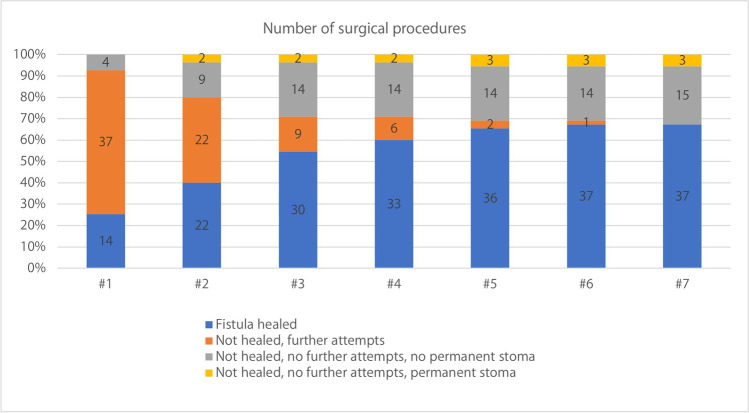
Healing rate after index surgery was 25.5% (n = 14) but the final healing rate was 67.3% (n = 37). Comparing the etiologies, traumatic fistulas (iatrogenic and obstetric) had the highest healing rates after index surgery (n = 11, 45.9%) and after repeated operations at final follow-up (n = 22, 91.7%) compared with fistulas of inflammatory fistulas (Crohn's disease, cryptoglandular infection, and anastomotic leakage) that had inferior healing rates after both index surgery (n = 7, 7.1%) and at final follow-up (n = 13, 46.4%). Fistulas of the category others (radiation damage and unknown etiology) included a small amount of patients with intermediate results at both index surgery (n = 1, 33.3%) and healing rate at last follow-up (n = 2, 66.7%). The differences were statistically significant for both index surgery (p = 0.004) and at final follow-up (p = 0.001). Unhealed patients scored lower than both healed patients and the normal population in 6/8 Rand-36 domains, but the differences were not statistically significant.
Most traumatic rectovaginal fistulas closed after repeated surgery whereas inflammatory fistulas had a poor prognosis. Low healing rates after local repairs suggest that tissue transfer might be indicated more early in the treatment process. Unhealed fistulas were associated with reduced quality of life. Trial registration Clinicaltrials.gov No. NCT05006586.
确定直肠阴道瘘(RVF)修复后的结果,并找出影响结果的预测因素。主要目标是瘘口愈合。次要结果是发病率和患者健康相关生活质量(HRQoL)。
对 2003 年至 2018 年期间接受 RVF 修复的 55 名女性进行了一项观察性研究,包括局部手术和组织转移。记录了患者和瘘口的基线特征,结合前瞻性 HRQoL 随访和描述瘘口症状的一般问卷调查。
索引手术后的愈合率为 25.5%(n=14),但最终愈合率为 67.3%(n=37)。比较病因,创伤性瘘(医源性和产科)在索引手术后(n=11,45.9%)和最终随访时的重复手术后(n=22,91.7%)的愈合率最高,而炎症性瘘(克罗恩病、隐窝感染和吻合口漏)的愈合率较低,索引手术后(n=7,7.1%)和最终随访时(n=13,46.4%)。其他类别(放射损伤和未知病因)的瘘口包括少量患者在索引手术时(n=1,33.3%)和最后随访时(n=2,66.7%)的结果处于中间水平。这两种情况在索引手术(p=0.004)和最终随访(p=0.001)时均有统计学差异。未愈合的患者在 8/8 Rand-36 域中的 6 个域的得分均低于愈合的患者和正常人群,但差异无统计学意义。
大多数创伤性直肠阴道瘘在重复手术后关闭,而炎症性瘘的预后较差。局部修复后的低愈合率表明,在治疗过程中可能更早地需要进行组织转移。未愈合的瘘口与生活质量下降有关。
Clinicaltrials.gov 编号 NCT05006586。