Andrology, Women's Endocrinology and Gender Incongruence Unit, Careggi University Hospital, Florence University Hospital, Florence, Italy.
Department of Experimental, Clinical and Biomedical Sciences, Careggi University Hospital, University of Florence, Florence, Italy.
J Endocrinol Invest. 2022 Nov;45(11):2059-2068. doi: 10.1007/s40618-022-01835-1. Epub 2022 Jul 2.
We evaluated differences in Autism Spectrum Quotient (AQ) scores between a sample of hormone-naïve transgender and cisgender people and the impact of gender-affirming hormonal treatment (GAHT) on AQ scores across time. Furthermore, we assessed alexithymia and social anxiety as possible mediators of changes in AQ scores.
A cross-sectional comparison between cisgender and transgender people before GAHT and a prospective study on the effects of GAHT over time were performed. Transgender and cisgender people completed several psychometric tests. A total sample of 789 persons (n = 229 cismen; n = 172 ciswomen; n = 206 transmen; n = 182 transwomen) referring to the Florence and Rome Gender Clinics between 2018 and 2020 was enrolled. Of these, 62 participants referring to the Florence Gender Clinic were evaluated in a prospective study at baseline and 12 months after GAHT.
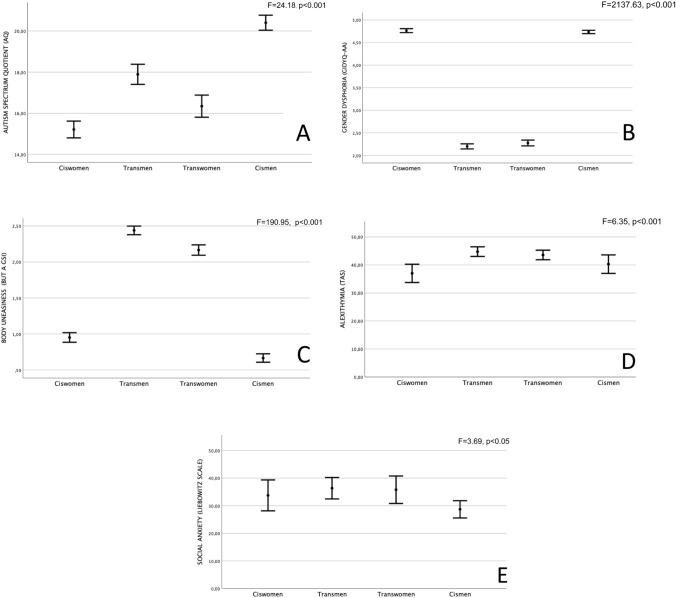
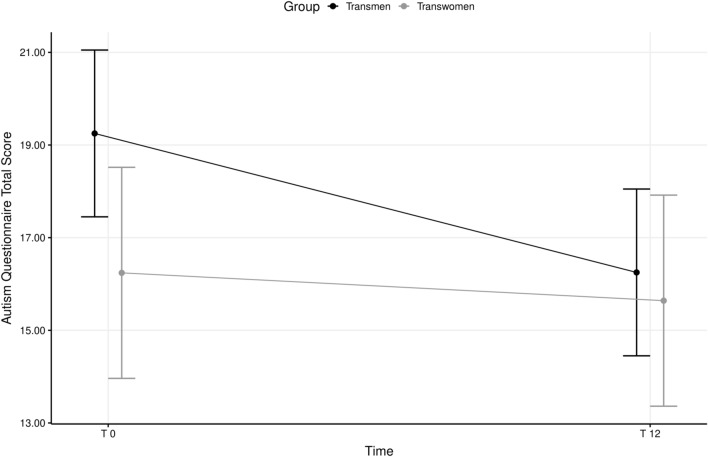
Groups showed significant differences in terms of autistic traits: ciswomen showed lower scores of AQ, while cismen reported higher scores of AQ than all other groups. Transgender individuals showed significant higher levels of Gender Dysphoria (GD), body uneasiness, alexithymia and social anxiety, compared to cisgender ones. No significant differences in general psychopathology were found between groups. Across time, transmen and transwomen showed a significant reduction in AQ scores. The decrease in alexithymia and social anxiety after GAHT did not predict the change in AQ scores.
The autistic traits in our sample may represent an epiphenomenon of GD rather than being part of an Autism Spectrum Disorder (ASD) condition, since they significantly decreased after 12 months of GAHT.
我们评估了激素初治跨性别者和 cisgender 人群的自闭症谱系商数(AQ)评分差异,以及性别肯定激素治疗(GAHT)对跨性别者 AQ 评分随时间的影响。此外,我们评估了述情障碍和社交焦虑是否可能是 AQ 评分变化的中介因素。
在 GAHT 之前对 cisgender 和 transgender 人群进行了横断面比较,并对 GAHT 随时间的影响进行了前瞻性研究。 transgender 和 cisgender 人群完成了多项心理测试。共有 789 人(n=229 cis 男性;n=172 cis 女性;n=206 trans 男性;n=182 trans 女性)于 2018 年至 2020 年期间在佛罗伦萨和罗马性别诊所就诊。其中,62 名在佛罗伦萨性别诊所就诊的患者在 GAHT 前后进行了前瞻性研究。
各组在自闭症特征方面存在显著差异:cis 女性的 AQ 评分较低,而 cis 男性的 AQ 评分高于其他所有组。 transgender 个体比 cisgender 个体表现出更高的性别焦虑症(GD)、身体不适、述情障碍和社交焦虑水平。各组间一般精神病理学无显著差异。随时间推移,trans 男性和 trans 女性的 AQ 评分显著降低。 GAHT 后述情障碍和社交焦虑的降低并不能预测 AQ 评分的变化。
我们样本中的自闭症特征可能代表 GD 的一种表现,而不是自闭症谱系障碍(ASD)的一部分,因为它们在 GAHT 后 12 个月显著降低。