Division of Endocrine and Metabolic Diseases, Istituto Auxologico Italiano IRCCS, Milan, Italy.
Department of Medical Biotechnology and Translational Medicine, University of Milan, Milan, Italy.
Endocrine. 2022 Sep;77(3):510-518. doi: 10.1007/s12020-022-03106-8. Epub 2022 Jul 2.
Current treatment of acromegaly restores a normal life expectancy in most cases. So, the study of persistent complications affecting patients' quality of life (QoL) is of paramount importance, especially motor disability and depression. In a large cohort of acromegalic patients we aimed at establishing the prevalence of depression, to look for clinical and sociodemographic factors associated with it, and to investigate the respective roles (and interactions) of depression and arthropathy in influencing QoL.
One hundred and seventy-one acromegalic patients (95 women and 76 men, aged 20-85 years) among those recruited in a cross-sectional Italian multicentric study were investigated. Each patient filled in three validated questionnaires: AcroQoL, WOMAC (measuring articular pain, stiffness and functionality), and AIMS (evaluating articular symptoms and depression).
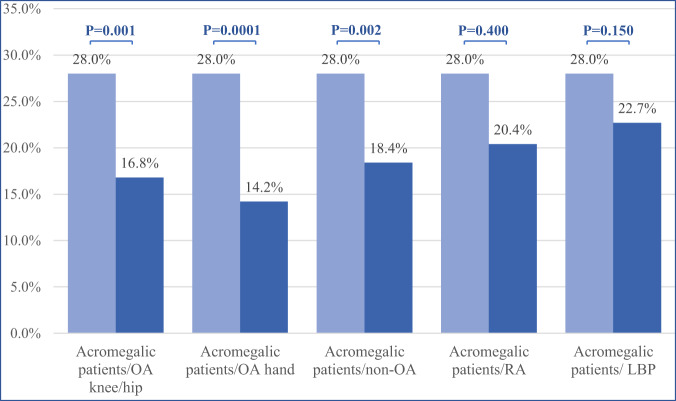
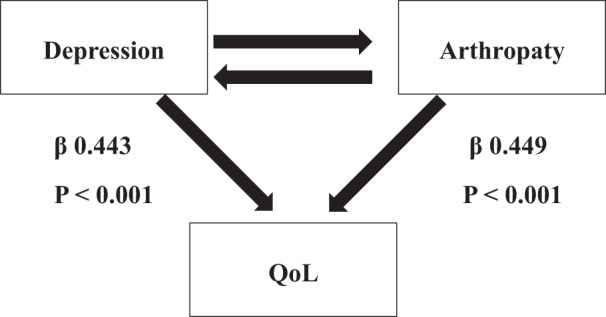
A very high (up to 28%) depression rate was detected in acromegalic subjects. Two patients showing pathological AIMS depression scores, committed suicide during the three years observational period. In our population poor psychological status was significantly associated with female sex. Furthermore, a significant strong correlation was found between AIMS depression score and WOMAC score. Both depression and arthropathy-related motor disability turned out to independently contribute with similar strength to the impairment of QoL.
We report a high prevalence of depression in acromegaly, which is associated with female sex and arthropathy. Both depression and arthropathy strongly and independently contribute to the impaired QoL of patients. Our study shows that assessment and monitoring of psychological status is mandatory in acromegaly, also suggesting an inexpensive tool for this assessment.
目前,肢端肥大症的治疗在大多数情况下可恢复正常预期寿命。因此,研究影响患者生活质量(QoL)的持续性并发症至关重要,尤其是运动障碍和抑郁。在一项大型肢端肥大症患者队列研究中,我们旨在确定抑郁的患病率,寻找与之相关的临床和社会人口统计学因素,并研究抑郁和关节炎分别在影响 QoL 中的作用(和相互作用)。
我们调查了参加意大利多中心横断面研究的 171 例肢端肥大症患者(95 名女性和 76 名男性,年龄 20-85 岁)。每位患者填写了三份经过验证的问卷:AcroQoL、WOMAC(测量关节疼痛、僵硬和功能)和 AIMS(评估关节症状和抑郁)。
在肢端肥大症患者中发现了高达 28%的高(高)抑郁率。在三年观察期内,两名出现病理性 AIMS 抑郁评分的患者自杀。在我们的人群中,较差的心理状况与女性显著相关。此外,还发现 AIMS 抑郁评分与 WOMAC 评分之间存在显著的强相关性。抑郁和与关节炎相关的运动障碍均独立且相似地导致 QoL 受损。
我们报告了肢端肥大症中抑郁的高患病率,其与性别和关节炎有关。抑郁和关节炎均强烈且独立地导致患者 QoL 受损。我们的研究表明,在肢端肥大症中评估和监测心理状态是强制性的,还提示了一种用于这种评估的廉价工具。