London School of Hygiene & Tropical Medicine, Keppel St., London, WC1E 7HT, United Kingdom.
Department of Environmental Health, Harvard T.H. Chan School of Public Health, 655 Huntington Avenue, Boston, MA, 02115, United States.
Environ Pollut. 2022 Sep 1;308:119686. doi: 10.1016/j.envpol.2022.119686. Epub 2022 Jun 30.
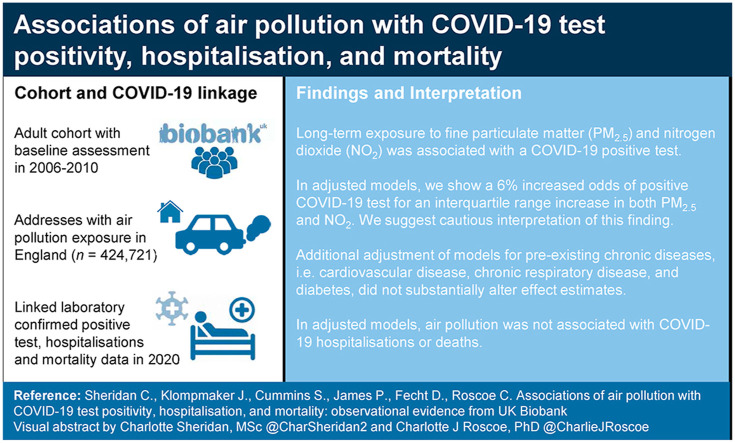
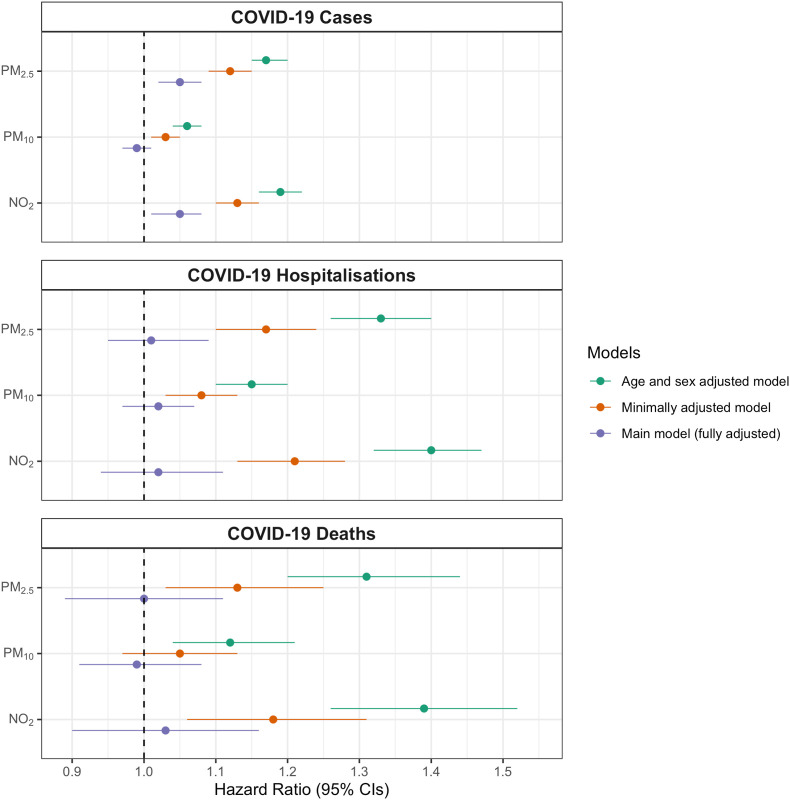
Individual-level studies with adjustment for important COVID-19 risk factors suggest positive associations of long-term air pollution exposure (particulate matter and nitrogen dioxide) with COVID-19 infection, hospitalisations and mortality. The evidence, however, remains limited and mechanisms unclear. We aimed to investigate these associations within UK Biobank, and to examine the role of underlying chronic disease as a potential mechanism. UK Biobank COVID-19 positive laboratory test results were ascertained via Public Health England and general practitioner record linkage, COVID-19 hospitalisations via Hospital Episode Statistics, and COVID-19 mortality via Office for National Statistics mortality records from March-December 2020. We used annual average outdoor air pollution modelled at 2010 residential addresses of UK Biobank participants who resided in England (n = 424,721). We obtained important COVID-19 risk factors from baseline UK Biobank questionnaire responses (2006-2010) and general practitioner record linkage. We used logistic regression models to assess associations of air pollution with COVID-19 outcomes, adjusted for relevant confounders, and conducted sensitivity analyses. We found positive associations of fine particulate matter (PM) and nitrogen dioxide (NO) with COVID-19 positive test result after adjustment for confounders and COVID-19 risk factors, with odds ratios of 1.05 (95% confidence intervals (CI) = 1.02, 1.08), and 1.05 (95% CI = 1.01, 1.08), respectively. PM 2.5 and NO 2 were positively associated with COVID-19 hospitalisations and deaths in minimally adjusted models, but not in fully adjusted models. No associations for PM were found. In analyses with additional adjustment for pre-existing chronic disease, effect estimates were not substantially attenuated, indicating that underlying chronic disease may not fully explain associations. We found some evidence that long-term exposure to PM and NO was associated with a COVID-19 positive test result in UK Biobank, though not with COVID-19 hospitalisations or deaths.
个体水平的研究表明,在调整了 COVID-19 的重要危险因素后,长期暴露于空气污染(颗粒物和二氧化氮)与 COVID-19 感染、住院和死亡呈正相关。然而,证据仍然有限,其机制尚不清楚。我们旨在通过英国生物库(UK Biobank)来研究这些关联,并探讨潜在慢性疾病作为潜在机制的作用。我们通过英格兰公共卫生署(Public Health England)和全科医生记录链接来确定 COVID-19 阳性实验室检测结果,通过医院事件统计数据(Hospital Episode Statistics)来确定 COVID-19 住院情况,通过国家统计局(Office for National Statistics)的死亡率记录来确定 COVID-19 死亡情况,这些数据均来自 2020 年 3 月至 12 月。我们使用 UK Biobank 参与者在 2010 年居住地址的年度平均室外空气污染模型(n=424721)。我们从 UK Biobank 的基线问卷(2006-2010 年)和全科医生记录链接中获得了重要的 COVID-19 危险因素。我们使用逻辑回归模型来评估空气污染与 COVID-19 结果之间的关联,同时调整了相关混杂因素,并进行了敏感性分析。我们发现,在调整了混杂因素和 COVID-19 危险因素后,细颗粒物(PM)和二氧化氮(NO)与 COVID-19 阳性检测结果呈正相关,比值比(OR)分别为 1.05(95%置信区间(CI)=1.02,1.08)和 1.05(95% CI=1.01,1.08)。在最小调整模型中,PM 2.5 和 NO 2 与 COVID-19 住院和死亡呈正相关,但在完全调整模型中则不然。我们没有发现 PM 与 COVID-19 之间存在关联。在进一步调整了预先存在的慢性疾病的分析中,效应估计值并没有明显减弱,这表明潜在的慢性疾病可能无法完全解释这些关联。我们发现,在英国生物库中,长期暴露于 PM 和 NO 与 COVID-19 阳性检测结果存在一定关联,但与 COVID-19 住院或死亡无关。