Department of Earth and Environmental Science, Centre for Atmospheric Science, School of Natural Sciences, The University of Manchester, Manchester, UK; Institute of Immunology and Inflammation, Faculty of Biology Medicine and Health, The University of Manchester, Manchester, UK.
Section of Environmental Health, Department of Public Health, University of Copenhagen, Copenhagen, Denmark.
Environ Pollut. 2023 Jun 15;327:121594. doi: 10.1016/j.envpol.2023.121594. Epub 2023 Apr 6.
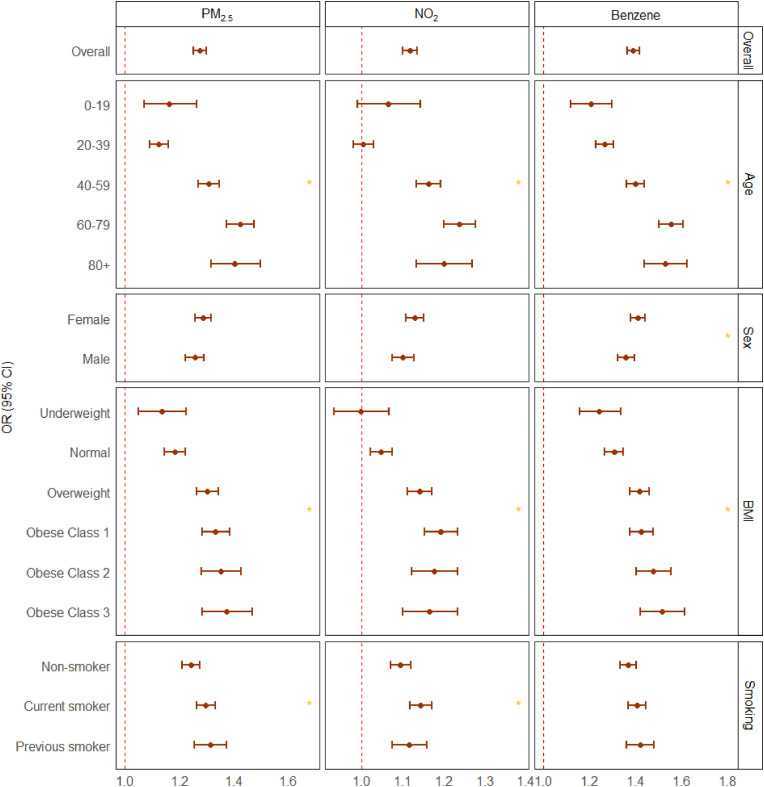
Exposure to outdoor air pollution may affect incidence and severity of coronavirus disease 2019 (COVID-19). In this retrospective cohort based on patient records from the Greater Manchester Care Records, all first COVID-19 cases diagnosed between March 1, 2020 and May 31, 2022 were followed until COVID-19 related hospitalization or death within 28 days. Long-term exposure was estimated using mean annual concentrations of particulate matter with diameter ≤2.5 μm (PM), ≤10 μm (PM), nitrogen dioxide (NO), ozone (O), sulphur dioxide (SO) and benzene (CH) in 2019 using a validated air pollution model developed by the Department for Environment, Food and Rural Affairs (DEFRA). The association of long-term exposure to air pollution with COVID-19 hospitalization and mortality were estimated using multivariate logistic regression models after adjusting for potential individual, temporal and spatial confounders. Significant positive associations were observed between PM, PM NO SO benzene and COVID-19 hospital admissions with odds ratios (95% Confidence Intervals [CI]) of 1.27 (1.25-1.30), 1.15 (1.13-1.17), 1.12 (1.10-1.14), 1.16 (1.14-1.18), and 1.39 (1.36-1.42), (per interquartile range [IQR]), respectively. Significant positive associations were also observed between PM, PM, SO, or benzene and COVID-19 mortality with odds ratios (95% CI) of 1.39 (1.31-1.48), 1.23 (1.17-1.30), 1.18 (1.12-1.24), and 1.62 (1.52-1.72), per IQR, respectively. Individuals who were older, overweight or obese, current smokers, or had underlying comorbidities showed greater associations between all pollutants of interest and hospital admission, compared to the corresponding groups. Long-term exposure to air pollution is associated with developing severe COVID-19 after a positive SARS-CoV-2 infection, resulting in hospitalization or death.
暴露于户外空气污染可能会影响 2019 年冠状病毒病(COVID-19)的发病率和严重程度。在这项基于大曼彻斯特护理记录中患者记录的回顾性队列研究中,所有在 2020 年 3 月 1 日至 2022 年 5 月 31 日之间诊断出的首例 COVID-19 病例均进行了随访,直到 COVID-19 相关住院或 28 天内死亡。使用环境、食品和农村事务部(DEFRA)开发的经过验证的空气污染模型,根据 2019 年直径≤2.5μm(PM)、≤10μm(PM)、二氧化氮(NO)、臭氧(O)、二氧化硫(SO)和苯(CH)的年均浓度来估算长期暴露。使用多变量逻辑回归模型,在校正潜在的个体、时间和空间混杂因素后,估计长期暴露于空气污染与 COVID-19 住院和死亡的相关性。PM、PM、NO、SO 和苯与 COVID-19 住院的相关性呈显著正相关,优势比(95%置信区间[CI])分别为 1.27(1.25-1.30)、1.15(1.13-1.17)、1.12(1.10-1.14)、1.16(1.14-1.18)和 1.39(1.36-1.42)(每四分位间距[IQR])。PM、PM、SO 或苯与 COVID-19 死亡率也呈显著正相关,优势比(95%CI)分别为 1.39(1.31-1.48)、1.23(1.17-1.30)、1.18(1.12-1.24)和 1.62(1.52-1.72)(每 IQR)。与相应的组相比,年龄较大、超重或肥胖、当前吸烟者或患有潜在合并症的个体与所有感兴趣的污染物与住院之间的相关性更强。长期暴露于空气污染与感染 SARS-CoV-2 后出现严重 COVID-19 相关,导致住院或死亡有关。