Zhang Boyi, Bender Amy, Tan Xiao, Wang Xiuqiang, Le Shenglong, Cheng Sulin
Department of Physical Education, Shanghai Jiao Tong University, Shanghai, China.
Faculties of Kinesiology, University of Calgary, Calgary, Alberta, Canada.
Sports Med Health Sci. 2022 Feb 10;4(2):133-139. doi: 10.1016/j.smhs.2022.02.001. eCollection 2022 Jun.
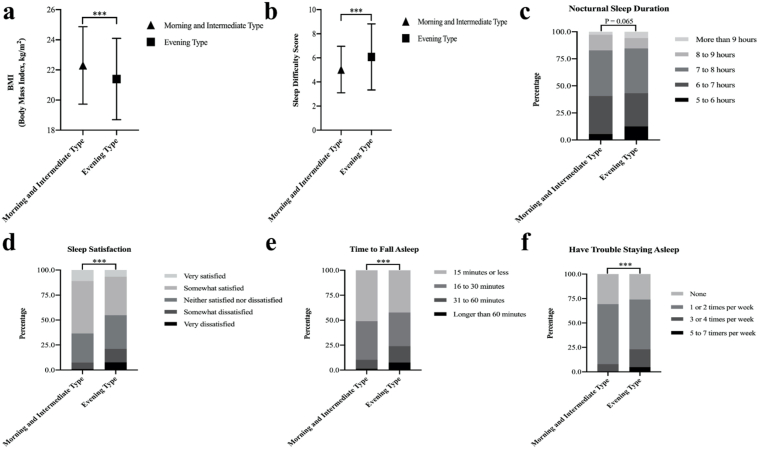
This study investigated the factors that are associated with sleep disturbances among Chinese athletes. Sleep quality and associated factors were assessed by the Athlete Sleep Screening Questionnaire (ASSQ, = 394, aged 18-32 years, 47.6% female). Sleep difficulty score (SDS) and level of sleep problem (none, mild, moderate, or severe) were used to classify participants' sleep quality. Categorical variables were analyzed by Chi-square or fisher's exact tests. An ordinal logistic regression analysis was used to explore factors with poor sleep (SDS ≥8). Approximately 14.2% of participants had moderate to severe sleep problem (SDS ≥8). Fifty-nine percent of the athletes reported sleep disturbance during travel, while 43.3% experienced daytime dysfunction when travelling for competition. No significant difference was found in the SDS category between gender, sports level and events. Athletes with evening chronotype were more likely to report worse sleep than athletes with morning and intermediate chronotype (, 2.25; 95%, 1.44-3.52; < 0.001). For each additional year of age, there was an increase of odds ratio for poor sleep quality (, 1.15; 95%, 1.04-1.26; = 0.004), while each additional year of training reduced the odds ratio (, 0.95; 95%, 0.91-0.99; = 0.044). To improve sleep health in athletes, chronotype, travel-related issues, age and years of training should be taken into consideration.
本研究调查了与中国运动员睡眠障碍相关的因素。通过运动员睡眠筛查问卷(ASSQ,n = 394,年龄18 - 32岁,47.6%为女性)评估睡眠质量及相关因素。采用睡眠困难评分(SDS)和睡眠问题程度(无、轻度、中度或重度)对参与者的睡眠质量进行分类。分类变量采用卡方检验或Fisher精确检验进行分析。采用有序逻辑回归分析探讨睡眠不佳(SDS≥8)的因素。约14.2%的参与者存在中度至重度睡眠问题(SDS≥8)。59%的运动员报告在旅行期间存在睡眠障碍,而43.3%的运动员在比赛旅行时出现日间功能障碍。在性别、运动水平和项目之间,SDS类别未发现显著差异。与早晨型和中间型生物钟类型的运动员相比,夜晚型生物钟类型的运动员更有可能报告睡眠较差(β,2.25;95%置信区间,1.44 - 3.52;P < 0.001)。年龄每增加一岁,睡眠质量差的比值比增加(β,1.15;95%置信区间,1.04 - 1.26;P = 0.004),而训练年限每增加一年,比值比降低(β,0.95;95%置信区间,0.91 - 0.99;P = 0.044)。为改善运动员的睡眠健康,应考虑生物钟类型、与旅行相关的问题、年龄和训练年限。