Jiang Zongze, Chen Huilin, Li Ming, Wang Wei, Fan Chuanwen, Long Feiwu
Department of Gastrointestinal Surgery, Bariatric and Metabolic Surgery, West China School of Public Health and West China Fourth Hospital, Sichuan University, Chengdu, China.
Research Center for Nutrition, Metabolism and Food Safety, West China-PUMC C.C. Chen Institute of Health, Sichuan University, Chengdu, China.
Front Nutr. 2022 Jun 17;9:888898. doi: 10.3389/fnut.2022.888898. eCollection 2022.
The evidence of dietary carrot/carotene intake's effect on the association with colorectal cancer (CRC) risk is conflicted. We sought to examine the association of carrot/carotene intake with CRC incidence and mortality in the Prostate, Lung, Colorectal, and Ovarian Cancer (PLCO) Screening cohort.
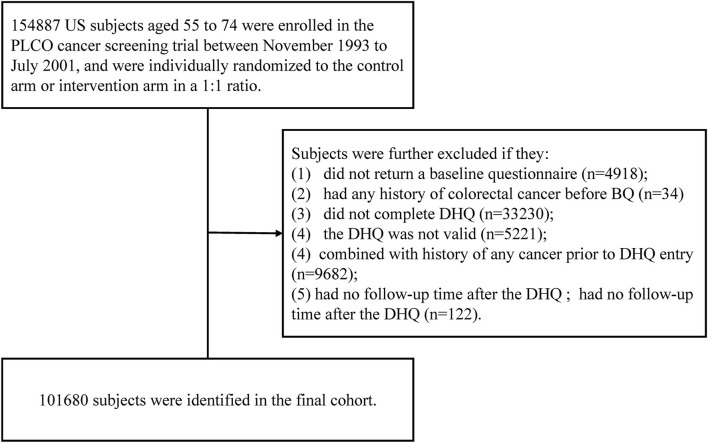
In all, 101,680 participants were enrolled between November 1993 and July 2001 from the PLCO cohort. We employed the multivariable Cox regression analyses to estimate the hazard ratios and 95% confidence interval. Subgroup analyses and interaction tests were performed to examine the potential effect modifiers. We further applied the generalized additive model to explore the non-linear trend of the exposure to cancer-related outcomes.
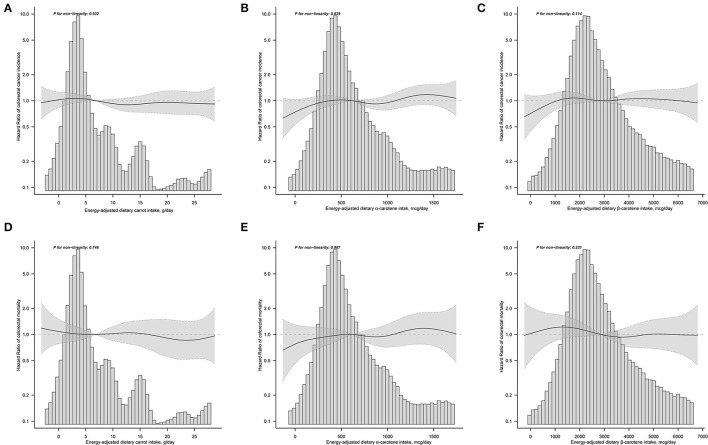
A total of 1,100 CRC cases and 443 cancer-related deaths were documented. We noted that the 4th quintile of dietary carrot intakes was associated with a 21% lower risk of CRC incidence, compared with the lowest quintile group (full-adjusted HR = 0.79, 95%CI = 0.65-0.97, for trend = 0.05), while the adjusted-HR was 0.95 (95%CI = 0.89-1.02) with per SD increment of carrot intakes, and no statistically significant associations were detected between dietary α-, and β-carotene intake and CRC incidence. There were no statistically significant associations observed between carrot/carotene intakes and CRC mortality. Furthermore, there were no non-linear dose-response relationships between dietary carrot, α-, and β-carotene intake and CRC incidence and mortality (all > 0.05). Of note, smoking status as a modifier on the association of dietary carrot intakes with CRC incidence but not mortality was observed.
In summary, this large U.S. prospective cohort study indicated that a moderate consumption of carrots was associated with a lower CRC incidence, which suggested that a certain dose-range of carrots consumed might contribute to a potential cancer-prevention effect, not the more the better.
饮食中胡萝卜/胡萝卜素摄入量与结直肠癌(CRC)风险之间关联的证据存在矛盾。我们试图在前列腺、肺、结肠和卵巢癌(PLCO)筛查队列中研究胡萝卜/胡萝卜素摄入量与CRC发病率和死亡率之间的关联。
1993年11月至2001年7月期间,共有101,680名参与者纳入PLCO队列。我们采用多变量Cox回归分析来估计风险比和95%置信区间。进行亚组分析和交互检验以检查潜在的效应修饰因素。我们进一步应用广义相加模型来探索暴露与癌症相关结局之间的非线性趋势。
共记录了1100例CRC病例和443例癌症相关死亡。我们注意到,与最低五分位组相比,饮食中胡萝卜摄入量的第四个五分位与CRC发病率风险降低21%相关(完全调整后的HR = 0.79,95%CI = 0.65 - 0.97,趋势P = 0.05),而胡萝卜摄入量每增加一个标准差,调整后的HR为0.95(95%CI = 0.89 - 1.02),并且未检测到饮食中α-和β-胡萝卜素摄入量与CRC发病率之间存在统计学显著关联。未观察到胡萝卜/胡萝卜素摄入量与CRC死亡率之间存在统计学显著关联。此外,饮食中胡萝卜、α-和β-胡萝卜素摄入量与CRC发病率和死亡率之间不存在非线性剂量反应关系(所有P > 0.05)。值得注意的是,观察到吸烟状态是饮食中胡萝卜摄入量与CRC发病率之间关联的修饰因素,但不是死亡率的修饰因素。
总之,这项大型美国前瞻性队列研究表明,适度食用胡萝卜与较低的CRC发病率相关,这表明食用一定剂量范围的胡萝卜可能有助于产生潜在的防癌效果,并非越多越好。