Sun Yuanjie, Koyama Yoshihisa, Shimada Shoichi
Department of Neuroscience and Cell Biology, Osaka University Graduate School of Medicine, Osaka, Japan.
Addiction Research Unit, Osaka Psychiatric Research Center, Osaka Psychiatric Medical Center, Osaka, Japan.
Front Aging Neurosci. 2022 Jun 16;14:903455. doi: 10.3389/fnagi.2022.903455. eCollection 2022.
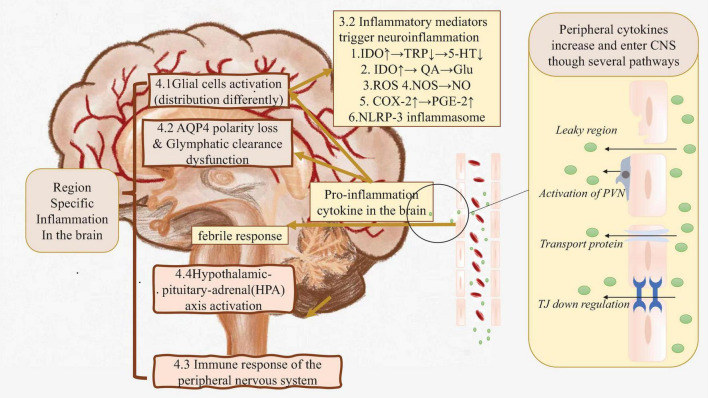
As inflammation in the brain contributes to several neurological and psychiatric diseases, the cause of neuroinflammation is being widely studied. The causes of neuroinflammation can be roughly divided into the following domains: viral infection, autoimmune disease, inflammation from peripheral organs, mental stress, metabolic disorders, and lifestyle. In particular, the effects of neuroinflammation caused by inflammation of peripheral organs have yet unclear mechanisms. Many diseases, such as gastrointestinal inflammation, chronic obstructive pulmonary disease, rheumatoid arthritis, dermatitis, chronic fatigue syndrome, or myalgic encephalomyelitis (CFS/ME), trigger neuroinflammation through several pathways. The mechanisms of action for peripheral inflammation-induced neuroinflammation include disruption of the blood-brain barrier, activation of glial cells associated with systemic immune activation, and effects on autonomic nerves via the organ-brain axis. In this review, we consider previous studies on the relationship between systemic inflammation and neuroinflammation, focusing on the brain regions susceptible to inflammation.
由于脑部炎症会引发多种神经和精神疾病,因此神经炎症的成因正在被广泛研究。神经炎症的成因大致可分为以下几类:病毒感染、自身免疫性疾病、外周器官炎症、精神压力、代谢紊乱以及生活方式。特别是,由外周器官炎症引起的神经炎症的作用机制尚不清楚。许多疾病,如胃肠道炎症、慢性阻塞性肺疾病、类风湿性关节炎、皮炎、慢性疲劳综合征或肌痛性脑脊髓炎(慢性疲劳综合征/肌痛性脑脊髓炎),会通过多种途径引发神经炎症。外周炎症诱导神经炎症的作用机制包括破坏血脑屏障、激活与全身免疫激活相关的神经胶质细胞,以及通过器官-脑轴对自主神经产生影响。在本综述中,我们回顾了以往关于全身炎症与神经炎症之间关系的研究,重点关注易受炎症影响的脑区。