Mori Kensaku, Sakano Hitoshi
RIKEN Center for Brain Science, Wako, Japan.
Department of Brain Function, School of Medical Sciences, University of Fukui, Fukui, Japan.
Front Behav Neurosci. 2022 Jun 16;16:943647. doi: 10.3389/fnbeh.2022.943647. eCollection 2022.
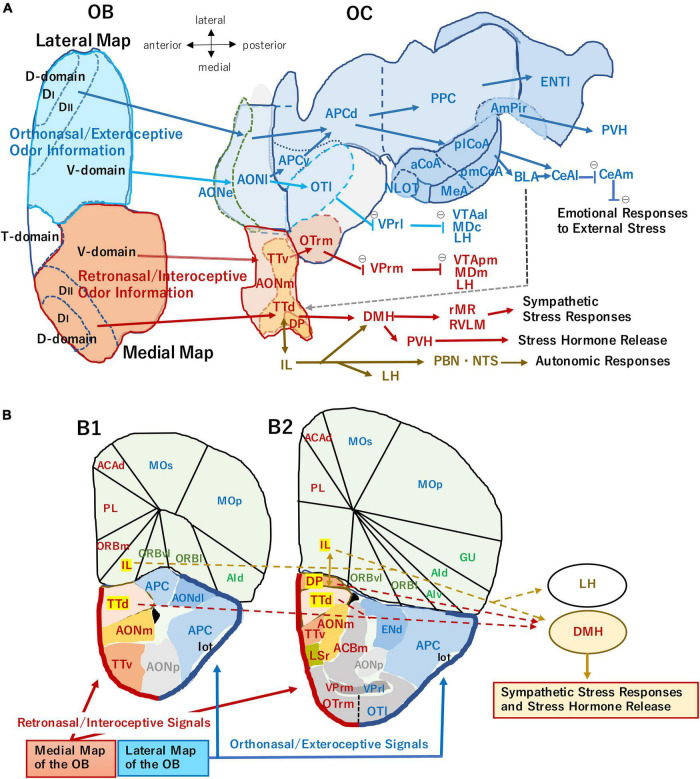
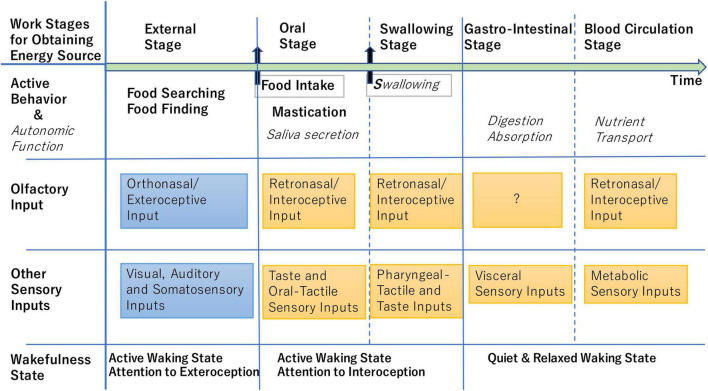
In mammals, odor information detected in the olfactory epithelium is converted to a topographic map of activated glomeruli in the olfactory bulb. Odor signals are then conveyed by projection neurons to the olfactory cortex for decision making. Odor information is processed by two distinct pathways, one is innate and the other is learned, which are separately activated during exhalation and inhalation, respectively. There are two types of odor signals, exteroceptive and interoceptive, which are also processed in different phases of respiration. Exteroceptive sensory information whether attractive/pleasant or aversive/stressful, is evaluated by the valence regions in the amygdala. Stress is an alert signal telling the body to take an action so that the normal condition can be recovered. When the odor quality is negative, the brain sets up a behavioral strategy to avoid the danger or to improve the situation. In this review article, we will describe the recent progress in the study of olfactory perception focusing on stress responses to external and internal odors.
在哺乳动物中,嗅觉上皮检测到的气味信息会转化为嗅球中激活的肾小球的地形图。然后,气味信号由投射神经元传递到嗅觉皮层进行决策。气味信息通过两条不同的途径进行处理,一条是先天的,另一条是后天习得的,它们分别在呼气和吸气过程中被激活。有两种类型的气味信号,即外感受性和内感受性,它们也在呼吸的不同阶段进行处理。外感受性感觉信息,无论是有吸引力/令人愉悦的还是厌恶/有压力的,都由杏仁核中的效价区域进行评估。压力是一种警报信号,告诉身体采取行动以便恢复正常状态。当气味性质为负面时,大脑会制定一种行为策略来避免危险或改善状况。在这篇综述文章中,我们将描述嗅觉感知研究的最新进展,重点关注对外部和内部气味的应激反应。