Kooverjee Bhaveni B, Soma Pranisha, Van Der Nest Magrieta A, Scholtz Michiel M, Neser Frederick W C
Department of Animal Breeding and Genetics, Animal Production, Agricultural Research Council, Pretoria, South Africa.
Department of Animal, Wildlife and Grassland Sciences, University of the Free State, Bloemfontein, South Africa.
Front Genet. 2022 Jun 17;13:909012. doi: 10.3389/fgene.2022.909012. eCollection 2022.
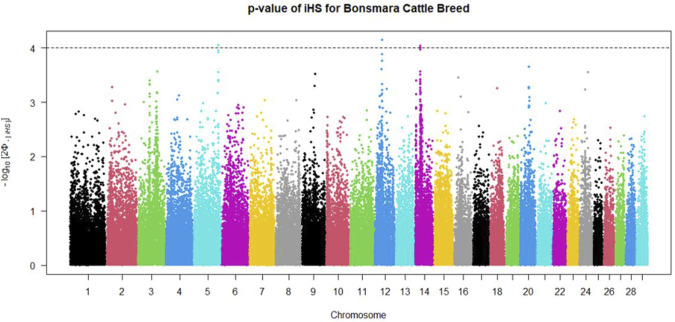
Climate change is a major influencing factor in beef production. The greenhouse gases produced from livestock production systems contribute to the overall greenhouse gas emissions. The aim of this study was to identify selection signatures within and between Nguni and Bonsmara cattle in relation to production and adaptation. For this purpose, genomic 150 K single nucleotide polymorphism data from Nguni ( = 231) and Bonsmara ( = 252) cattle in South Africa were used. Extended haplotype homozygosity (EHH) based analysis was executed within each population using integrated haplotype score (iHS). The R package rehh was used for detecting selection signatures across the two populations with cross population EHH (XP-EHH). Total of 121 regions of selection signatures were detected ( < 0.0001) in the Bonsmara and Nguni populations. Several genes relating to DNA methylation, heat stress, feed efficiency and nitrogen metabolism were detected within and between each population. These regions also included QTLs associated with residual feed intake, residual gain, carcass weight, stature and body weight in the Bonsmara, while QTLs associated with conception rate, shear force, tenderness score, juiciness, temperament, heat tolerance, feed efficiency and age at puberty were identified in Nguni. Based on the results of the study it is recommended that the Nguni and Bonsmara be utilized in crossbreeding programs as they have beneficial traits that may allow them to perform better in the presence of climate change. Results of this study coincide with Nguni and Bonsmara breed characteristics and performance, and furthermore support informative crossbreeding programs to enhance livestock productivity in South Africa.
气候变化是牛肉生产中的一个主要影响因素。畜牧生产系统产生的温室气体导致了总体温室气体排放。本研究的目的是确定恩古尼牛和邦斯玛拉牛在生产和适应性方面的群体内和群体间选择印记。为此,使用了来自南非的恩古尼牛(n = 231)和邦斯玛拉牛(n = 252)的基因组150K单核苷酸多态性数据。使用综合单倍型评分(iHS)在每个群体内基于扩展单倍型纯合性(EHH)进行分析。使用R包rehh通过跨群体EHH(XP-EHH)检测两个群体间 的选择印记。在邦斯玛拉牛和恩古尼牛群体中总共检测到121个选择印记区域(P < 0.0001)。在每个群体内和群体间检测到了几个与DNA甲基化、热应激、饲料效率和氮代谢相关的基因。这些区域还包括与邦斯玛拉牛的剩余采食量、剩余增重、胴体重、体高和体重相关的QTL,而在恩古尼牛中鉴定出了与受胎率、剪切力、嫩度评分、多汁性、性情、耐热性、饲料效率和初情期年龄相关的QTL。基于研究结果,建议在杂交育种计划中利用恩古尼牛和邦斯玛拉牛,因为它们具有有益性状,可能使其在气候变化条件下表现更好。本研究结果与恩古尼牛和邦斯玛拉牛的品种特征和性能相符,并且进一步支持了旨在提高南非畜牧生产力的信息丰富型杂交育种计划。