Dwiyana Reiva Farah, Nuraeni Lita, Diana Inne Arline, Effendi Raden Mohamad Rendy Ariezal, Gondokaryono Srie Prihianti, Ruchiatan Kartika, Hindritiani Reti, Gunawan Hendra
Department of Dermatology and Venereology, Faculty of Medicine, Universitas Padjadjaran-Dr. Hasan Sadikin Hospital, Bandung, West Java, Indonesia.
Clin Cosmet Investig Dermatol. 2022 Jun 27;15:1175-1182. doi: 10.2147/CCID.S366854. eCollection 2022.
To evaluate the correlation between melatonin levels and sleep quality, based on the Children's Sleep Habit Questionnaire (CSHQ), among children with atopic dermatitis (AD).
This was an analytic study with a cross-sectional design involving two groups, AD children as the case group and participants without AD as the control group, conducted at the Pediatric Dermatology Clinic of Dr. Hasan Sadikin Hospital, Bandung, Indonesia. Melatonin levels and CSHQ score in the case group were compared to that in the control group. Correlation analysis was performed between melatonin levels and sleep quality based on CSHQ in the case group.
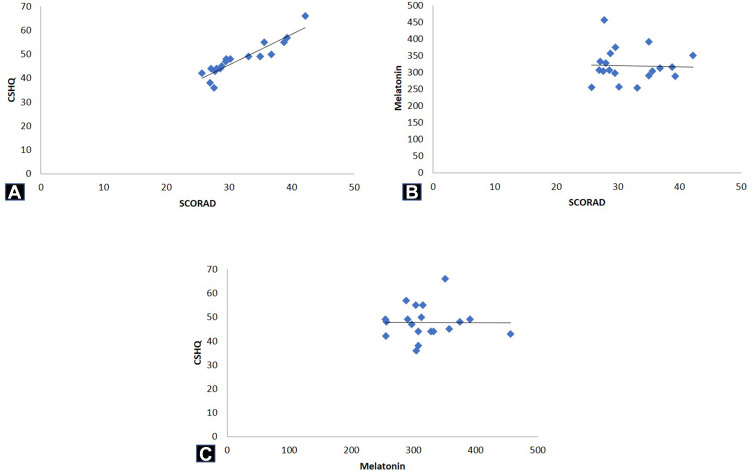
Participants in this study consisted of 19 children with moderate AD, (no patient with mild and severe AD was recruited), and 19 participants without AD. The mean CSHQ score in the case group was significantly higher than the control group (47.84 vs 36.79; <0.05). The mean melatonin level in the case group was significantly lower than the control group (320.18 pg/mL vs 383.86 pg/mL; <0.05). Comparative analysis was conducted using independent -test. There was a significant Pearson's correlation index between SCORAD and CSHQ (<0.05). However, there was no correlation between melatonin levels and CSHQ, as well as between melatonin levels and SCORAD (<0.05).
Children with moderate AD have impaired sleep quality and lower melatonin levels compared to controls. No correlation was found between melatonin levels and CSHQ, as well as melatonin levels and SCORAD, although there was a strong and significant correlation between SCORAD and CSHQ. Therefore, melatonin levels may not be the main cause of sleep disturbances in children with moderate AD.
基于儿童睡眠习惯问卷(CSHQ)评估特应性皮炎(AD)患儿褪黑素水平与睡眠质量之间的相关性。
这是一项采用横断面设计的分析性研究,涉及两组,AD患儿作为病例组,无AD的参与者作为对照组,在印度尼西亚万隆哈桑·萨迪金博士医院儿科皮肤科诊所进行。将病例组的褪黑素水平和CSHQ评分与对照组进行比较。基于病例组的CSHQ对褪黑素水平与睡眠质量进行相关性分析。
本研究的参与者包括19名中度AD患儿(未招募轻度和重度AD患者)和19名无AD的参与者。病例组的CSHQ平均评分显著高于对照组(47.84对36.79;<0.05)。病例组的褪黑素平均水平显著低于对照组(320.18 pg/mL对383.86 pg/mL;<0.05)。采用独立样本t检验进行比较分析。SCORAD与CSHQ之间存在显著的Pearson相关指数(<0.05)。然而,褪黑素水平与CSHQ之间以及褪黑素水平与SCORAD之间均无相关性(<0.05)。
与对照组相比,中度AD患儿的睡眠质量受损且褪黑素水平较低。尽管SCORAD与CSHQ之间存在强且显著的相关性,但褪黑素水平与CSHQ以及褪黑素水平与SCORAD之间均未发现相关性。因此,褪黑素水平可能不是中度AD患儿睡眠障碍的主要原因。