Michishita Takahiro, Nakajima Kento, Doi Tomoki, Mori Kurumi, Takeuchi Ichiro
Department of Emergency Medicine, Yokosuka Kyosai Hospital, Yokosuka, JPN.
Advanced Critical Care and Emergency Center, Yokohama City University Medical Center, Yokohama, JPN.
Cureus. 2022 Jun 1;14(6):e25560. doi: 10.7759/cureus.25560. eCollection 2022 Jun.
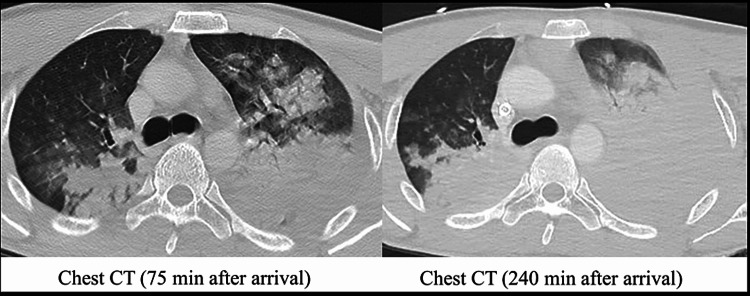
Venovenous extracorporeal membrane oxygenation (VV-ECMO) is indicated for patients with severe respiratory failure who cannot be managed with a ventilator. We report a case of severe chest trauma with an injury severity score of 66, in which hemostasis was achieved after VV-ECMO. A 29-year-old male patient sustained a fall injury from a 4-m cliff. The fall resulted in significant traumatic cerebral hemorrhage, bilateral pulmonary contusion, hemothorax, pelvic fracture, and limb fracture. During transcatheter arterial embolization, the patient continued to bleed from the left lung and showed progressive hypoxemia. In addition, the patient was unable to maintain tidal volume and experienced hypercapnia, and thus, VV-ECMO was introduced, followed by a thoracotomy to stop the bleeding. On the third day of hospitalization, the patient was weaned off VV-ECMO, and on day 35, he was transferred to a rehabilitation hospital for recovery. VV-ECMO may serve as a "bridge" until hemostatic maneuvers for severe chest trauma are completed and may contribute to help ensure adequate respiration.
静脉-静脉体外膜肺氧合(VV-ECMO)适用于无法通过呼吸机治疗的严重呼吸衰竭患者。我们报告一例严重胸部创伤病例,损伤严重程度评分为66分,该患者在接受VV-ECMO治疗后实现了止血。一名29岁男性患者从4米高的悬崖坠落受伤。此次坠落导致严重创伤性脑出血、双侧肺挫伤、血胸、骨盆骨折和肢体骨折。在经导管动脉栓塞治疗期间,患者左肺持续出血,并出现进行性低氧血症。此外,患者无法维持潮气量并出现高碳酸血症,因此,在进行开胸止血手术前引入了VV-ECMO。住院第三天,患者撤掉了VV-ECMO,在第35天,他被转至康复医院进行康复治疗。VV-ECMO可作为一种“桥梁”,直至完成严重胸部创伤的止血操作,并可能有助于确保充分的呼吸。