Department of Surgery, Division of Surgical Oncology, University of Illinois at Chicago, Chicago, IL, 60612, USA.
University of Illinois Hospital and Health Sciences System Cancer Center, University of Illinois at Chicago, Chicago, IL, 60612, USA.
Cell Death Dis. 2022 Jul 4;13(7):581. doi: 10.1038/s41419-022-05022-1.
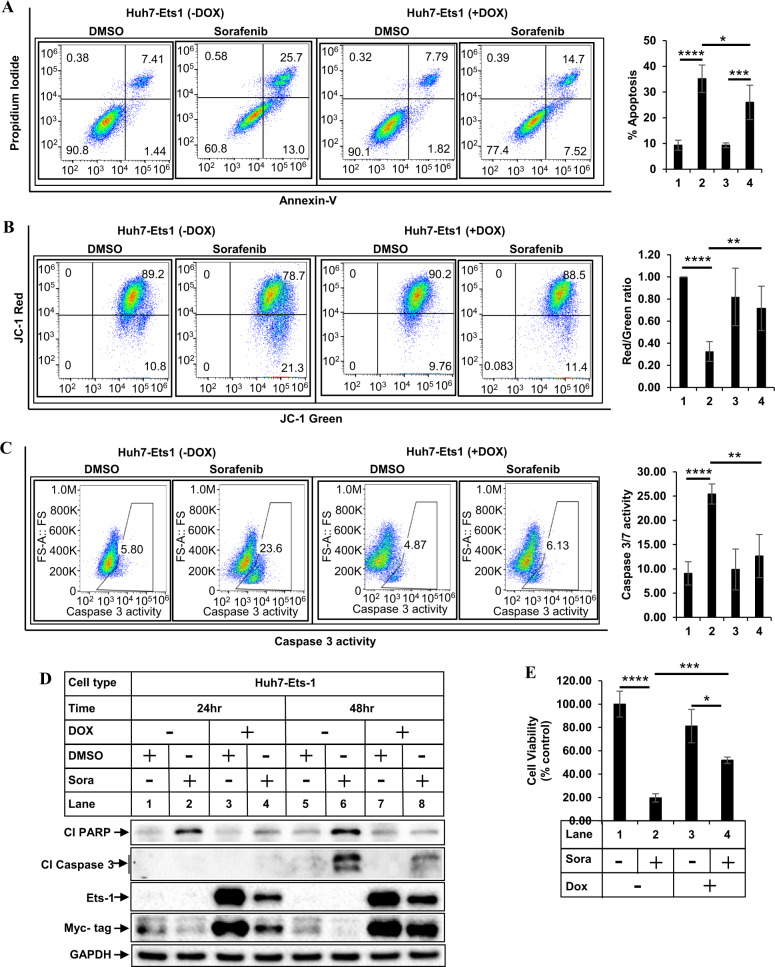
The incidence and mortality of hepatocellular carcinoma (HCC) are on a rise in the Western countries including US, attributed mostly to late detection. Sorafenib has been the first-line FDA-approved drug for advanced unresectable HCC for almost a decade, but with limited efficacy due to the development of resistance. More recently, several other multi-kinase inhibitors (lenvatinib, cabozantinib, regorafenib), human monoclonal antibody (ramucirumab), and immune checkpoint inhibitors (nivolumab, pembrolizumab) have been approved as systemic therapies. Despite this, the median survival of patients is not significantly increased. Understanding of the molecular mechanism(s) that govern HCC resistance is critically needed to increase efficacy of current drugs and to develop more efficacious ones in the future. Our studies with sorafenib-resistant (soraR) HCC cells using transcription factor RT Profiler PCR Arrays revealed an increase in E26 transformation-specific-1 (Ets-1) transcription factor in all soraR cells. HCC TMA studies showed an increase in Ets-1 expression in advanced HCC compared to the normal livers. Overexpression or knocking down Ets-1 modulated sorafenib resistance-related epithelial-mesenchymal transition (EMT), migration, and cell survival. In addition, the soraR cells showed a significant reduction of mitochondrial damage and mitochondrial reactive oxygen species (mROS) generation, which were antagonized by knocking down Ets-1 expression. More in-depth analysis identified GPX-2 as a downstream mediator of Ets-1-induced sorafenib resistance, which was down-regulated by Ets-1 knockdown while other antioxidant pathway genes were not affected. Interestingly, knocking down GPX2 expression significantly increased sorafenib sensitivity in the soraR cells. Our studies indicate the activation of a novel Ets-1-GPX2 signaling axis in soraR cells, targeting which might successfully antagonize resistance and increase efficacy.
肝细胞癌 (HCC) 的发病率和死亡率在包括美国在内的西方国家呈上升趋势,主要归因于晚期发现。索拉非尼是近十年来 FDA 批准的用于不可切除的晚期 HCC 的一线药物,但由于耐药性的发展,疗效有限。最近,其他几种多激酶抑制剂(仑伐替尼、卡博替尼、瑞戈非尼)、人源单克隆抗体(雷莫芦单抗)和免疫检查点抑制剂(纳武单抗、帕博利珠单抗)已被批准作为系统治疗药物。尽管如此,患者的中位生存期并没有显著延长。了解控制 HCC 耐药性的分子机制对于提高现有药物的疗效和未来开发更有效的药物至关重要。我们使用转录因子 RT Profiler PCR 阵列对索拉非尼耐药 (soraR) HCC 细胞进行的研究表明,所有 soraR 细胞中的 E26 转化特异性-1 (Ets-1) 转录因子表达增加。HCC TMA 研究表明,与正常肝脏相比,晚期 HCC 中 Ets-1 表达增加。过表达或敲低 Ets-1 可调节索拉非尼耐药相关的上皮-间充质转化 (EMT)、迁移和细胞存活。此外,soraR 细胞显示线粒体损伤和线粒体活性氧 (mROS) 生成显著减少,而敲低 Ets-1 表达可拮抗这种减少。更深入的分析确定 GPX-2 为 Ets-1 诱导的索拉非尼耐药的下游介质,Ets-1 敲低可下调其表达,而其他抗氧化途径基因不受影响。有趣的是,敲低 GPX2 表达可显著增加 soraR 细胞对索拉非尼的敏感性。我们的研究表明,soraR 细胞中存在一种新的 Ets-1-GPX2 信号轴的激活,靶向该信号轴可能成功拮抗耐药性并提高疗效。