College of Geographical Sciences, Harbin Normal University, Harbin, China.
Northeast Institute of Geography and Agroecology, Chinese Academy Sciences, Changchun, China.
PLoS One. 2022 Jul 6;17(7):e0267272. doi: 10.1371/journal.pone.0267272. eCollection 2022.
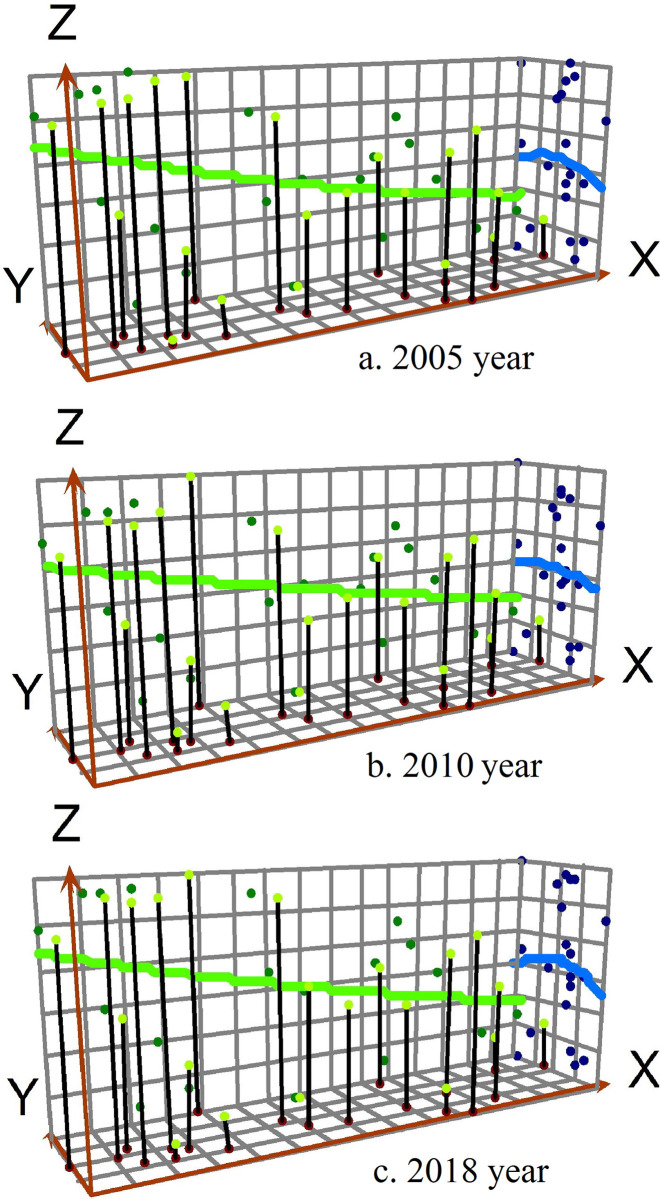
Under the background of "the Belt and Road" and "the economic corridor of China, Mongolia and Russia" initiatives, it has great value to study the temporal and spatial evolution characteristics of the coordinated development between the urbanization and ecological environment in eastern Russia (the Siberian Federal District and the Far East Federal District). In this paper, we studied the urbanization development level, eco-environment development level, and their coupling coordinated development degree during 2005-2018 in the eastern Russia from the perspectives of the 3D global trend and 2D plane analysis. First, combining with the Population-Economic-Sociology and Pressure-State-Response models, the urbanization development level and eco-environment development level were calculated by the comprehensive weighting method of entropy weight and variation coefficient for eastern Russia. Second, the coupling coordinated development degree of the urbanization development level and eco-environment development level was measured by the coupling coordination model for eastern Russia. Finally, the spatial differentiation of the urbanization development level, the eco-environment development level and their coupling coordinated development degree was performed respectively by the 3D global trend and 2D plane analysis using ArcGIS. The results are as following. First, the comprehensive urbanization development level of eastern Russia has increased from 2005 to 2018, and the economic urbanization is the main factor that affects the urbanization development in eastern Russia. The comprehensive eco-environment development level of eastern Russia has decreased from 2005 to 2018, and the eco-environment pressure is the main factor that affects the eco-environment development in eastern Russia. The coupling coordination degree of the urbanization development and eco-environment development has increased from 2005 to 2018. However, it is still in the uncoordinated stage. Second, from 2005 to 2018, the urbanization development level of the Siberian Federal District is higher than that of the Far East Federal District. The eco-environment development level of the Siberian Federal District is balanced to that of the Far East Federal District. The coupling coordination degree of the Siberian Federal District is higher than that of the Far East Federal District. Among the Siberian and Far East Federal Districts, most of the federal subjects belong to the uncoordinated stage of the urbanization development and the eco-environment development. Third, the urbanization development level, the eco-environment development level, and their coupling coordinated development level are all spatially imbalanced in the eastern Russia, which show the "High West, Low East" and "High Center, Low North and Low South" spatial pattern from the perspectives of the 3D global trend and 2D plane analysis. The areas with high levels are concentrated in the Novosibirsk Region, Altay Territory, Kemerovo Region, Krasnoyarsk Territory, and Irkutsk Region. The areas with low ones are mostly in the Republic of Altay and Chukotka Autonomous Area. Finally, we suggest policies and strategies that can boost the growth and development of the urbanization and the eco-environment in the Sino-Russian border areas.

在“一带一路”和“中蒙俄经济走廊”倡议的背景下,研究俄罗斯东部(西伯利亚联邦区和远东联邦区)城市化与生态环境协调发展的时空演变特征具有重要价值。本文从三维全球趋势和二维平面分析两个方面,研究了 2005-2018 年俄罗斯东部城市化发展水平、生态环境发展水平及其耦合协调发展程度。首先,结合人口-经济-社会学和压力-状态-响应模型,采用熵权和变异系数综合加权法计算了俄罗斯东部的城市化发展水平和生态环境发展水平。其次,采用耦合协调模型测算了城市化发展水平和生态环境发展水平的耦合协调发展程度。最后,利用 ArcGIS 对城市化发展水平、生态环境发展水平及其耦合协调发展程度进行了三维全局趋势和二维平面分析的空间分异。结果表明:第一,俄罗斯东部综合城市化发展水平从 2005 年到 2018 年呈上升趋势,经济城市化是影响俄罗斯东部城市化发展的主要因素。俄罗斯东部综合生态环境发展水平从 2005 年到 2018 年呈下降趋势,生态环境压力是影响俄罗斯东部生态环境发展的主要因素。城市化发展与生态环境发展的耦合协调度从 2005 年到 2018 年呈上升趋势,但仍处于不协调阶段。第二,2005 年至 2018 年,西伯利亚联邦区城市化发展水平高于远东联邦区,西伯利亚联邦区生态环境发展水平均衡于远东联邦区,西伯利亚联邦区耦合协调度高于远东联邦区。在西伯利亚和远东联邦区,大多数联邦主体属于城市化发展和生态环境发展不协调阶段。第三,俄罗斯东部城市化发展水平、生态环境发展水平及其耦合协调发展水平在空间上均存在不平衡性,从三维全局趋势和二维平面分析来看,呈现出“西高东低”和“中心高、北低南高”的空间格局。高水平地区集中在新西伯利亚州、阿尔泰边疆区、克麦罗沃州、克拉斯诺亚尔斯克边疆区和伊尔库茨克州,低水平地区主要集中在阿尔泰共和国和楚科奇自治区。最后,我们提出了一些政策和战略建议,以促进中俄边境地区城市化和生态环境的增长和发展。