Zheng Ji, Hu Yingjie, Boldanov Tamir, Bazarzhapov Tcogto, Meng Dan, Li Yu, Dong Suocheng
Institute of Geographic Sciences and Natural Resources Research, Chinese Academy of Sciences, Beijing, China.
University of Chinese Academy of Sciences, Beijing, China.
PeerJ. 2020 Jun 15;8:e9125. doi: 10.7717/peerj.9125. eCollection 2020.
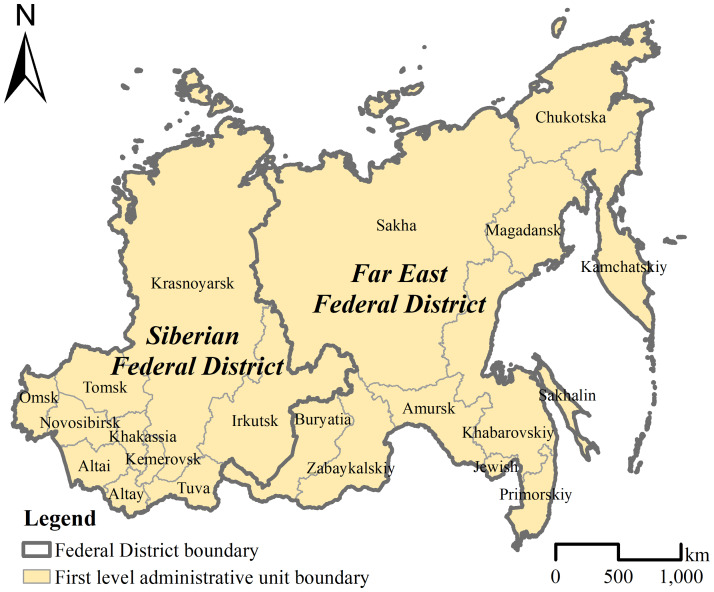
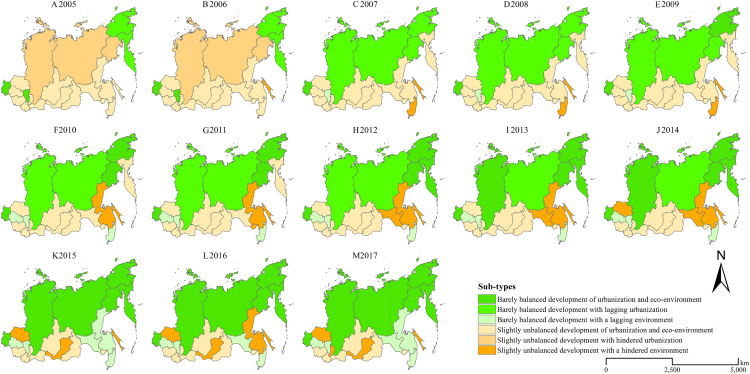
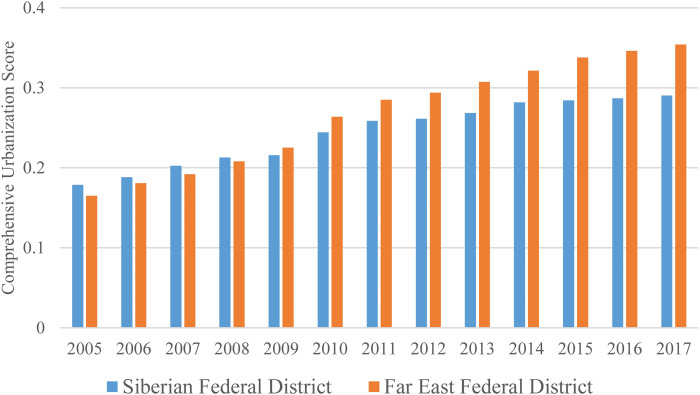
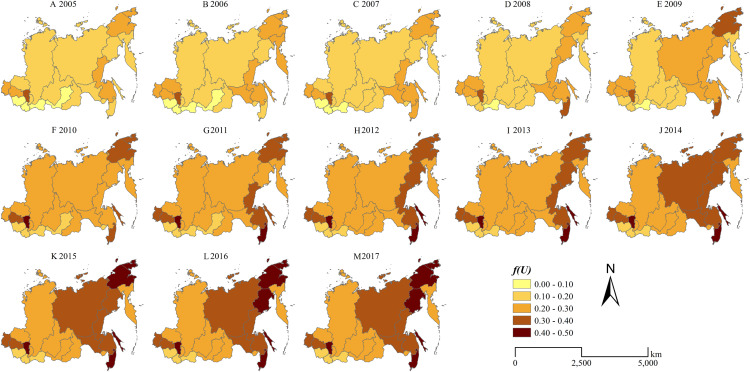
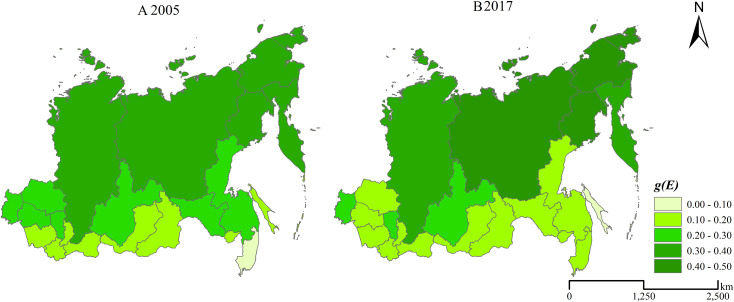
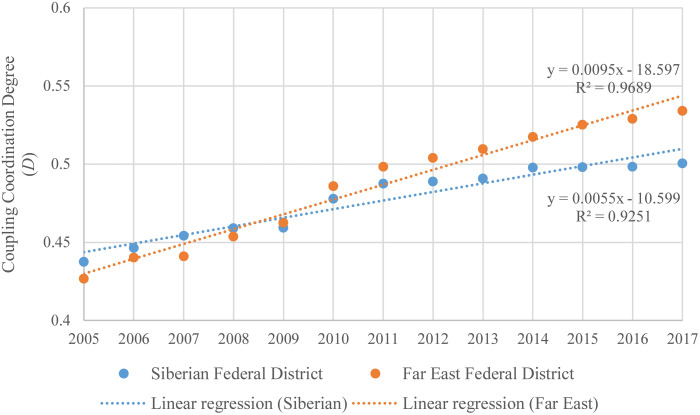
The urbanization growth in the 20th and 21st centuries has led to a series of unprecedented problems in the ecological environment. Based on constructing an integrated urbanization-ecological environment index system, this article conducts a comprehensive evaluation of the coupling coordination degree between urbanization and the ecological environment and uncovers its spatiotemporal variation characteristics in the Siberian and Far East Federal Districts, Russia from 2005 to 2017. The coupling coordination of urbanization and the ecological environment in the Siberian and Far East Federal Districts improve from slightly unbalanced development stage to barely balanced development stage from 2005 to 2017. In 2017, more than half regions achieved the barely balanced development of urbanization and the ecological environment. However, the most desirable development stage, the superior balanced development stage, is never achieved in the Siberian and Far East Federal Districts during the study period. The spatial pattern of the coupling coordination degree of urbanization and the ecological environment in the Siberian and Far East Federal District gradually changes from "dumbbell" to "high-north low-south". The south part of the Siberian and Far East Federal Districts should be paid more attention in the future urban development process. This research will provide support in the future coordination of urban development in the Siberian and Far East Federal Districts.
20世纪和21世纪的城市化发展给生态环境带来了一系列前所未有的问题。基于构建城市化-生态环境综合指标体系,本文对俄罗斯西伯利亚和远东联邦区2005年至2017年城市化与生态环境的耦合协调度进行了综合评价,并揭示了其时空变化特征。2005年至2017年,西伯利亚和远东联邦区城市化与生态环境的耦合协调性从轻度失衡发展阶段提升至勉强协调发展阶段。2017年,超过半数地区实现了城市化与生态环境的勉强协调发展。然而,在研究期内,西伯利亚和远东联邦区从未达到最理想的发展阶段——优质协调发展阶段。西伯利亚和远东联邦区城市化与生态环境耦合协调度的空间格局逐渐从“哑铃型”转变为“北高南低”型。在未来城市发展过程中,应更多关注西伯利亚和远东联邦区的南部地区。本研究将为未来西伯利亚和远东联邦区城市发展的协调提供支持。