Juyal Garima, Pandey Anuj, Garcia Sara L, Negi Sapna, Gupta Ramneek, Kumar Uma, Bhat Bheema, Juyal Ramesh C, Thelma B K
School of Biotechnology, Jawaharlal Nehru University, New Delhi 110067, India.
Department of Genetics, University of Delhi South Campus, New Delhi 110021, India.
J Ayurveda Integr Med. 2022 Jul-Sep;13(3):100578. doi: 10.1016/j.jaim.2022.100578. Epub 2022 Jul 3.
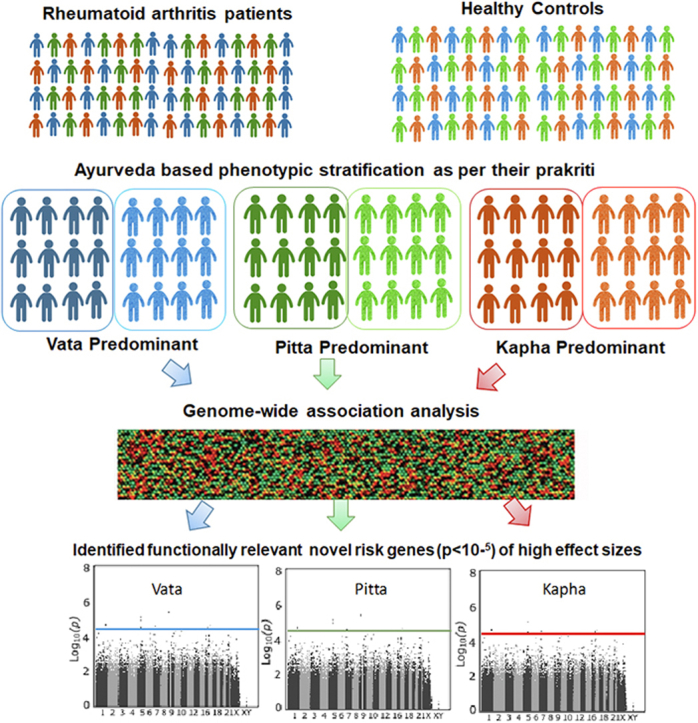
Genome wide association studies have scaled up both in terms of sample size and range of complex disorders investigated, but these have explained relatively little phenotypic variance. Of the several reasons, phenotypic heterogeneity seems to be a likely contributor for missing out genetic associations of large effects. Ayurveda, the traditional Indian system of medicine is one such tool which adopts a holistic deep phenotyping approach and classifies individuals based on their body constitution/prakriti. We hypothesized that Ayurveda based phenotypic stratification of healthy and diseased individuals will allow us to achieve much desired homogeneous cohorts which would facilitate detection of genetic association of large effects. In this proof of concept study, we performed a genome wide association testing of clinically diagnosed rheumatoid arthritis patients and healthy controls, who were re-phenotyped into Vata, Pitta and Kapha predominant prakriti sub-groups.
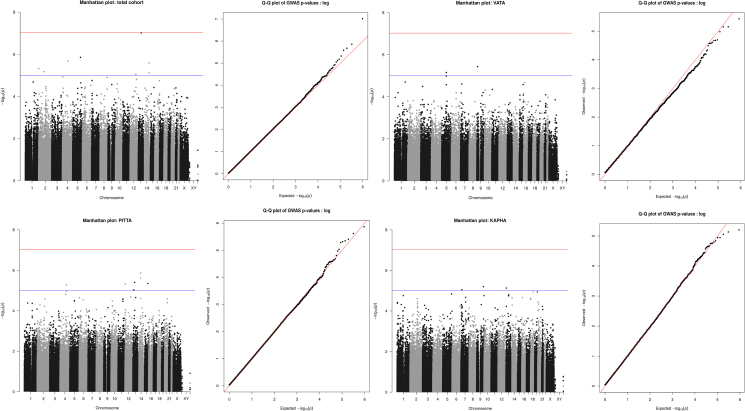
Genotypes of rheumatoid arthritis cases (Vata = 49; Pitta = 117; Kapha = 78) and controls (Vata = 33; Pitta = 175; Kapha = 85) were retrieved from the total genotype data, used in a recent genome-wide association study performed in our laboratory. A total of 528461 SNPs were included after quality control. Prakriti-wise genome-wide association analysis was employed.
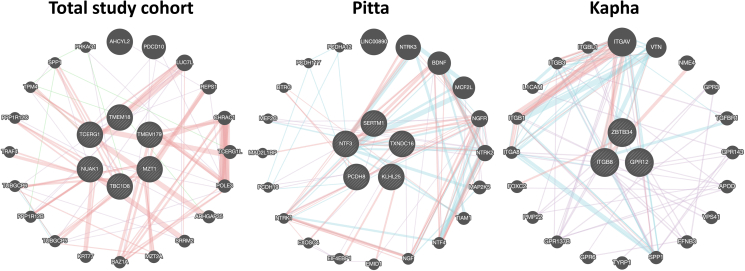
This study identified (i) prakriti-specific novel disease risk genes of high effect sizes; (ii) putative candidates of novel therapeutic potential; and (iii) a good correlation between genetic findings and clinical knowledge in Ayurveda. Adopting Ayurveda based deep phenotyping may facilitate explaining hitherto undiscovered heritability in complex traits and may propel much needed progress in personalized medicine.
全基因组关联研究在样本量和所研究的复杂疾病范围方面都有所扩大,但这些研究对表型变异的解释相对较少。在诸多原因中,表型异质性似乎是导致遗漏大效应基因关联的一个可能因素。阿育吠陀医学,即传统的印度医学体系,就是这样一种采用整体深度表型分析方法并根据个体的体质/体液类型对其进行分类的工具。我们假设,基于阿育吠陀医学对健康个体和患病个体进行表型分层,将使我们能够获得非常理想的同质队列,这将有助于检测大效应的基因关联。在这项概念验证研究中,我们对临床诊断的类风湿性关节炎患者和健康对照进行了全基因组关联测试,这些患者和对照被重新表型化为以风、火、水为主的体液类型亚组。
类风湿性关节炎病例(风型 = 49;火型 = 117;水型 = 78)和对照(风型 = 33;火型 = 175;水型 = 85)的基因型是从我们实验室最近进行的一项全基因组关联研究中使用的总基因型数据中提取的。经过质量控制后,共纳入了528461个单核苷酸多态性(SNP)。采用了基于体液类型的全基因组关联分析。
本研究确定了(i)具有高效应大小的特定体液类型的新型疾病风险基因;(ii)具有新型治疗潜力的推定候选基因;以及(iii)基因研究结果与阿育吠陀医学临床知识之间的良好相关性。采用基于阿育吠陀医学的深度表型分析可能有助于解释复杂性状中迄今未被发现的遗传力,并可能推动个性化医学取得急需的进展。