Govindaraj Periyasamy, Nizamuddin Sheikh, Sharath Anugula, Jyothi Vuskamalla, Rotti Harish, Raval Ritu, Nayak Jayakrishna, Bhat Balakrishna K, Prasanna B V, Shintre Pooja, Sule Mayura, Joshi Kalpana S, Dedge Amrish P, Bharadwaj Ramachandra, Gangadharan G G, Nair Sreekumaran, Gopinath Puthiya M, Patwardhan Bhushan, Kondaiah Paturu, Satyamoorthy Kapaettu, Valiathan Marthanda Varma Sankaran, Thangaraj Kumarasamy
CSIR-Centre for Cellular and Molecular Biology, Hyderabad, Telangana, India.
School of Life Sciences, Manipal University, Manipal, Karnataka, India.
Sci Rep. 2015 Oct 29;5:15786. doi: 10.1038/srep15786.
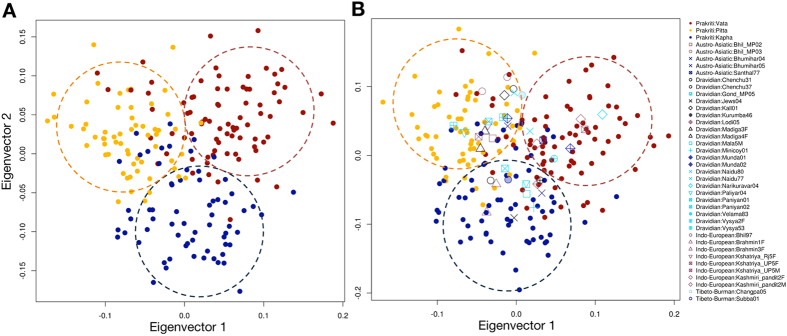
The practice of Ayurveda, the traditional medicine of India, is based on the concept of three major constitutional types (Vata, Pitta and Kapha) defined as "Prakriti". To the best of our knowledge, no study has convincingly correlated genomic variations with the classification of Prakriti. In the present study, we performed genome-wide SNP (single nucleotide polymorphism) analysis (Affymetrix, 6.0) of 262 well-classified male individuals (after screening 3416 subjects) belonging to three Prakritis. We found 52 SNPs (p ≤ 1 × 10(-5)) were significantly different between Prakritis, without any confounding effect of stratification, after 10(6) permutations. Principal component analysis (PCA) of these SNPs classified 262 individuals into their respective groups (Vata, Pitta and Kapha) irrespective of their ancestry, which represent its power in categorization. We further validated our finding with 297 Indian population samples with known ancestry. Subsequently, we found that PGM1 correlates with phenotype of Pitta as described in the ancient text of Caraka Samhita, suggesting that the phenotypic classification of India's traditional medicine has a genetic basis; and its Prakriti-based practice in vogue for many centuries resonates with personalized medicine.
印度传统医学阿育吠陀基于三种主要体质类型(风、火、水)的概念,这三种体质类型被定义为“原质”。据我们所知,尚无研究能令人信服地将基因变异与原质分类相关联。在本研究中,我们对属于三种原质的262名分类明确的男性个体(在筛选了3416名受试者之后)进行了全基因组单核苷酸多态性(SNP)分析(Affymetrix,6.0)。经过10^6次排列后,我们发现52个SNP(p≤1×10^(-5))在不同原质之间存在显著差异,且无分层的混杂效应。对这些SNP进行主成分分析(PCA),可将262名个体分为各自所属的组(风、火、水),而不论其祖先如何,这体现了该分析在分类方面的能力。我们进一步用297个已知祖先的印度人群样本验证了我们的发现。随后,我们发现磷酸葡萄糖变位酶1(PGM1)与《阇罗迦本集》古代文献中所描述的火型体质表型相关,这表明印度传统医学的表型分类具有遗传基础;其基于原质的实践流行了多个世纪,与个性化医疗相呼应。