Department of Veterinary Pathology, Western College of Veterinary Medicine, University of Saskatchewan, Saskatoon, SK S7N 5B4 Canada.
Canadian Centre for Health and Safety in Agriculture, University of Saskatchewan, Saskatoon, Canada, SK S7N 5E5, Canada.
Poult Sci. 2022 Aug;101(8):101983. doi: 10.1016/j.psj.2022.101983. Epub 2022 Jun 3.
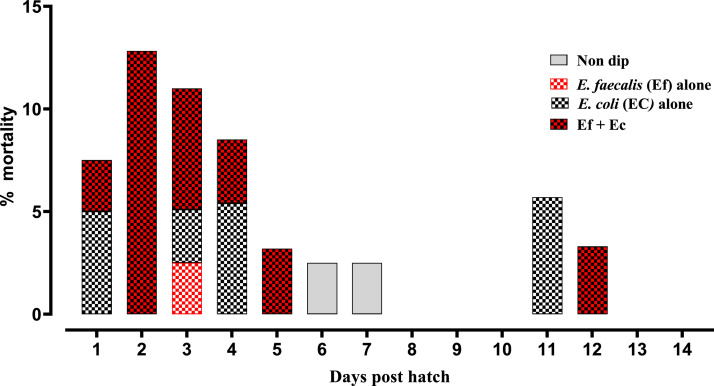
Enterococci and Escherichia coli are opportunistic pathogens of poultry and are associated with embryo and neonatal chick mortality. We have recently demonstrated that 56% of dead broiler chicken embryos in commercial hatcheries in western Canada were due to the coinfection of Enterococcus species and E. coli. The objective of this study was to investigate the host-pathogen interactions of Enterococcus faecalis and E. coli in developing chicken embryos. Embryonating eggs at 12 d of incubation were dipped in a solution of E. faecalis and/or E. coli for 30 s to expose the eggshell to study the migration and colonization of E. faecalis and E. coli in the internal organs of chicken embryos and subsequent neonatal chicken mortality following hatch. A multidrug-resistant E. faecalis isolate from a dead chicken embryo and an E. faecalis isolate from a case of yolk sac infection were able to colonize the internal organs of chicken embryos rapidly compared to an E. faecalis isolate from a healthy chicken without affecting viability or hatchability of embryos. Although E. faecalis colonized internal organs of chicken embryos, no evidence of inflammation of these organs nor the expression of virulence genes of E. faecalis was observed. Although E. faecalis and E. coli alone did not affect the viability of embryos, a significantly high neonatal chicken mortality (27%) was observed following exposure of embryos to both E. faecalis and E. coli. Upregulation of IL-1 and CXCR4 was evident 48 h before peak mortality of neonatal chickens; this could suggest a possible link of cytokine dysregulation to increased mortality in coinfected neonatal chickens. However, further studies are warranted to investigate this issue vis-à-vis coinfection with E. faecalis and E. coli in chicken embryos and neonatal chickens.
肠球菌和大肠杆菌是禽类的机会致病菌,与胚胎和新生雏鸡死亡有关。我们最近的研究表明,加拿大西部商业孵化场的 56%死亡肉鸡胚胎是由于肠球菌属和大肠杆菌的混合感染。本研究的目的是研究肠球菌和大肠杆菌在发育中的鸡胚胎中的宿主-病原体相互作用。在孵化 12 天的胚胎卵上浸泡 30 秒含有肠球菌和/或大肠杆菌的溶液,以研究肠球菌和大肠杆菌在鸡胚胎内部器官中的迁移和定植,以及孵化后新生鸡的死亡率。从死亡鸡胚胎中分离的一种多药耐药肠球菌分离株和一种蛋黄囊感染的肠球菌分离株能够比来自健康鸡的肠球菌分离株更快地定植鸡胚胎的内部器官,而不影响胚胎的活力或孵化率。尽管肠球菌定植于鸡胚胎的内部器官,但未观察到这些器官的炎症或肠球菌毒力基因的表达。尽管肠球菌和大肠杆菌单独使用不会影响胚胎的活力,但在胚胎暴露于两者后,新生鸡的死亡率(27%)显著升高。IL-1 和 CXCR4 的上调在新生鸡死亡高峰前 48 小时明显,这可能表明细胞因子失调与混合感染新生鸡死亡率增加之间存在可能的联系。然而,需要进一步的研究来调查与肠球菌和大肠杆菌在鸡胚胎和新生鸡中的混合感染有关的这一问题。