Department of Pathology, Leiden University Medical Center, Leiden, The Netherlands.
Department of Surgery, Leiden University Medical Center, Leiden, The Netherlands.
J Immunother Cancer. 2022 Jul;10(7). doi: 10.1136/jitc-2022-004638.
Pancreatic ductal adenocarcinoma (PDAC) is a highly lethal malignancy in need of effective (immuno)therapeutic treatment strategies. For the optimal application and development of cancer immunotherapies, a comprehensive understanding of local and systemic immune profiles in patients with PDAC is required. Here, our goal was to decipher the interplay between local and systemic immune profiles in treatment-naïve patients with PDAC.
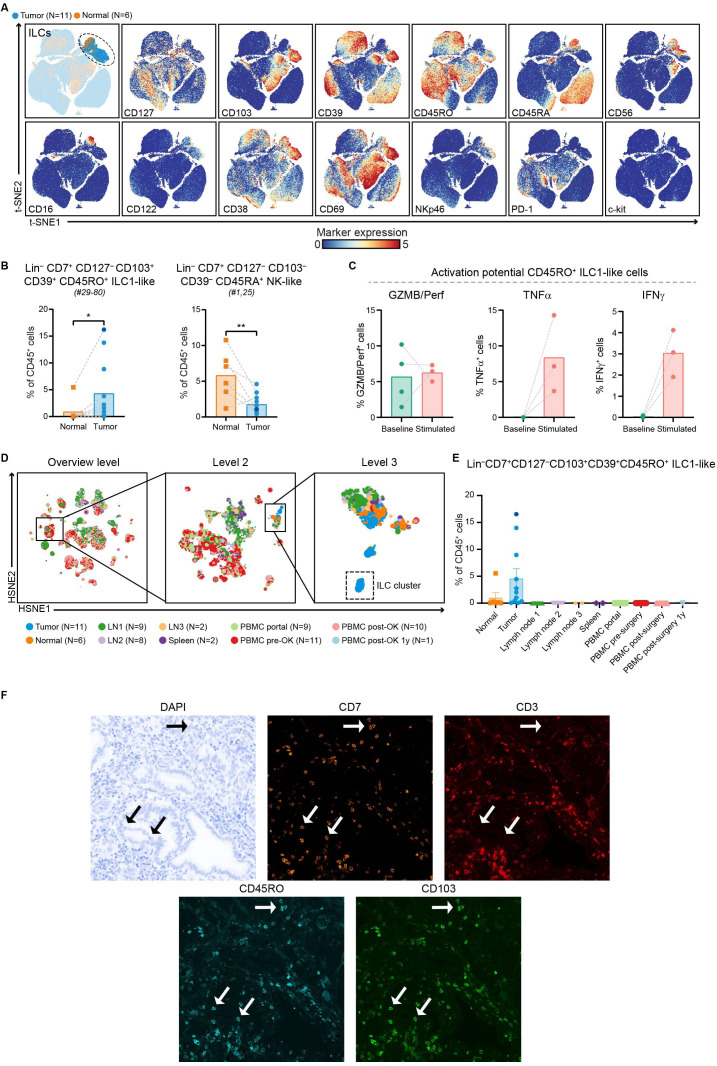
The immune composition of PDAC, matched non-malignant pancreatic tissue, regional lymph nodes, spleen, portal vein blood, and peripheral blood samples (collected before and after surgery) from 11 patients with PDAC was assessed by measuring 41 immune cell markers by single-cell mass cytometry. Furthermore, the activation potential of tumor-infiltrating lymphocytes as determined by their ability to produce cytokines was investigated by flow cytometry. In addition, the spatial localization of tumor-infiltrating innate lymphocytes in the tumor microenvironment was confirmed by multispectral immunofluorescence.
We found that CD103CD8 T cells with cytotoxic potential are infrequent in the PDAC immune microenvironment and lack the expression of activation markers and checkpoint blockade molecule programmed cell death protein-1 (PD-1). In contrast, PDAC tissues showed a remarkable increased relative frequency of B cells and regulatory T cells as compared with non-malignant pancreatic tissues. Besides, a previously unappreciated innate lymphocyte cell (ILC) population (CD127CD103CD39CD45RO ILC1-like) was discovered in PDAC tissues. Strikingly, the increased relative frequency of B cells and regulatory T cells in pancreatic cancer samples was reflected in matched portal vein blood samples but not in peripheral blood, suggesting a regional enrichment of immune cells that infiltrate the PDAC microenvironment. After surgery, decreased frequencies of myeloid dendritic cells were found in peripheral blood.
Our work demonstrates an immunosuppressive landscape in PDAC tissues, generally deprived of cytotoxic T cells and enriched in regulatory T cells and B cells. The antitumor potential of ILC1-like cells in PDAC may be exploited in a therapeutic setting. Importantly, immune profiles detected in blood isolated from the portal vein reflected the immune cell composition of the PDAC microenvironment, suggesting that this anatomical location could be a source of tumor-associated immune cell subsets.
胰腺导管腺癌(PDAC)是一种高度致命的恶性肿瘤,需要有效的(免疫)治疗策略。为了优化癌症免疫疗法的应用和发展,需要全面了解 PDAC 患者的局部和全身免疫谱。在这里,我们的目标是破译初治 PDAC 患者局部和全身免疫谱之间的相互作用。
通过单细胞质谱流式细胞术测量 41 种免疫细胞标志物,评估 11 例 PDAC 患者的 PDAC、匹配的非恶性胰腺组织、区域淋巴结、脾脏、门静脉血液和外周血样本(手术前后采集)的免疫组成。此外,通过流式细胞术检测肿瘤浸润淋巴细胞产生细胞因子的能力来研究其激活潜能。此外,通过多光谱免疫荧光证实肿瘤浸润固有淋巴细胞在肿瘤微环境中的空间定位。
我们发现具有细胞毒性潜力的 CD103CD8 T 细胞在 PDAC 免疫微环境中很少见,并且缺乏激活标志物和检查点阻断分子程序性细胞死亡蛋白-1(PD-1)的表达。相比之下,PDAC 组织与非恶性胰腺组织相比,B 细胞和调节性 T 细胞的相对频率显著增加。此外,在 PDAC 组织中发现了一种以前未被认识的固有淋巴细胞群(CD127CD103CD39CD45RO ILC1 样)。引人注目的是,在胰腺癌样本中,B 细胞和调节性 T 细胞的相对频率增加反映在匹配的门静脉血液样本中,但在外周血中没有反映,这表明免疫细胞在 PDAC 微环境中浸润的区域富集。手术后,在外周血中发现髓样树突状细胞的频率降低。
我们的工作表明 PDAC 组织中存在免疫抑制景观,通常缺乏细胞毒性 T 细胞,富含调节性 T 细胞和 B 细胞。在 PDAC 中,ILC1 样细胞的抗肿瘤潜力可能在治疗中得到利用。重要的是,从门静脉分离的血液中检测到的免疫谱反映了 PDAC 微环境中的免疫细胞组成,这表明该解剖位置可能是肿瘤相关免疫细胞亚群的来源。