Medicine, Columbia University Irving Medical Center, New York, New York, USA.
Department of Pathology, Yale School of Medicine, New Haven, Connecticut, USA.
J Immunother Cancer. 2022 Jul;10(7). doi: 10.1136/jitc-2022-005025.
Despite the prominent role of innate immunity in the antitumor response, little is known about the myeloid composition of human non-small cell lung cancer (NSCLC) with respect to histology and molecular subtype. We used multiplexed quantitative immunofluorescence (QIF) to measure the distribution and clinical significance of major myeloid cell subsets in large retrospective NSCLC collections.
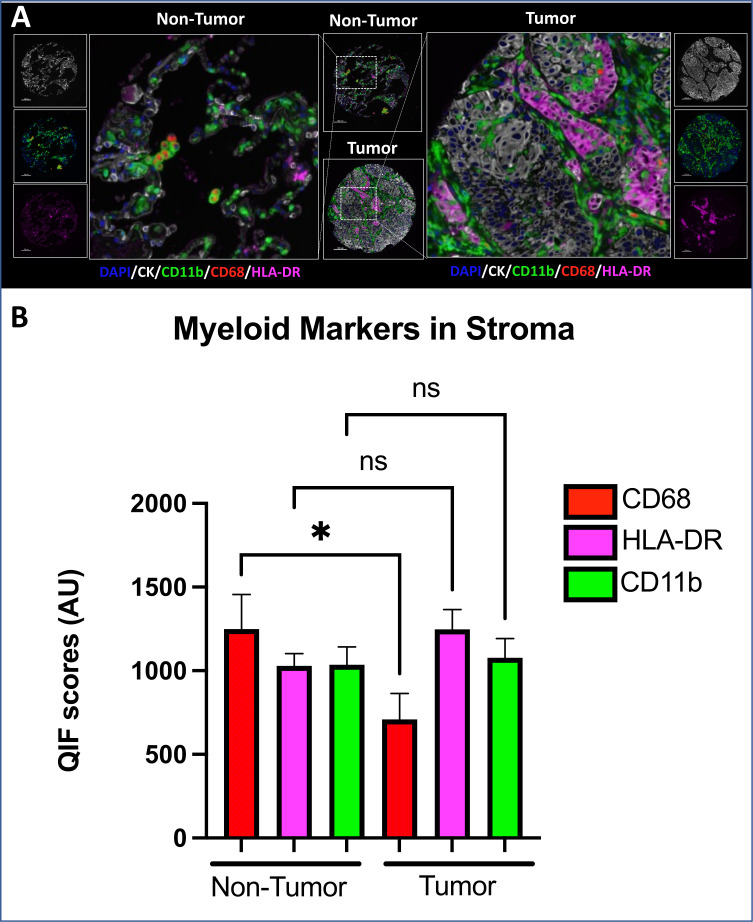
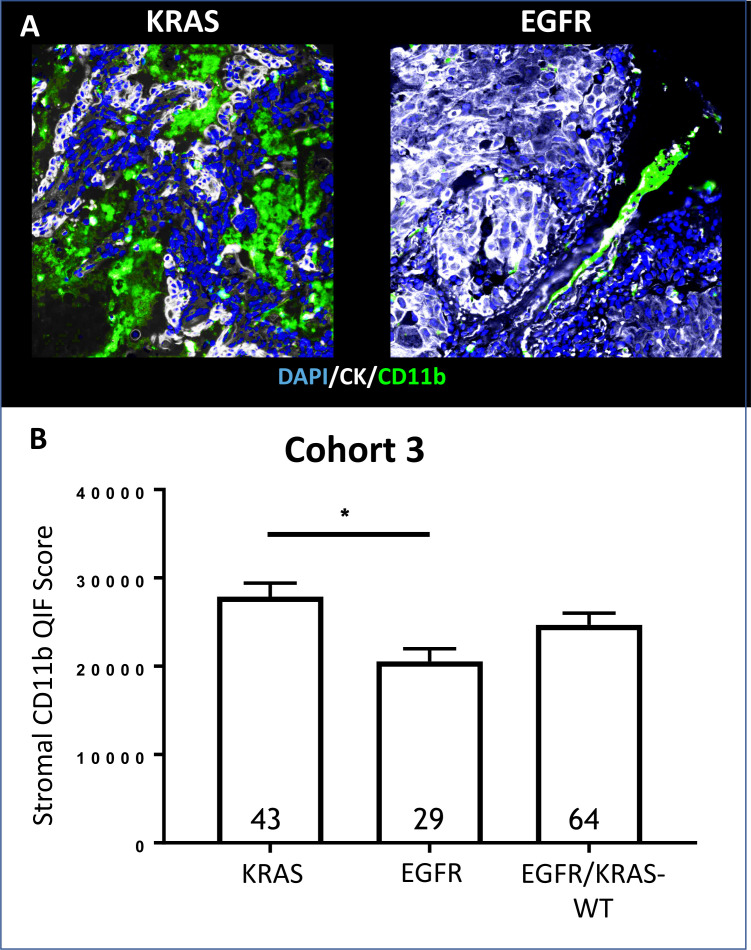
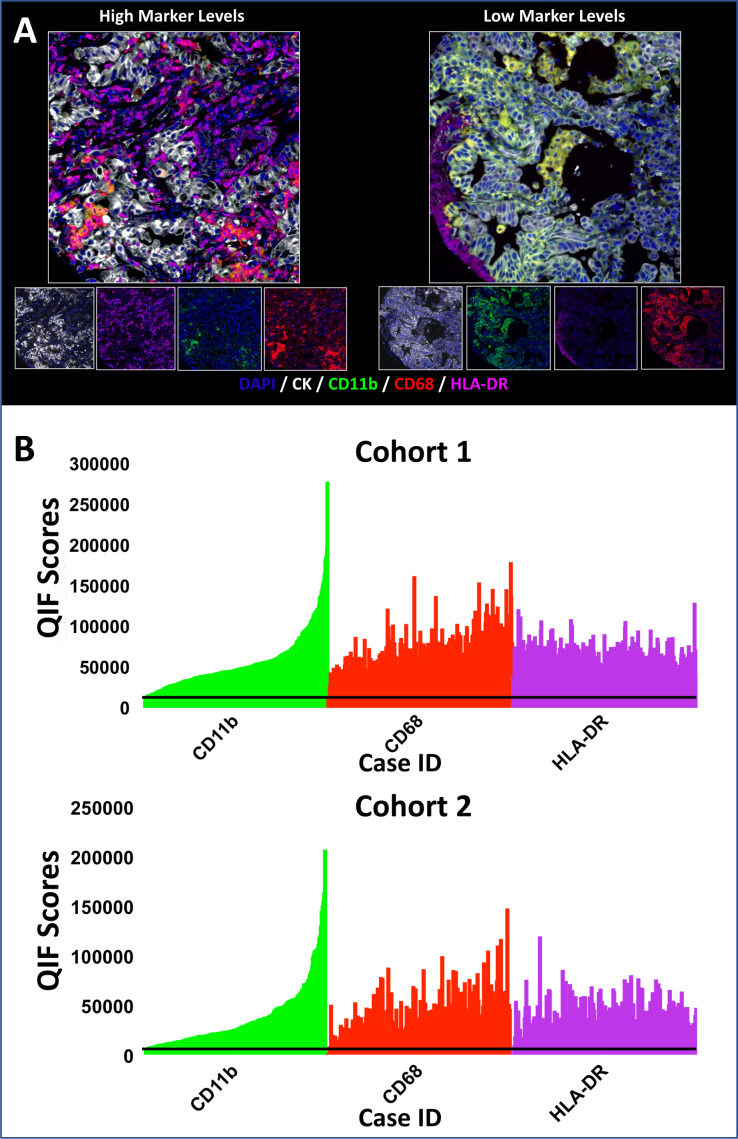
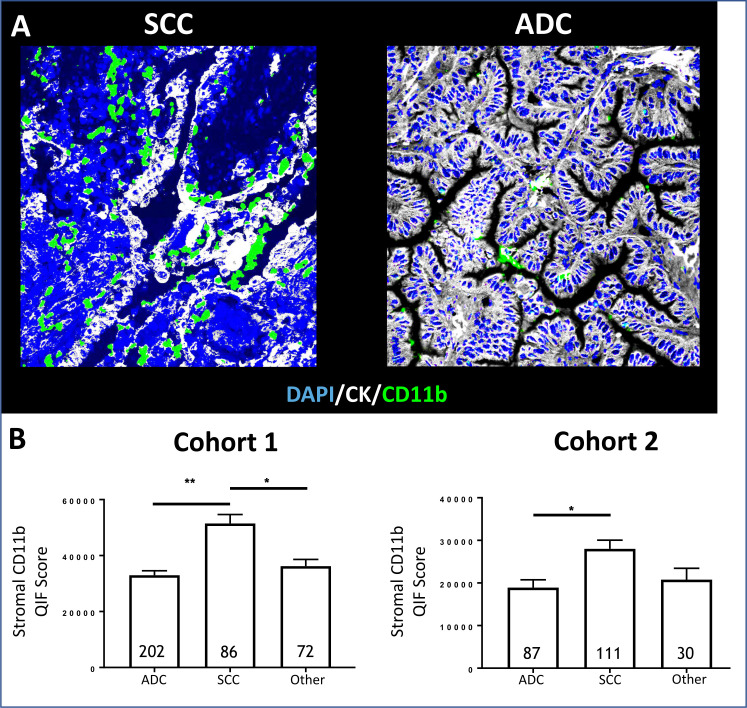
We established a QIF panel to map major myeloid cell subsets in fixed human NSCLC including 4',6-Diamidino-2-Phenylindole for all cells, pancytokeratin for tumor-epithelial cells, CD68 for M1-like macrophages; and CD11b plus HLA-DR to interrogate mature and immature myeloid cell populations such as myeloid derived suppressor cells (MDSCs). We interrogated 793 NSCLCs represented in four tissue microarray-based cohorts: #1 (Yale, n=379) and #2 (Greece, n=230) with diverse NSCLC subtypes; #3 (Yale, n=138) with molecularly annotated lung adenocarcinomas (ADC); and #4 (Yale, n=46) with patient-matched NSCLC and morphologically-normal lung tissue. We examined associations between marker levels, myeloid cell profiles, clinicopathologic/molecular variables and survival.
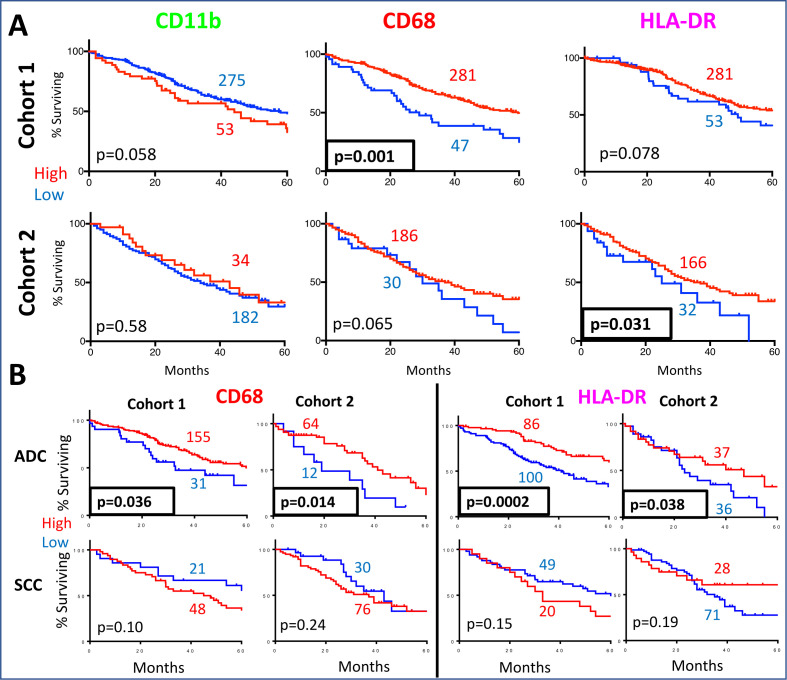
The levels of CD68+ M1 like macrophages were significantly lower and the fraction of CD11b+/HLA-DR- MDSC-like cells was prominently higher in tumor than in matched non-tumor lung tissues. HLA-DR was consistently higher in myeloid cells from tumors with elevated CD68 expression. Stromal CD11b was significantly higher in squamous cell carcinomas (SCC) than in ADC across the cohorts and EGFR-mutated lung ADCs displayed lower CD11b levels than KRAS-mutant tumors. Increased stromal CD68- and HLA-DR-expressing cells was associated with better survival in ADCs from two independent NSCLC cohorts. In SCC, increased stromal CD11b or HLA-DR expression was associated with a trend towards shorter 5-year survival.
NSCLCs display an unfavorable myeloid immune contexture relative to non-tumor lung and exhibit distinct myeloid-cell profiles across histologies and presence of major oncogenic driver-mutations. Elevated M1-like stromal proinflammatory myeloid cells are prognostic in lung ADC, but not in SCC.
尽管先天免疫在抗肿瘤反应中起着重要作用,但对于组织学和分子亚型,人类非小细胞肺癌(NSCLC)中的髓样细胞组成知之甚少。我们使用多重定量免疫荧光(QIF)来测量大型回顾性 NSCLC 集合中主要髓样细胞亚群的分布和临床意义。
我们建立了一个 QIF 面板,以绘制固定的人类 NSCLC 中的主要髓样细胞亚群,包括 4',6-二脒基-2-苯基吲哚(DAPI)用于所有细胞,细胞角蛋白用于肿瘤上皮细胞,CD68 用于 M1 样巨噬细胞;CD11b 加 HLA-DR 用于询问成熟和不成熟的髓样细胞群体,如髓样来源的抑制细胞(MDSCs)。我们询问了四个组织微阵列为基础的队列中代表的 793 例 NSCLC:#1(耶鲁大学,n=379)和#2(希腊,n=230)具有不同的 NSCLC 亚型;#3(耶鲁大学,n=138)具有分子标记的肺腺癌(ADC);和#4(耶鲁大学,n=46)具有患者匹配的 NSCLC 和形态正常的肺组织。我们检查了标记物水平、髓样细胞特征、临床病理/分子变量与生存之间的关系。
与匹配的非肿瘤肺组织相比,CD68+M1 样巨噬细胞的水平显著降低,而 CD11b+/HLA-DR-MDSC 样细胞的比例明显升高。在 CD68 表达升高的肿瘤中,髓样细胞中的 HLA-DR 始终较高。在两个独立的 NSCLC 队列中,CD11b 在鳞状细胞癌(SCC)中的基质水平明显高于 ADC,而 EGFR 突变型肺 ADC 的 CD11b 水平低于 KRAS 突变型肿瘤。在 ADC 中,增加的基质 CD68-和 HLA-DR 表达的细胞与更好的生存相关。在 SCC 中,增加的基质 CD11b 或 HLA-DR 表达与 5 年生存率降低趋势相关。
NSCLC 相对于非肿瘤肺组织表现出不利的髓样免疫结构,并表现出不同的髓样细胞特征,跨越组织学和主要致癌驱动突变的存在。升高的 M1 样基质促炎髓样细胞在肺 ADC 中具有预后意义,但在 SCC 中没有。