Department of Radiation Oncology, Shandong Cancer Hospital and Institute, Shandong First Medical University and Shandong Academy of Medical Sciences, Jinan, China.
Department of Radiation Oncology, Yantai Affiliated Hospital of Binzhou Medical University, Yantai, China.
Cancer Immunol Immunother. 2023 Jan;72(1):193-209. doi: 10.1007/s00262-022-03227-z. Epub 2022 Jul 6.
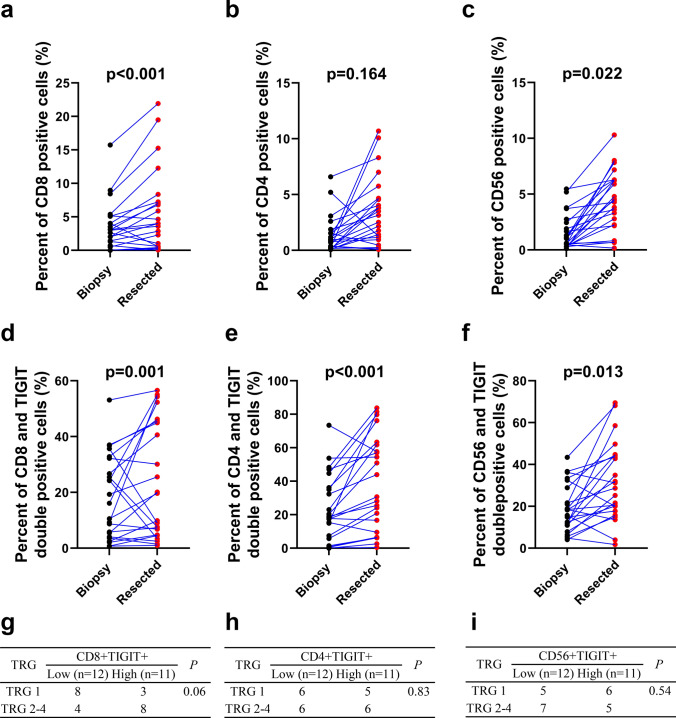
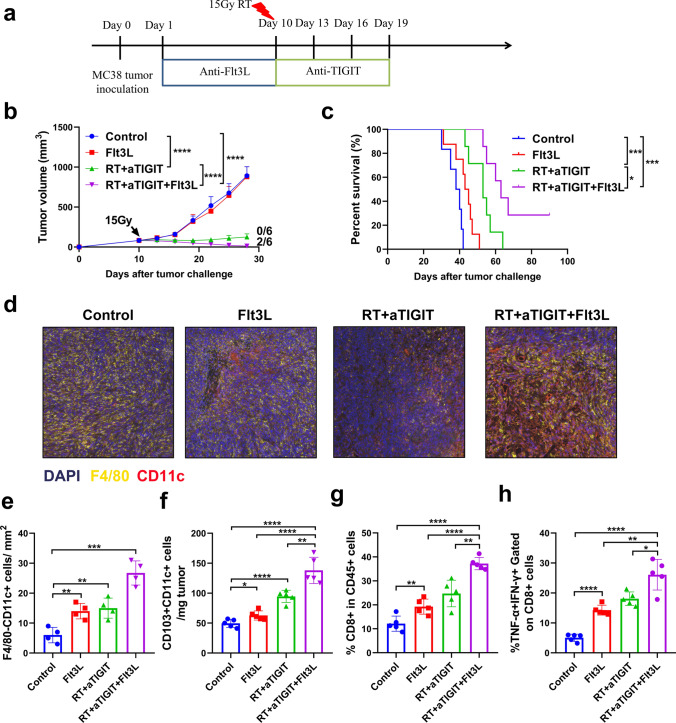
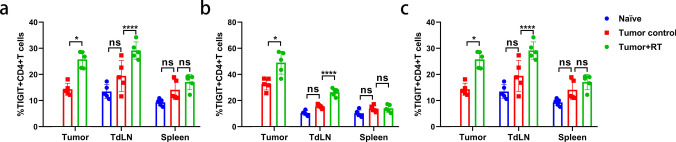
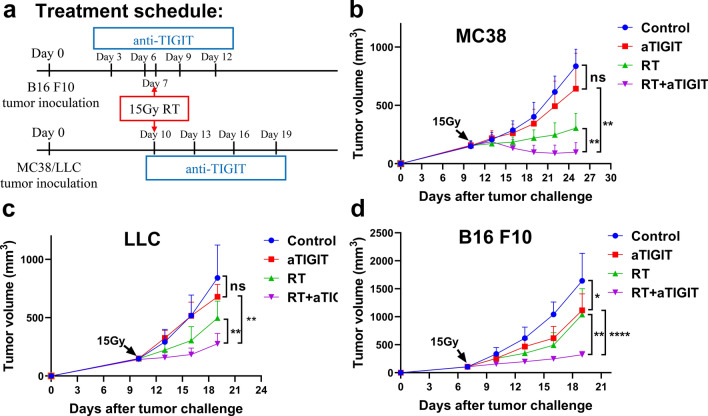
Blockade of the T cell immunoreceptor with the immunoglobulin and immunoreceptor tyrosine-based inhibitory motif domain (TIGIT) can enhance innate and adaptive tumor immunity and radiotherapy (RT) can enhance anti-tumor immunity. However, our data suggest that TIGIT-mediated immune suppression may be an impediment to such goals. Herein, we report on the synergistic effects of RT combined with anti-TIGIT therapy and the mechanism of their interaction. Treatment efficacy was assessed by measuring primary and secondary tumor growth, survival, and immune memory capacity. The function of CD103 + dendritic cells (DCs) under the combined treatment was assessed in wild-type and BATF3-deficient (BATF3) mice. FMS-like tyrosine kinase 3 ligand (Flt3L) was used to confirm the role of CD103 + DCs in RT combined with anti-TIGIT therapy. TIGIT was upregulated in immune cells following RT in both esophageal squamous cell carcinoma patients and mouse models. Administration of the anti-TIGIT antibody enhanced the efficacy of RT through a CD8 + T cell-dependent mechanism. It was observed that RT and the anti-TIGIT antibody synergistically enhanced the accumulation of tumor-infiltrating DCs, which activated CD8 + T cells. The efficacy of the combination therapy was negated in the BATF3 mouse model. CD103 + DCs were required to promote the anti-tumor effects of combination therapy. Additionally, Flt3L therapy enhanced tumor response to RT combined with TIGIT blockade. Our study demonstrated TIGIT blockade can synergistically enhance anti-tumor T cell responses to RT via CD8 + T cells (dependent on CD103 + DCs), suggesting the clinical potential of targeting the TIGIT pathway and expanding CD103 + DCs in RT.
阻断 T 细胞免疫受体与免疫球蛋白和免疫受体酪氨酸基抑制基序域(TIGIT)的结合可以增强先天和适应性肿瘤免疫,放疗(RT)可以增强抗肿瘤免疫。然而,我们的数据表明,TIGIT 介导的免疫抑制可能是实现这些目标的障碍。在此,我们报告了 RT 联合抗 TIGIT 治疗的协同作用及其相互作用的机制。通过测量原发性和继发性肿瘤生长、生存和免疫记忆能力来评估治疗效果。在野生型和 BATF3 缺陷(BATF3)小鼠中评估了联合治疗下 CD103+树突状细胞(DC)的功能。使用 FMS 样酪氨酸激酶 3 配体(Flt3L)来确认 CD103+DC 在 RT 联合抗 TIGIT 治疗中的作用。在食管癌患者和小鼠模型中,RT 后免疫细胞中 TIGIT 上调。抗 TIGIT 抗体的给药通过 CD8+T 细胞依赖性机制增强了 RT 的疗效。观察到 RT 和抗 TIGIT 抗体协同增强了肿瘤浸润性 DC 的积累,从而激活了 CD8+T 细胞。在 BATF3 小鼠模型中,组合疗法的疗效被否定。CD103+DC 是促进联合治疗抗肿瘤作用所必需的。此外,Flt3L 治疗增强了 TIGIT 阻断联合 RT 的肿瘤反应。我们的研究表明,TIGIT 阻断可以通过 CD8+T 细胞(依赖于 CD103+DC)协同增强对 RT 的抗肿瘤 T 细胞反应,提示靶向 TIGIT 途径和在 RT 中扩增 CD103+DC 的临床潜力。