Department of Oncology, Xiangya Hospital, Central South University, No. 87 Xiangya Road, Kaifu District, Changsha, 410008, China.
Xiangya Lung Cancer Center, Xiangya Hospital, Central South University, Changsha, 410008, China.
Mol Cancer. 2023 Jun 8;22(1):93. doi: 10.1186/s12943-023-01800-3.
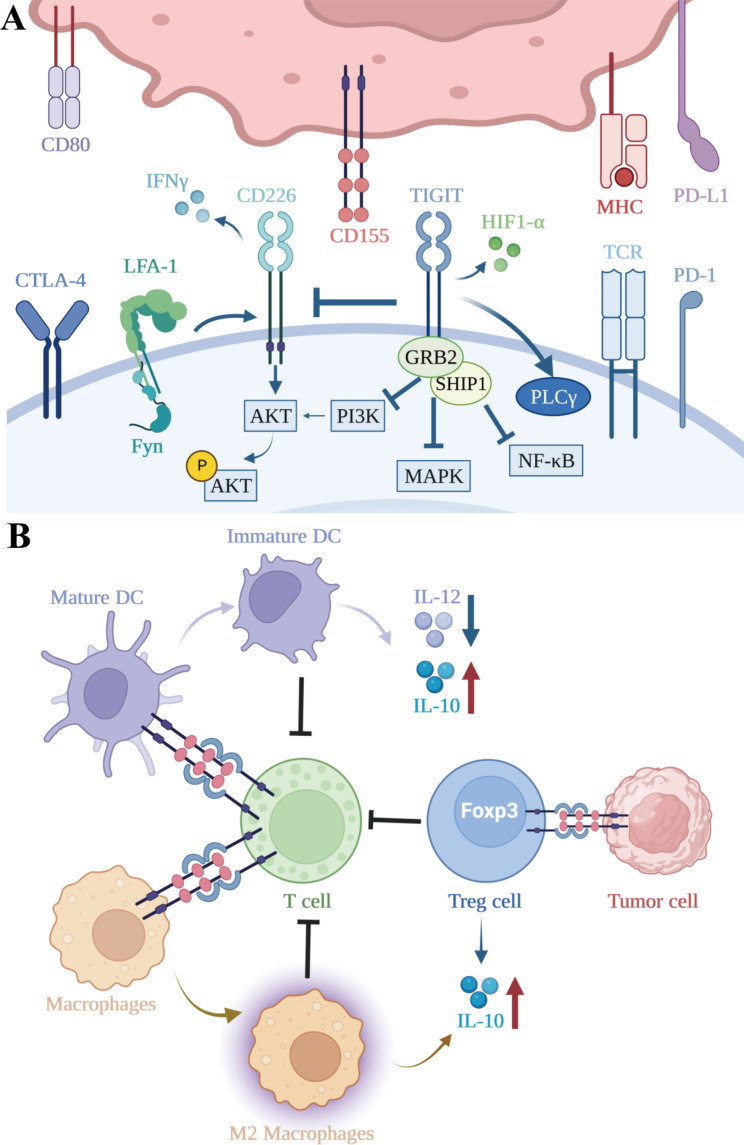
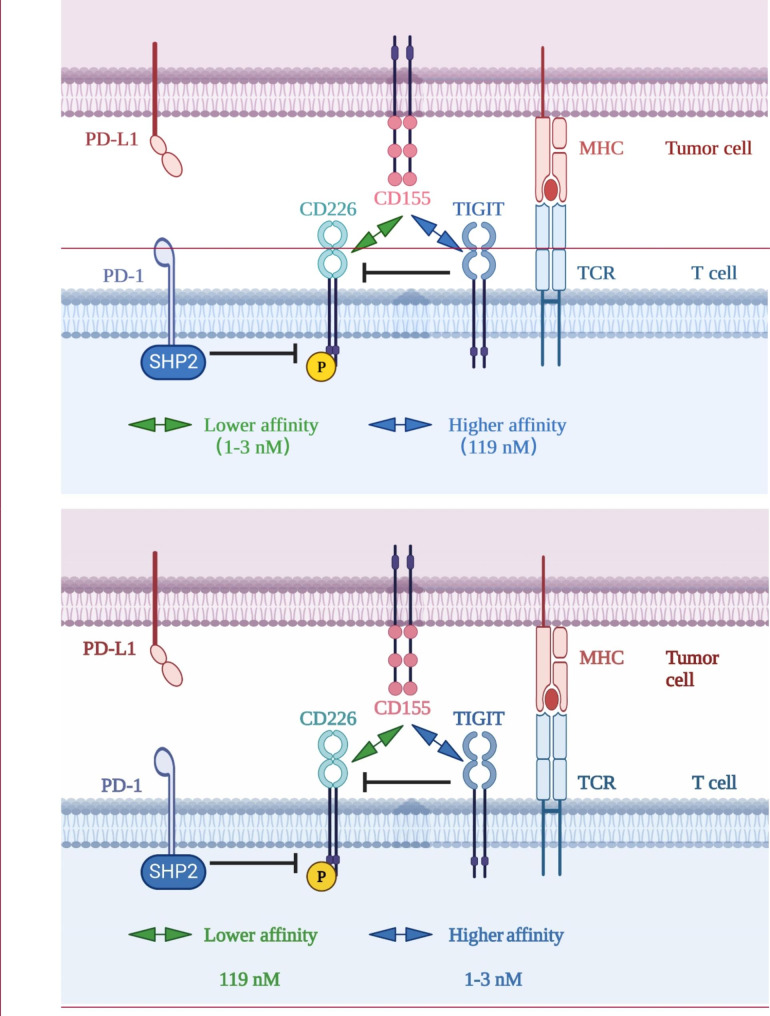
Over the past decade, immune checkpoint inhibitors (ICIs) have emerged as a revolutionary cancer treatment modality, offering long-lasting responses and survival benefits for a substantial number of cancer patients. However, the response rates to ICIs vary significantly among individuals and cancer types, with a notable proportion of patients exhibiting resistance or showing no response. Therefore, dual ICI combination therapy has been proposed as a potential strategy to address these challenges. One of the targets is TIGIT, an inhibitory receptor associated with T-cell exhaustion. TIGIT has diverse immunosuppressive effects on the cancer immunity cycle, including the inhibition of natural killer cell effector function, suppression of dendritic cell maturation, promotion of macrophage polarization to the M2 phenotype, and differentiation of T cells to regulatory T cells. Furthermore, TIGIT is linked with PD-1 expression, and it can synergize with PD-1/PD-L1 blockade to enhance tumor rejection. Preclinical studies have demonstrated the potential benefits of co-inhibition of TIGIT and PD-1/PD-L1 in enhancing anti-tumor immunity and improving treatment outcomes in several cancer types. Several clinical trials are underway to evaluate the safety and efficacy of TIGIT and PD-1/PD-L1 co-inhibition in various cancer types, and the results are awaited. This review provides an overview of the mechanisms of TIGIT and PD-1/PD-L1 co-inhibition in anti-tumor treatment, summarizes the latest clinical trials investigating this combination therapy, and discusses its prospects. Overall, co-inhibition of TIGIT and PD-1/PD-L1 represents a promising therapeutic approach for cancer treatment that has the potential to improve the outcomes of cancer patients treated with ICIs.
在过去的十年中,免疫检查点抑制剂(ICIs)已成为一种革命性的癌症治疗方法,为数以千计的癌症患者提供了持久的反应和生存获益。然而,ICI 的反应率在个体和癌症类型之间存在显著差异,相当一部分患者表现出耐药性或无反应。因此,双重 ICI 联合治疗被提出是解决这些挑战的一种潜在策略。其中一个靶点是 TIGIT,它是一种与 T 细胞耗竭相关的抑制性受体。TIGIT 对癌症免疫周期具有多种免疫抑制作用,包括抑制自然杀伤细胞效应功能、抑制树突状细胞成熟、促进巨噬细胞向 M2 表型极化以及 T 细胞向调节性 T 细胞分化。此外,TIGIT 与 PD-1 表达相关,它可以与 PD-1/PD-L1 阻断协同作用,增强肿瘤排斥。临床前研究表明,在几种癌症类型中,TIGIT 和 PD-1/PD-L1 的共抑制可增强抗肿瘤免疫并改善治疗结果。目前正在进行多项临床试验,以评估 TIGIT 和 PD-1/PD-L1 共抑制在各种癌症类型中的安全性和有效性,结果正在等待中。本综述概述了 TIGIT 和 PD-1/PD-L1 共抑制在抗肿瘤治疗中的作用机制,总结了最新的研究该联合治疗的临床试验,并讨论了其前景。总的来说,TIGIT 和 PD-1/PD-L1 的共抑制代表了一种有前途的癌症治疗方法,有可能改善接受 ICI 治疗的癌症患者的结局。