Department of Shared Decision-Making and Value-Based Health Care, Santeon, Utrecht, the Netherlands.
Department of Internal Medicine, Maasstad Hospital, Rotterdam, the Netherlands.
BMC Nephrol. 2022 Jul 6;23(1):236. doi: 10.1186/s12882-022-02853-0.
Patient decision aids (PtDAs) support patients and clinicians in shared decision-making (SDM). Real-world outcome information may improve patients' risk perception, and help patients make decisions congruent with their expectations and values. Our aim was to develop an online PtDA to support kidney failure treatment modality decision-making, that: 1) provides patients with real-world outcome information, and 2) facilitates SDM in clinical practice.
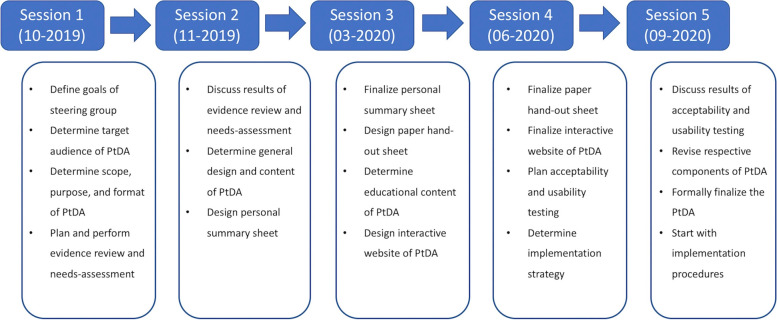
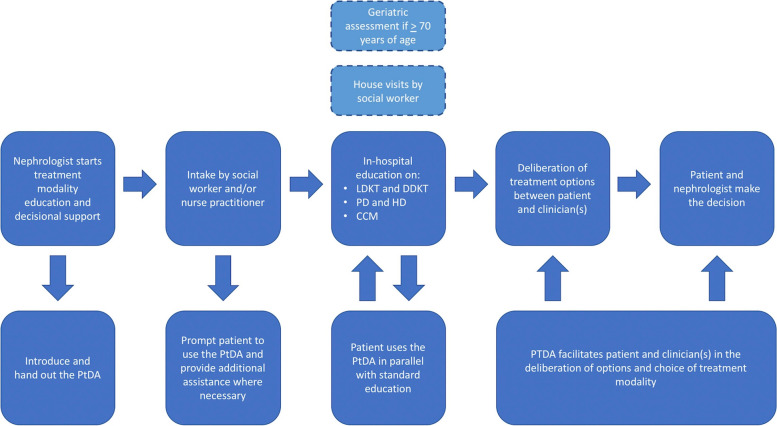
The International Patient Decision Aids Standards (IPDAS) development process model was complemented with a user-centred and convergent mixed-methods approach. Rapid prototyping was used to develop the PtDA with a multidisciplinary steering group in an iterative process of co-creation. The results of an exploratory evidence review and a needs-assessment among patients, caregivers, and clinicians were used to develop the PtDA. Seven Dutch teaching hospitals and two national Dutch outcome registries provided real-world data on selected outcomes for all kidney failure treatment modalities. Alpha and beta testing were performed to assess the prototype and finalise development. An implementation strategy was developed to guide implementation of the PtDA in clinical practice.
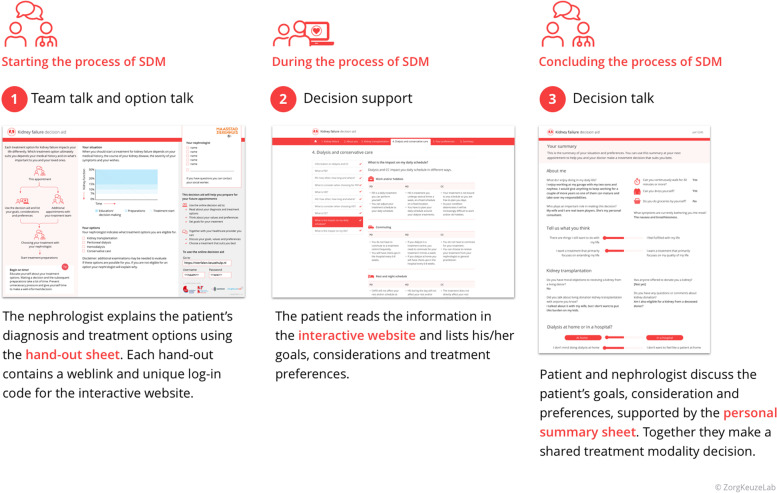
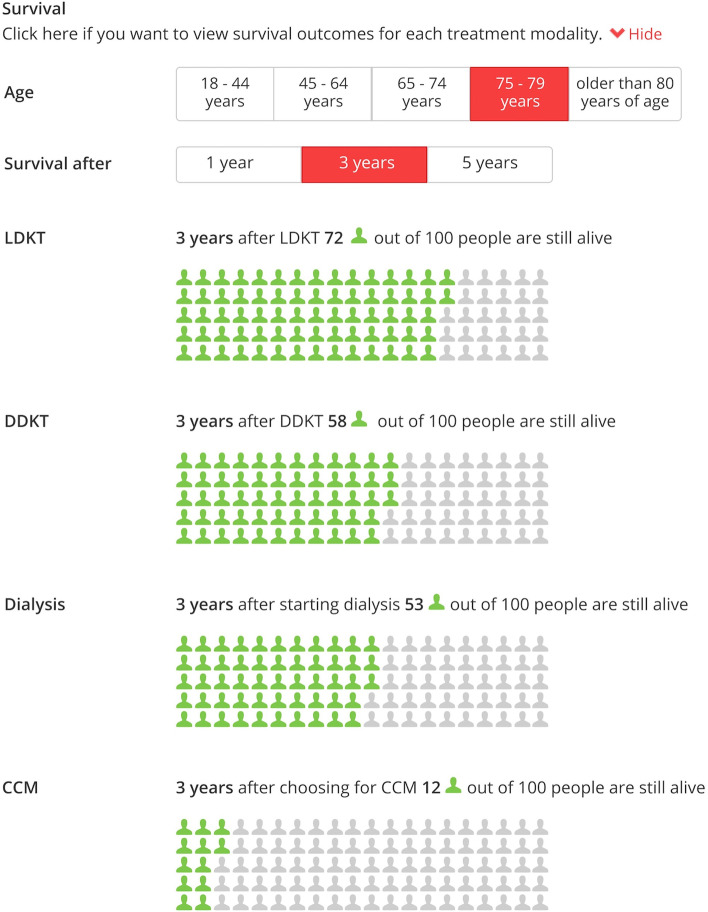
The 'Kidney Failure Decision Aid' consists of three components designed to help patients and clinicians engage in SDM: 1) a paper hand-out sheet, 2) an interactive website, and 3) a personal summary sheet. A 'patients-like-me' infographic was developed to visualise survival probabilities for each treatment modality on the website. Other treatment outcomes were incorporated as event rates (e.g. hospitalisation rates) or explained in text (e.g. the flexibility of each treatment modality). No major revisions were needed after alpha and beta testing. During beta testing, some patients ignored the survival probabilities because they considered these too confronting. Nonetheless, patients agreed that every patient has the right to choose whether they want to view this information. Patients and clinicians believed that the PtDA would help patients make informed decisions, and that it would support values- and preferences-based decision-making. Implementation of the PtDA has started in October 2020.
The 'Kidney Failure Decision Aid' was designed to facilitate SDM in clinical practice and contains real-world outcome information on all kidney failure treatment modalities. It is currently being investigated for its effects on SDM in a clinical trial.
患者决策辅助工具(PtDAs)支持患者和临床医生共同决策(SDM)。实际结果信息可以改善患者的风险感知,并帮助患者做出与他们的期望和价值观相符的决策。我们的目标是开发一个支持肾脏衰竭治疗方式决策的在线 PtDA,该工具:1)为患者提供实际结果信息,2)在临床实践中促进 SDM。
国际患者决策辅助工具标准(IPDAS)的开发过程模型补充了以患者为中心和收敛的混合方法方法。快速原型制作用于在多学科指导小组的迭代共创过程中开发 PtDA。探索性证据审查和患者、护理人员和临床医生的需求评估的结果用于开发 PtDA。七所荷兰教学医院和两个荷兰国家结果登记处为所有肾脏衰竭治疗方式提供了选定结果的实际数据。进行了 alpha 和 beta 测试以评估原型并完成开发。制定了实施策略以指导 PtDA 在临床实践中的实施。
“肾衰竭决策辅助工具”由三个旨在帮助患者和临床医生进行 SDM 的组件组成:1)纸质手册,2)交互式网站,3)个人总结表。开发了一个“像我一样的患者”信息图,以在网站上可视化每种治疗方式的生存率。其他治疗结果被纳入事件率(例如住院率)或在文本中解释(例如每种治疗方式的灵活性)。在 alpha 和 beta 测试后不需要进行重大修订。在 beta 测试期间,一些患者忽略了生存率,因为他们认为这些信息太令人不安。尽管如此,患者们都同意每个患者都有权选择是否要查看此信息。患者和临床医生认为,PtDA 将帮助患者做出明智的决策,并支持基于价值观和偏好的决策制定。PtDA 的实施已于 2020 年 10 月开始。
“肾衰竭决策辅助工具”旨在促进临床实践中的 SDM,并包含有关所有肾衰竭治疗方式的实际结果信息。目前正在一项临床试验中研究其对 SDM 的影响。