Nota Ingrid, Drossaert Constance H C, Melissant Heleen C, Taal Erik, Vonkeman Harald E, Haagsma Cees J, van de Laar Mart A F J
Department of Psychology, Health and Technology, University of Twente, PO Box 217, 7500AE, Enschede, The Netherlands.
Department of Clinical Psychology, VU University Amsterdam, Van der Boechorststraat 1, 1081 BT, Amsterdam, The Netherlands.
BMC Med Inform Decis Mak. 2017 Apr 26;17(1):51. doi: 10.1186/s12911-017-0433-5.
A main element of patient-centred care, Patient Decision Aids (PtDAs) facilitate shared decision-making (SDM). A recent update of the International Patient Decision Aids Standards (IPDAS) emphasised patient involvement during PtDA development, but omitted a methodology for doing so. This article reports on the value of user-centred design (UCD) methods for the development of a PtDA that aims to support inflammatory arthritis patients in their choice between disease modifying anti-rheumatic drugs (DMARDs).
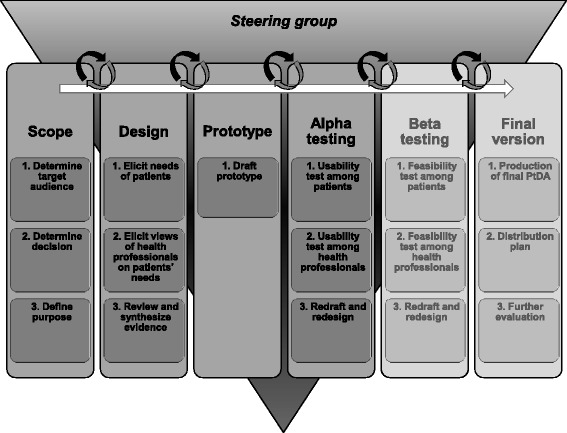
The IPDAS development process model in combination with UCD methods were applied. The process was overseen by an eight-member multidisciplinary steering group. Patients and health professionals were iteratively consulted. Qualitative in-depth interviews combined with rapid prototyping were conducted with patients to assess their needs for specific functionality, content and design of the PtDA. Group meetings with health professionals were organized to assess patients' needs and to determine how the PtDA should be integrated into patient pathways. The current literature was reviewed to determine the clinical evidence to include in the PtDA. To evaluate usability among patients, they were observed using the PtDA while thinking aloud and then interviewed.
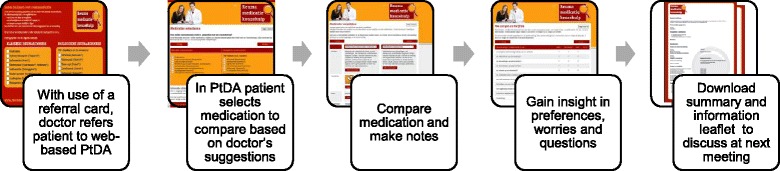
The combination of patient interviews with rapid prototyping revealed that patients wanted to compare multiple DMARDs both for their clinical aspects and implications for daily life. Health professionals mainly wanted to refer patients to a reliable, easily adjustable source of information about DMARDs. A web-based PtDA was constructed consisting of four parts: 1) general information about SDM, inflammatory arthritis and DMARDs; 2) an application to compare particular DMARDs; 3) value clarification exercises; and 4) a printed summary of patients' notes, preferences, worries and questions that they could bring to discuss with their rheumatologist.
The study demonstrated that UCD methods can be of great value for the development of PtDAs. The early, iterative involvement of patients and health professionals was helpful in developing a novel user-friendly PtDA that allowed patients to choose between DMARDs. The PtDA fits the values of all stakeholders and easily integrates with the patient pathway and daily workflow of health professionals. This collaborative designed PtDA may improve SDM and patient participation in arthritis care.
患者决策辅助工具(PtDAs)是患者中心护理的一个主要元素,有助于促进共同决策(SDM)。国际患者决策辅助工具标准(IPDAS)的最新更新强调了患者在PtDA开发过程中的参与,但未提供具体的方法。本文报告了以用户为中心的设计(UCD)方法在开发旨在支持炎性关节炎患者选择改善病情抗风湿药物(DMARDs)的PtDA中的价值。
应用IPDAS开发过程模型并结合UCD方法。该过程由一个八人多学科指导小组监督。对患者和卫生专业人员进行了反复咨询。对患者进行了定性深入访谈并结合快速原型制作,以评估他们对PtDA特定功能、内容和设计的需求。组织了与卫生专业人员的小组会议,以评估患者的需求并确定PtDA应如何融入患者就医流程。查阅了当前文献,以确定PtDA中应包含的临床证据。为了评估患者对PtDA的可用性,在患者边思考边出声使用PtDA时对其进行观察,然后进行访谈。
患者访谈与快速原型制作相结合表明,患者希望从临床方面和对日常生活的影响两方面比较多种DMARDs。卫生专业人员主要希望将患者引导至一个关于DMARDs可靠且易于调整的信息来源。构建了一个基于网络的PtDA,由四个部分组成:1)关于共同决策、炎性关节炎和DMARDs的一般信息;2)一个用于比较特定DMARDs的应用程序;3)价值澄清练习;4)一份患者记录、偏好、担忧和问题的打印摘要,患者可以携带该摘要与风湿病专家进行讨论。
该研究表明,UCD方法对PtDA的开发具有重要价值。患者和卫生专业人员的早期反复参与有助于开发一种新型的用户友好型PtDA,使患者能够在DMARDs之间进行选择。该PtDA符合所有利益相关者的价值观,并易于融入患者就医流程和卫生专业人员的日常工作流程。这种协作设计的PtDA可能会改善共同决策和患者在关节炎护理中的参与度。