Bister A, Ibach T, Haist C, Gerhorst G, Smorra D, Soldierer M, Roellecke K, Wagenmann M, Scheckenbach K, Gattermann N, Wiek C, Hanenberg H
Department of Pediatrics III, University Children's Hospital, University of Duisburg-Essen, Hufelandstr. 55, 45122 Essen, Germany.
Department of Otorhinolaryngology, Head & Neck Surgery, Heinrich Heine University, Düsseldorf, Germany.
Mol Ther Oncolytics. 2022 Jun 6;26:120-134. doi: 10.1016/j.omto.2022.05.012. eCollection 2022 Sep 15.
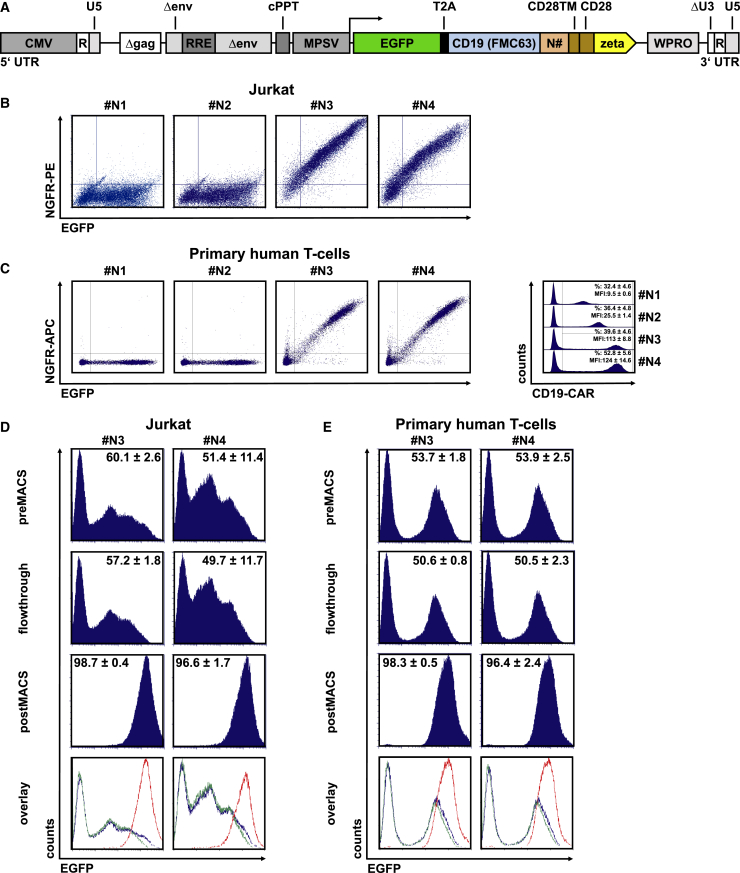
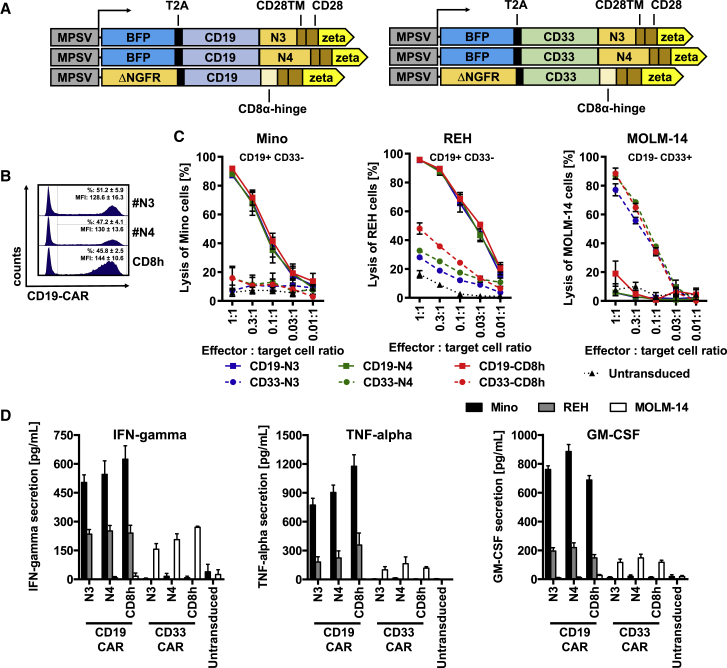
Chimeric antigen receptor (CAR) T cell therapy has demonstrated unprecedented success with high remission rates for heavily pretreated patients with hematological malignancies. The hinge connecting the extracellular antigen recognition unit to the transmembrane domain provides the length and flexibility of the CAR constructs and ensures that the CAR can reach the target antigen and mediate recognition and killing of target cells. The hinge can also include specific amino acid sequences to improve CAR expression, influence T cell proliferation, and facilitate CAR T cell detection, enrichment, and even elimination. Here, we report the generation of two novel hinge domains derived from the low-affinity p75 chain of the human nerve growth factor receptor (NGFR), termed N3 and N4, which, when incorporated into the CAR backbone, allow detection as well as high-grade enrichment of CAR T cells with GMP-compatible immunomagnetic reagents. After optimizing the MACS protocol for excellent CAR T cell purity and yield, we demonstrated that N3- and N4-hinged CAR T cells are as efficacious as their CD8-hinged counterparts against hematological blasts and also in the control of acute monocytic leukemia in an immunodeficient mouse xenograft model. Thus, both hinges could potentially be an integral part of future CAR designs and universally applicable in clinical applications.
嵌合抗原受体(CAR)T细胞疗法已取得了前所未有的成功,对于经过大量预处理的血液系统恶性肿瘤患者具有很高的缓解率。连接细胞外抗原识别单元与跨膜结构域的铰链区决定了CAR构建体的长度和灵活性,并确保CAR能够接触到靶抗原,介导对靶细胞的识别和杀伤。铰链区还可包含特定氨基酸序列,以提高CAR的表达、影响T细胞增殖,并便于CAR T细胞的检测、富集甚至清除。在此,我们报告了源自人神经生长因子受体(NGFR)低亲和力p75链的两个新型铰链区N3和N4的产生,当将它们整合到CAR骨架中时,可使用符合GMP标准的免疫磁珠试剂对CAR T细胞进行检测和高度富集。在优化了用于获得优异CAR T细胞纯度和产量的MACS方案后,我们证明,在免疫缺陷小鼠异种移植模型中,带有N3和N4铰链区的CAR T细胞在对抗血液母细胞以及控制急性单核细胞白血病方面与带有CD8铰链区的CAR T细胞同样有效。因此,这两种铰链区都有可能成为未来CAR设计的一个组成部分,并普遍适用于临床应用。