West China School of Medicine, Sichuan University, Chengdu, Sichuan, China.
Department of Rehabilitation Medicine Center, West China Hospital, Sichuan University, Sichuan, China.
Front Endocrinol (Lausanne). 2022 Jun 20;13:877794. doi: 10.3389/fendo.2022.877794. eCollection 2022.
The triglycerides to high-density lipoprotein cholesterol (TG/HDL-C) ratio is an easy-to-use atherogenic and prognostic marker which has attracted increasing attention these days. However, whether TG/HDL-C correlate with outcomes in IgA nephropathy (IgAN) patients remains unknown. To clarify these issues, we conducted this study.
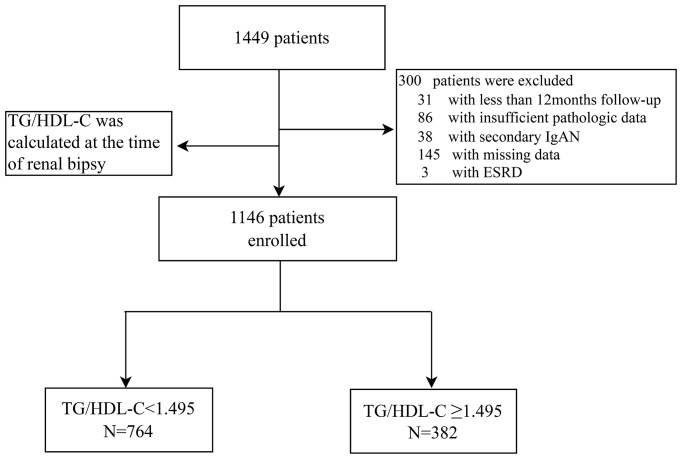
A total of 1146 patients from West China Hospital of Sichuan University were retrospectively analysed between 2008 and 2018.The demographic, clinical and pathological data of all patients at the time of biopsy were collected. Then, patients were divided into the high TG/HDL group (TG/HDL ≥ 1.495, N=382) and the low TG/HDL group (TG/HDL-C < 1.495, N=764) based on the optimal cut-off value of the TG/HDL-C using receive operating curve. Cox proportional hazard models and Kaplan-Meier curves were used to evaluate the renal outcomes of IgAN.
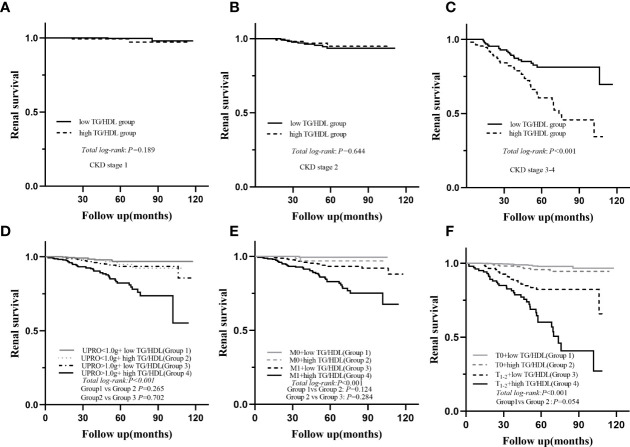
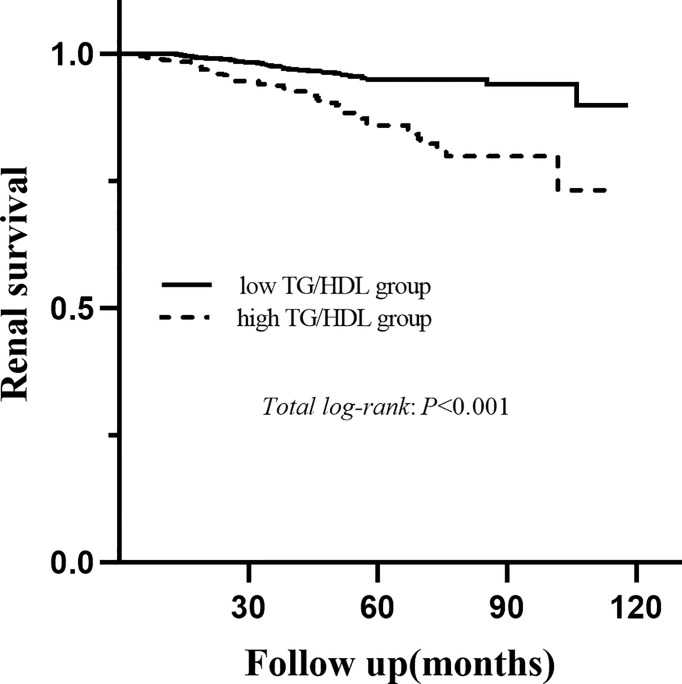
The median age of the patients was 33 (26-42) years, and 44.5% were men. By correlation analysis, we found that the TG/HDL-C ratio was negatively correlated with the eGFR (r = 0.250, < 0.001) but positively correlated with proteinuria (r = 0.230, < 0.001), BMI (r=0.380, P<0.001) and serum uric (r =0.308, < 0.001). Patients with a higher TG/HDL-C ratio tended to have hypertension [odds ratio (OR), 1.987; 95% CI, 1.527-2.587; <0.001] and more severe pathologic lesions with tubular atrophy/interstitial fibrosis (OR, 1.610; 95% CI, 1.203-2.154; =0.001). During a median follow-up period of 54.1 (35.6-73.2) months, a high TG/HDL ratio was strongly associated with worse renal survival in IgAN patients (log-rank: 0.001). Multivariate Cox analysis demonstrated that a high TG/HDL-C ratio (HR 1.775, 95% CI 1.056-2.798; =0.029) was an independent predictive marker to ESRD.
In this study, we addressed the importance of TG/HDL-C ratio as a predictive marker for IgAN progression.
甘油三酯与高密度脂蛋白胆固醇(TG/HDL-C)比值是一种易于使用的致动脉粥样硬化和预后标志物,近年来受到越来越多的关注。然而,TG/HDL-C 比值与 IgA 肾病(IgAN)患者的结局是否相关尚不清楚。为了阐明这些问题,我们进行了这项研究。
回顾性分析 2008 年至 2018 年期间来自四川大学华西医院的 1146 例患者。收集所有患者在活检时的人口统计学、临床和病理数据。然后,根据 TG/HDL-C 的最佳截断值,使用接收者工作特征曲线将患者分为高 TG/HDL 组(TG/HDL≥1.495,N=382)和低 TG/HDL 组(TG/HDL-C<1.495,N=764)。Cox 比例风险模型和 Kaplan-Meier 曲线用于评估 IgAN 的肾脏结局。
患者的中位年龄为 33(26-42)岁,44.5%为男性。通过相关性分析,我们发现 TG/HDL-C 比值与 eGFR 呈负相关(r=0.250,<0.001),但与蛋白尿(r=0.230,<0.001)、BMI(r=0.380,P<0.001)和血清尿酸(r=0.308,<0.001)呈正相关。TG/HDL-C 比值较高的患者往往有高血压[比值比(OR),1.987;95%置信区间(CI),1.527-2.587;<0.001]和更严重的病理损伤,包括肾小管萎缩/间质纤维化(OR,1.610;95%CI,1.203-2.154;=0.001)。在中位随访 54.1(35.6-73.2)个月期间,高 TG/HDL 比值与 IgAN 患者的肾脏预后不良密切相关(对数秩检验:0.001)。多变量 Cox 分析表明,高 TG/HDL-C 比值(HR 1.775,95%CI 1.056-2.798;=0.029)是预测 IgAN 进展为终末期肾病的独立标志物。
本研究探讨了 TG/HDL-C 比值作为 IgAN 进展预测标志物的重要性。