Shi Ke, Bi Yufei, Wang Xiaojing, Li Yanqiu, Zeng Xuanwei, Feng Ying, Wang Xianbo
Center of Integrative Medicine, Beijing Ditan Hospital, Capital Medical University, Beijing 100015, China.
Biomedicines. 2024 Aug 6;12(8):1783. doi: 10.3390/biomedicines12081783.
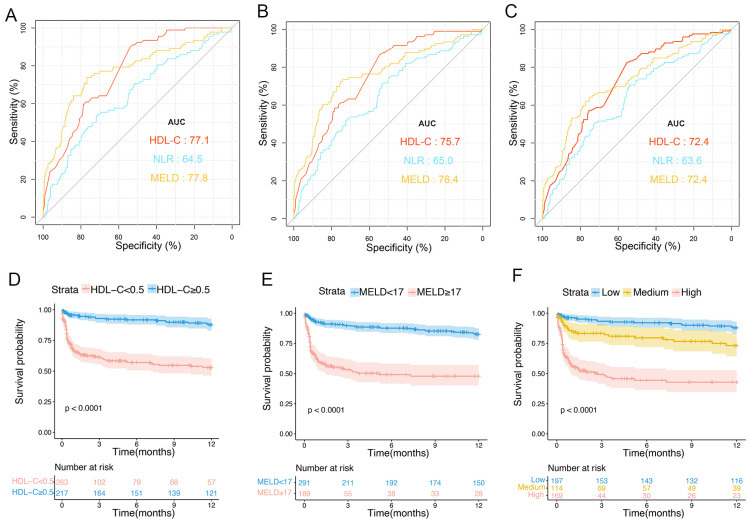
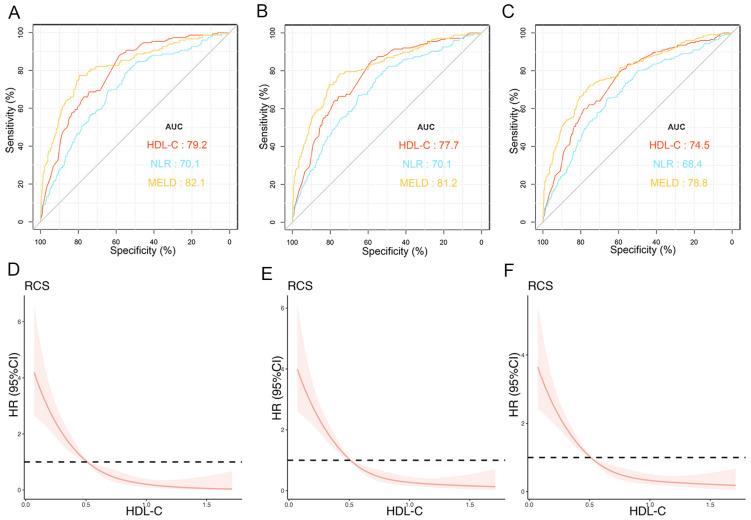
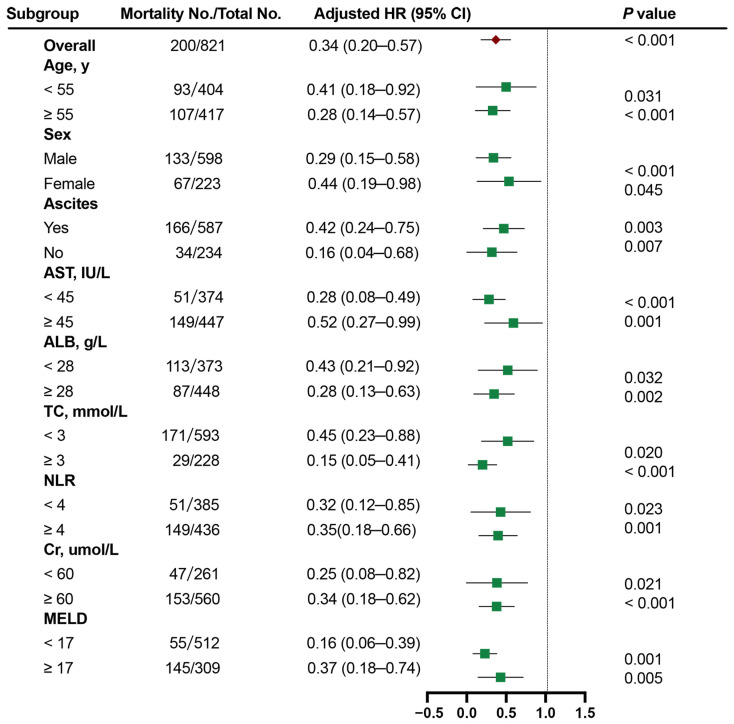
Overt hepatic encephalopathy (OHE), a serious complication of liver cirrhosis, is associated with alterations in lipid and lipoprotein metabolism. We evaluated the correlation between high-density lipoprotein cholesterol (HDL-C) levels and transplant-free (TF) mortality in patients with OHE. Patients with OHE admitted to Beijing Ditan Hospital between January 2010 and August 2016 (n = 821) and between September 2016 and December 2020 (n = 480) were included in the training and validation sets, respectively. Independent predictors were explored by a multivariate Cox regression analysis, and the area under the receiver operating characteristic curve (AUC) was used to assess the prognostic value of these factors. The prognostic value of HDL-C was good (AUC at 1 year: 0.745) and was equivalent to that of the Model for End-Stage Liver Disease (MELD) score (AUC at 1 year: 0.788). The optimal threshold values for HDL-C and MELD were 0.5 mmol/L and 17, respectively. The 1-year TF mortality rates in the low-risk (HDL-C ≥ 0.5 mmol/L and MELD < 17) and high-risk (HDL-C < 0.5 mmol/L and MELD ≥ 17) groups were 7.5% and 51.5% in the training set and 10.1% and 48.2% in the validation set, respectively. HDL-C level < 0.5 mmol/L and MELD score > 17 can facilitate the identification of high-risk patients and provide a basis for timely treatment.
显性肝性脑病(OHE)是肝硬化的一种严重并发症,与脂质和脂蛋白代谢改变有关。我们评估了显性肝性脑病患者高密度脂蛋白胆固醇(HDL-C)水平与无移植(TF)死亡率之间的相关性。分别将2010年1月至2016年8月期间(n = 821)和2016年9月至2020年12月期间(n = 480)入住北京地坛医院的显性肝性脑病患者纳入训练集和验证集。通过多因素Cox回归分析探索独立预测因素,并使用受试者工作特征曲线下面积(AUC)评估这些因素的预后价值。HDL-C的预后价值良好(1年时AUC:0.745),与终末期肝病模型(MELD)评分的预后价值相当(1年时AUC:0.788)。HDL-C和MELD的最佳阈值分别为0.5 mmol/L和17。训练集中低风险(HDL-C≥0.5 mmol/L且MELD < 17)和高风险(HDL-C < 0.5 mmol/L且MELD≥17)组的1年无移植死亡率分别为7.5%和51.5%,验证集中分别为10.1%和48.2%。HDL-C水平< 0.5 mmol/L且MELD评分> 17有助于识别高风险患者,并为及时治疗提供依据。