Lintao Ryan C V, Cando Leslie Faye T, Perias Glenmarie Angelica S, Tantengco Ourlad Alzeus G, Tabios Ian Kim B, Velayo Clarissa L, de Paz-Silava Sheriah Laine M
Multi-Omics Research Program for Health, College of Medicine, University of the Philippines Manila, Manila, Philippines.
Institute of Biology, College of Science, University of the Philippines Diliman, Quezon City, Philippines.
Front Med (Lausanne). 2022 Jun 20;9:929062. doi: 10.3389/fmed.2022.929062. eCollection 2022.
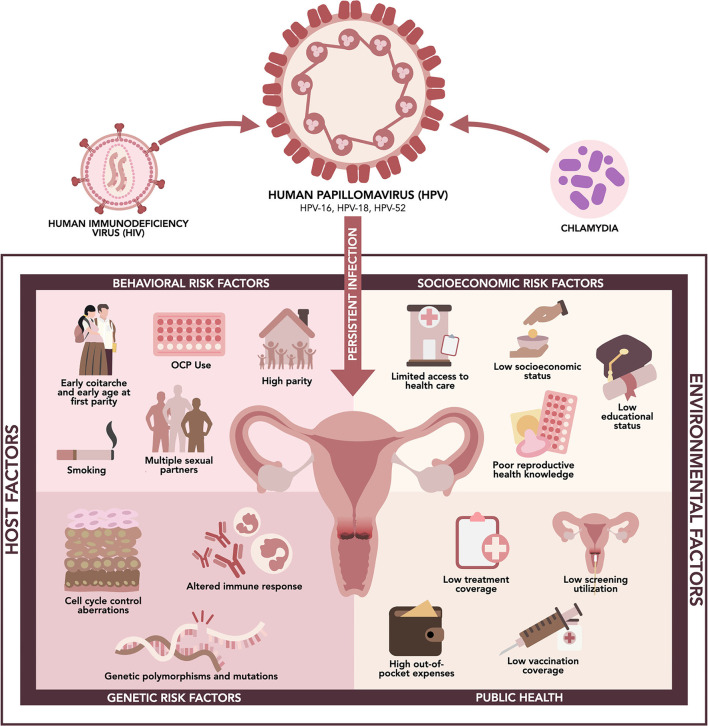
Cervical cancer is estimated to cause 341,831 deaths each year, with 9 of 10 deaths occurring in developing countries. Over the past decade, there has been a significant increase in cervical cancer incidence among women in the Philippines. Persistent infection with high-risk human papillomavirus (HPV) is the well-established necessary cause of cervical cancer. Based on limited studies conducted in the Philippines, the prevalence of infection with any HPV genotype was 93.8% for cervical squamous cell carcinoma and 90.9% for cervical adenocarcinomas. HPV types 16 and 18 were the most common HPV genotypes among Filipino patients with cervical cancer. On the other hand, the incidence of HPV infection among Filipino women with normal cervices was 9.2%. The World Health Organization has launched a global agenda of eliminating HPV infection by 2030. One of its key milestones is to vaccinate 90% of girls with the HPV vaccine by 15 years. However, the HPV vaccination rate among Filipino women remains to be unsatisfactory. HPV vaccination has only been included in the Philippine Department of Health's community-based National Immunization Program in 2015. Despite these efforts, the Philippines currently ranks last on HPV program coverage among low-middle income countries, with coverage of only 23% of the target female population for the first dose and 5% for the final dose. The principal reason for the non-acceptance of HPV vaccines was the perceived high cost of vaccination. The low utilization of available cervical cancer screening tests such as Pap smear and visual inspection with acetic acid hampered the Philippines' control and prevention of HPV infection and cervical cancer. Among those diagnosed with cervical cancer in the Philippines, only an estimated 50% to 60% receive some form of treatment. To this end, we summarize the burden of HPV infection and cervical cancer on Filipinos and the risk factors associated with the disease. We present the current screening, diagnostics, treatment, and prevention of HPV-related diseases in the Philippines. Lastly, we also propose solutions on how each building block in health systems can be improved to eliminate HPV infection and reduce the burden of cervical cancer in the Philippines.
据估计,宫颈癌每年导致341,831人死亡,其中十分之九的死亡发生在发展中国家。在过去十年中,菲律宾女性宫颈癌发病率显著上升。持续感染高危型人乳头瘤病毒(HPV)是已明确的宫颈癌必要病因。根据在菲律宾进行的有限研究,宫颈鳞状细胞癌中任何HPV基因型的感染率为93.8%,宫颈腺癌为90.9%。HPV 16型和18型是菲律宾宫颈癌患者中最常见的HPV基因型。另一方面,宫颈正常的菲律宾女性中HPV感染率为9.2%。世界卫生组织发起了到2030年消除HPV感染的全球议程。其关键里程碑之一是到15岁时为90%的女孩接种HPV疫苗。然而,菲律宾女性的HPV疫苗接种率仍不尽人意。HPV疫苗接种直到2015年才被纳入菲律宾卫生部基于社区的国家免疫规划。尽管做出了这些努力,菲律宾目前在中低收入国家的HPV项目覆盖方面排名垫底,第一剂疫苗的覆盖率仅为目标女性人口的23%,最后一剂为5%。不接受HPV疫苗的主要原因是认为疫苗接种成本高昂。可用的宫颈癌筛查测试如巴氏涂片和醋酸目视检查的低利用率阻碍了菲律宾对HPV感染和宫颈癌的控制与预防。在菲律宾被诊断为宫颈癌的患者中,估计只有50%至60%接受某种形式的治疗。为此,我们总结了HPV感染和宫颈癌对菲律宾人的负担以及与该疾病相关的风险因素。我们介绍了菲律宾目前对HPV相关疾病的筛查、诊断、治疗和预防情况。最后,我们还就如何改进卫生系统的各个组成部分以消除HPV感染和减轻菲律宾宫颈癌负担提出了解决方案。