Health Lit Res Pract. 2022 Apr;6(2):e104-e112. doi: 10.3928/24748307-20220419-01. Epub 2022 May 6.
Health literacy (HL) is the ability to access, understand, appraise, and apply health information across the three domains of the health continuum: health care, disease prevention, and health promotion. It is needed for people to effectively manage their health. Information on population HL level is useful for crafting appropriate and targeted interventions to improve HL.
The aim of this study was to describe the HL level of Filipino people at the national and subnational levels.
A cross-sectional survey was conducted between 2018 and 2019 with 2,303 randomly selected Filipino people age 15 to 70 years, using an adapted Asia version of the European Health Literacy Survey Questionnaire-47. Prevalence estimates for limited HL and the corresponding 95% confidence interval (CI) were computed at the national and subnational levels.
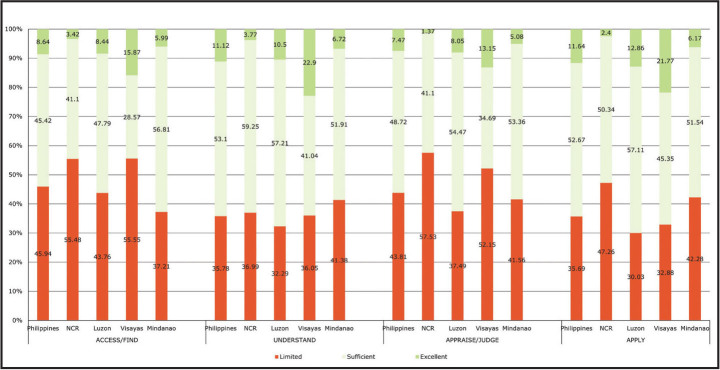
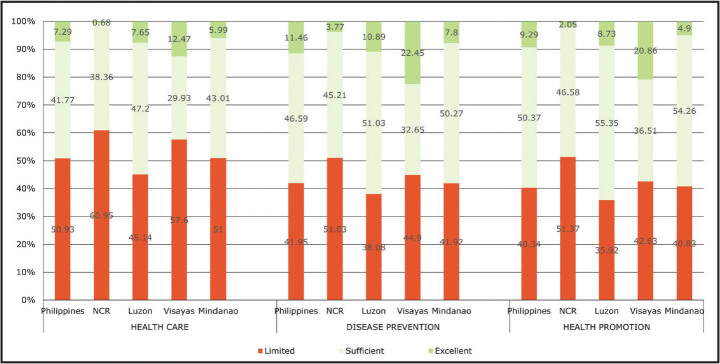
The nationwide prevalence of limited HL was 51.5% (95% CI, [49.5%, 53.6%]), while sub-national prevalence estimates ranged from 48.2% to 65.4%. The prevalence varied across HL dimensions, with difficulty in access to information having the highest level. Similarly, prevalence across domains was variable; health care-related HL had the highest prevalence of limited HL. The HL levels for different dimensions and domains also varied across subnational groups.
Many Filipino people had limited HL, and prevalence estimates varied across HL dimensions, HL domains, subnational groupings, and sociodemographic characteristics. The results highlight the need for targeted interventions focusing on subgroups with limited HL and on dimensions and domains where Filipino people have limited HL. Plain Language Summary: The National Health Literacy Survey is the first nationwide survey on the prevalence of HL in the Philippines, involving 2,303 randomly selected Filipino residents age 15 to 70 years. Many Filipino people have limited HL, and the prevalence of HL varies across the components of HL, subnational groupings, and sociodemographic characteristics, highlighting the need for targeted interventions.
健康素养(HL)是指在医疗保健、疾病预防和健康促进这三个健康连续体领域获取、理解、评估和应用健康信息的能力。人们需要有效地管理自己的健康。了解人口 HL 水平有助于制定适当和有针对性的干预措施,以提高 HL。
本研究旨在描述菲律宾人在国家和次国家层面的 HL 水平。
2018 年至 2019 年期间,使用经过改编的亚洲版欧洲健康素养调查问卷-47,对 2303 名年龄在 15 至 70 岁之间的随机菲律宾人进行了横断面调查。在国家和次国家层面计算了有限 HL 的流行率估计值及其相应的 95%置信区间(CI)。
全国范围内有限 HL 的流行率为 51.5%(95%CI,[49.5%,53.6%]),而次国家流行率估计值范围为 48.2%至 65.4%。HL 维度之间的流行率存在差异,信息获取困难的程度最高。同样,各领域的流行率也各不相同;与医疗保健相关的 HL 具有最高的有限 HL 流行率。不同维度和领域的 HL 水平也因次国家群体而异。
许多菲律宾人 HL 有限,流行率估计值因 HL 维度、HL 领域、次国家分组和社会人口特征而异。结果强调了针对 HL 有限的亚组以及菲律宾人 HL 有限的维度和领域实施有针对性干预措施的必要性。