Zhao Min, Qi Qin, Liu Shimin, Huang Rong, Shen Jiacheng, Zhu Yi, Chai Jing, Zheng Handan, Wu Huangan, Liu Huirong
Department of Acupuncture-Moxibustion, LongHua Hospital Shanghai University of Traditional Chinese Medicine, Shanghai University of Traditional Chinese Medicine, Shanghai, China.
Key Laboratory of Acupuncture and Immunological Effects, Shanghai University of Traditional Chinese Medicine, Shanghai, China.
Front Physiol. 2022 Jun 20;13:895242. doi: 10.3389/fphys.2022.895242. eCollection 2022.
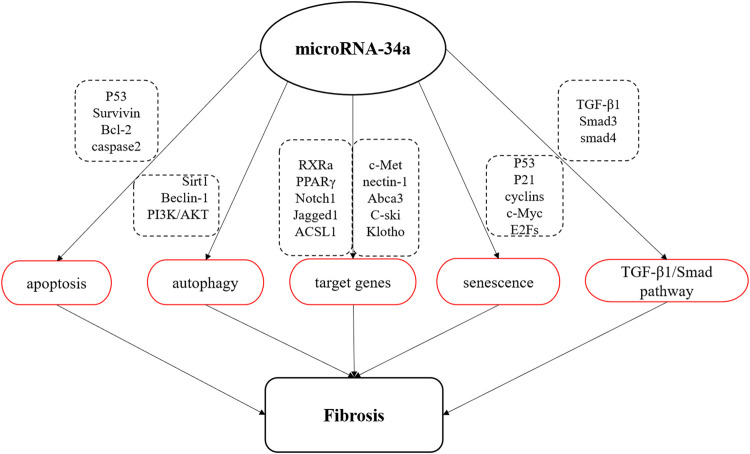
Fibrosis can occur in many organs, and severe cases leading to organ failure and death. No specific treatment for fibrosis so far. In recent years, microRNA-34a (miR-34a) has been found to play a role in fibrotic diseases. MiR-34a is involved in the apoptosis, autophagy and cellular senescence, also regulates TGF-β1/Smad signal pathway, and negatively regulates the expression of multiple target genes to affect the deposition of extracellular matrix and regulate the process of fibrosis. Some studies have explored the efficacy of miR-34a-targeted therapies for fibrotic diseases. Therefore, miR-34a has specific potential for the treatment of fibrosis. This article reviews the important roles of miR-34a in fibrosis and provides the possibility for miR-34a as a novel therapeutic target in fibrosis.
纤维化可发生于许多器官,严重时会导致器官衰竭和死亡。目前尚无针对纤维化的特效治疗方法。近年来,发现微小RNA-34a(miR-34a)在纤维化疾病中发挥作用。miR-34a参与细胞凋亡、自噬和细胞衰老,还调节TGF-β1/Smad信号通路,并负向调节多个靶基因的表达,从而影响细胞外基质的沉积并调控纤维化进程。一些研究已探索了针对纤维化疾病的miR-34a靶向治疗的疗效。因此,miR-34a在纤维化治疗方面具有特定潜力。本文综述了miR-34a在纤维化中的重要作用,并为其作为纤维化的新型治疗靶点提供了可能性。