Department of Orthopaedics, Xiangya Hospital, Central South University, Changsha, China.
Department of Medicine, University of Auckland, Auckland, New Zealand.
Semin Arthritis Rheum. 2022 Oct;56:152059. doi: 10.1016/j.semarthrit.2022.152059. Epub 2022 Jun 28.
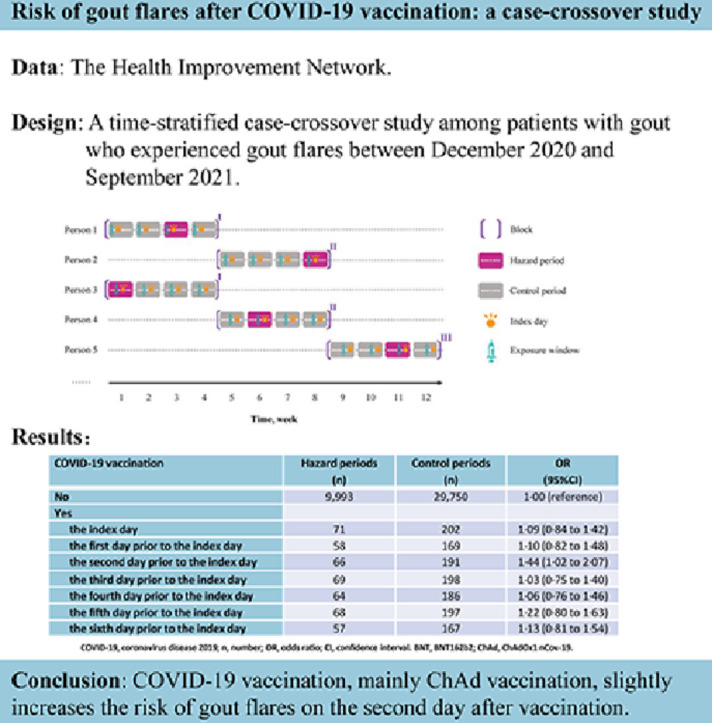
Routine vaccinations are associated with an increased risk of gout flares. We examined the association between COVID-19 vaccination, an immunization program implemented to a large proportion of population, and the risk of gout flares.
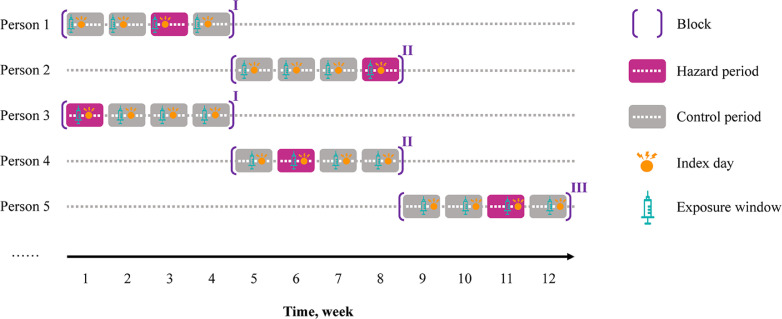
We conducted a time-stratified case-crossover study among patients with gout who experienced gout flares between December 2020 and September 2021, using data from The Health Improvement Network. We compared the risk of gout flares on each of the seven days on and after the day of COVID-19 vaccination vs. no vaccination during that period using conditional logistic regression. In addition, we performed subgroup analyses stratified by different COVID-19 vaccines (i.e., BNT162b2, hereafter referred to as BNT, and ChAdOx1 nCov-19, hereafter referred to as ChAd).
Among 5,904 patients with gout (mean age: 63·1 years; 85·5% male) who experienced gout flares within one month, the risk of gout flares slightly increased on the second day after COVID-19 vaccination (odds ratio: 1·44; 95% CI: 1·02 to 2·07). The risk of gout flares also slightly increased after receiving COVID-19 vaccine on other remaining days (ORs ranged from 1·03 to 1·22); however, none of them was statistically significant. An increased risk of gout flares on the second day after vaccination was mainly observed for the ChAd vaccine (odds ratio: 1·44; 95% CI: 1·00 to 2·05), but not for BNT vaccine (odds ratio: 1·18; 95% CI: 0·67 to 2·02).
COVID-19 vaccination, mainly ChAd vaccination, slightly increases the risk of gout flares on the second day after vaccination. This finding reassures the safety of COVID-19 vaccination for patients with gout.
常规疫苗接种与痛风发作风险增加有关。我们研究了 COVID-19 疫苗接种(一种针对很大一部分人群实施的免疫计划)与痛风发作风险之间的关系。
我们在 2020 年 12 月至 2021 年 9 月期间,利用 The Health Improvement Network 的数据,对经历痛风发作的痛风患者进行了时间分层病例交叉研究。我们使用条件逻辑回归比较了在接种 COVID-19 疫苗的当天及其后七天内与那段时间未接种疫苗的情况下,痛风发作的风险。此外,我们还根据不同的 COVID-19 疫苗(即 BNT162b2,简称 BNT,和 ChAdOx1 nCov-19,简称 ChAd)进行了亚组分析。
在 5904 名痛风发作(平均年龄:63.1 岁;85.5%为男性)的患者中,有 1 个月内有 5904 名患者经历了痛风发作,在接种 COVID-19 疫苗后的第二天,痛风发作的风险略有增加(优势比:1.44;95%可信区间:1.02 至 2.07)。在接种 COVID-19 疫苗的其他剩余几天,痛风发作的风险也略有增加(OR 范围为 1.03 至 1.22);然而,这些结果均无统计学意义。在接种疫苗后的第二天,痛风发作风险增加主要见于 ChAd 疫苗(优势比:1.44;95%可信区间:1.00 至 2.05),但不适用于 BNT 疫苗(优势比:1.18;95%可信区间:0.67 至 2.02)。
COVID-19 疫苗接种,主要是 ChAd 疫苗接种,在接种后的第二天略微增加了痛风发作的风险。这一发现使痛风患者对 COVID-19 疫苗接种的安全性感到安心。