Liu Chi-Hung, Lin Yu-Sheng, Sung Pi-Shan, Wei Yi-Chia, Chang Ting-Yu, Lee Tsong-Hai, Lee Ching-Yu, Li Yan-Rong
Stroke Center and Department of Neurology, Linkou Chang Gung Memorial Hospital, Taoyuan 333, Taiwan.
College of Medicine, Chang Gung University, Taoyuan 333, Taiwan.
J Pers Med. 2021 Sep 19;11(9):935. doi: 10.3390/jpm11090935.
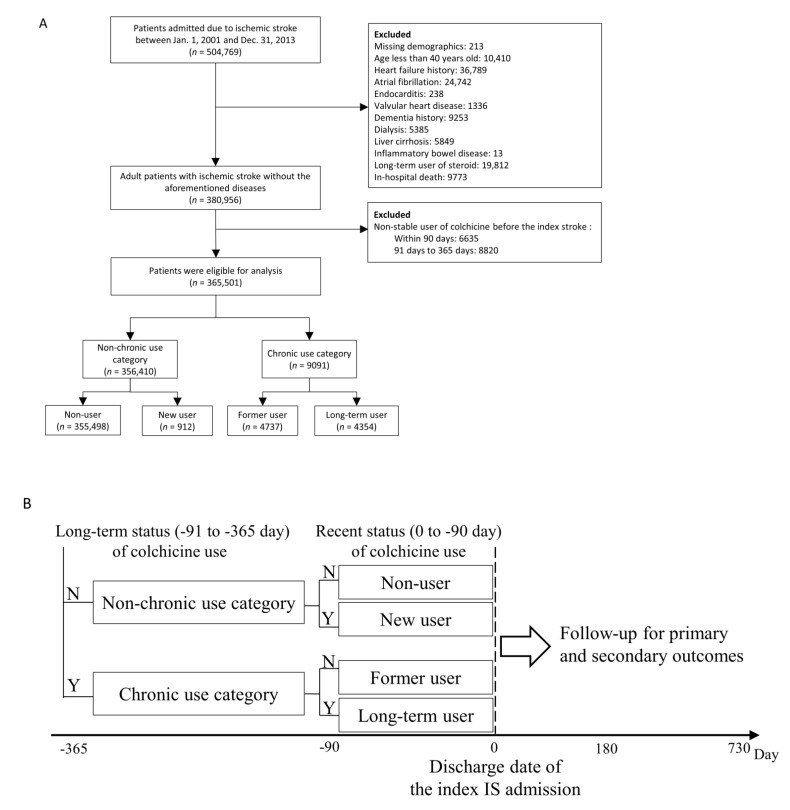
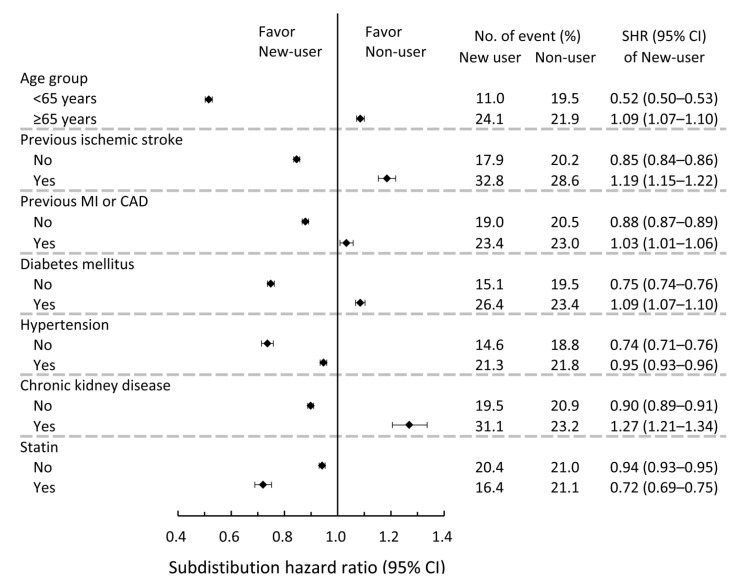
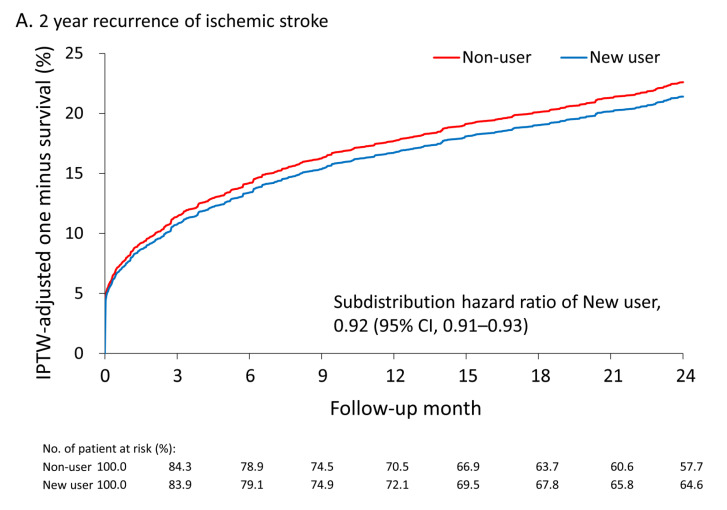
The objective is to study whether the cardiovascular protective effects of colchicines could be applied to non-cardiogenic ischemic stroke (IS) patients. Non-cardiogenic IS patients were identified from the National Health Insurance Research Database. Eligible patients were divided into chronic and non-chronic use categories based on their long-term status of colchicine use. The non-chronic use category was subdivided into (1) non-user and (2) new user groups while the chronic use category was divided into (3) former user and (4) long-term user groups according to the patient's recent status of colchicine use. Inverse probability of treatment weights for propensity scores was used to balance the baseline characteristics. The primary outcome was recurrent IS, which was compared within the non-chronic use and chronic use categories. In the non-chronic use category, the number of patients was 355,498 and 912 in the non-user and new user groups, respectively. In the chronic use category, the number of patients was 4737 and 4354 in the former user and long-term user groups, respectively. In the non-chronic use category, patients in the new user group had a marginally lower risk of recurrent IS at 6-months (subdistribution hazard ratio [SHR], 0.95; 95% confidence interval [CI], 0.94-0.97) and 2-years (SHR, 0.92; 95% CI, 0.91-0.93) follow up. In the chronic use category, patients in the long-term user group also had a marginally lower risk of recurrent IS at 6-months (SHR, 0.87; 95% CI, 0.86-0.88) and 2-years (SHR, 0.87; 95% CI, 0.86-0.88) follow up. The effect of colchicine on the reduced risk of recurrent IS was more favorable in patients who also used statins. Recent colchicine use in acute non-cardiogenic IS patients is associated with marginal fewer incidences of recurrent IS. Patients with concurrent statin use may have more profound protective effects.
目的是研究秋水仙碱的心血管保护作用是否可应用于非心源性缺血性卒中(IS)患者。从国民健康保险研究数据库中识别出非心源性IS患者。符合条件的患者根据其秋水仙碱的长期使用状况分为长期使用和非长期使用类别。非长期使用类别再细分为(1)未使用者和(2)新使用者组,而长期使用类别则根据患者最近的秋水仙碱使用状况分为(3)既往使用者和(4)长期使用者组。使用倾向评分的治疗权重逆概率来平衡基线特征。主要结局是复发性IS,在非长期使用和长期使用类别中进行比较。在非长期使用类别中,未使用者组和新使用者组的患者人数分别为355,498人和912人。在长期使用类别中,既往使用者组和长期使用者组的患者人数分别为4737人和4354人。在非长期使用类别中,新使用者组患者在6个月(亚分布风险比[SHR],0.95;95%置信区间[CI],0.94 - 0.97)和2年(SHR,0.92;95%CI,0.91 - 0.93)随访时复发性IS的风险略低。在长期使用类别中,长期使用者组患者在6个月(SHR,0.87;95%CI,0.86 - 0.88)和2年(SHR,0.87;95%CI,0.86 - 0.88)随访时复发性IS的风险也略低。秋水仙碱对降低复发性IS风险的作用在同时使用他汀类药物的患者中更有利。近期在急性非心源性IS患者中使用秋水仙碱与复发性IS的发生率略低相关。同时使用他汀类药物的患者可能具有更显著的保护作用。