Department of Pediatrics, University of California San Diego, La Jolla, CA, USA.
Department of Immunology and Microbiology, The Scripps Research Institute, La Jolla, CA, USA.
Nature. 2022 Sep;609(7925):101-108. doi: 10.1038/s41586-022-05049-6. Epub 2022 Jul 7.
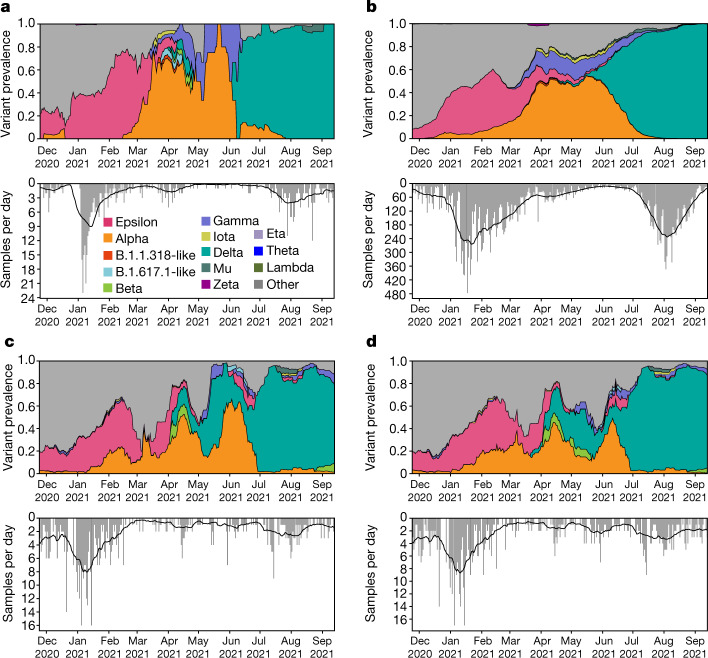
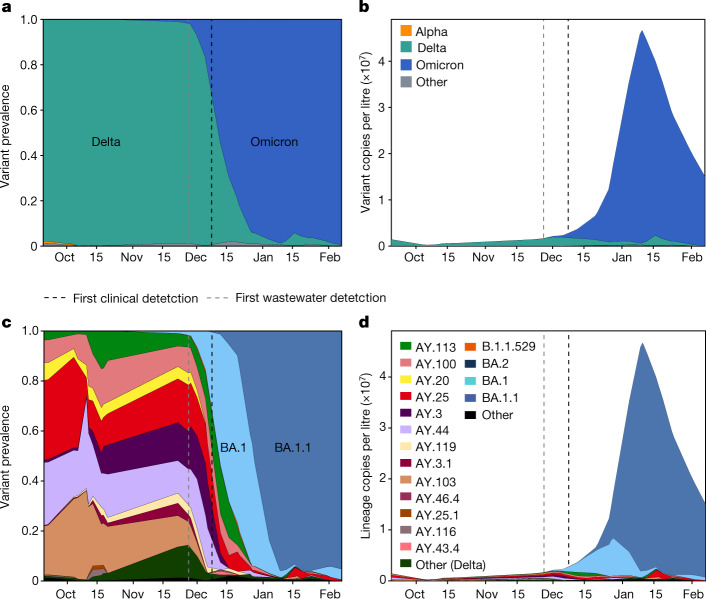
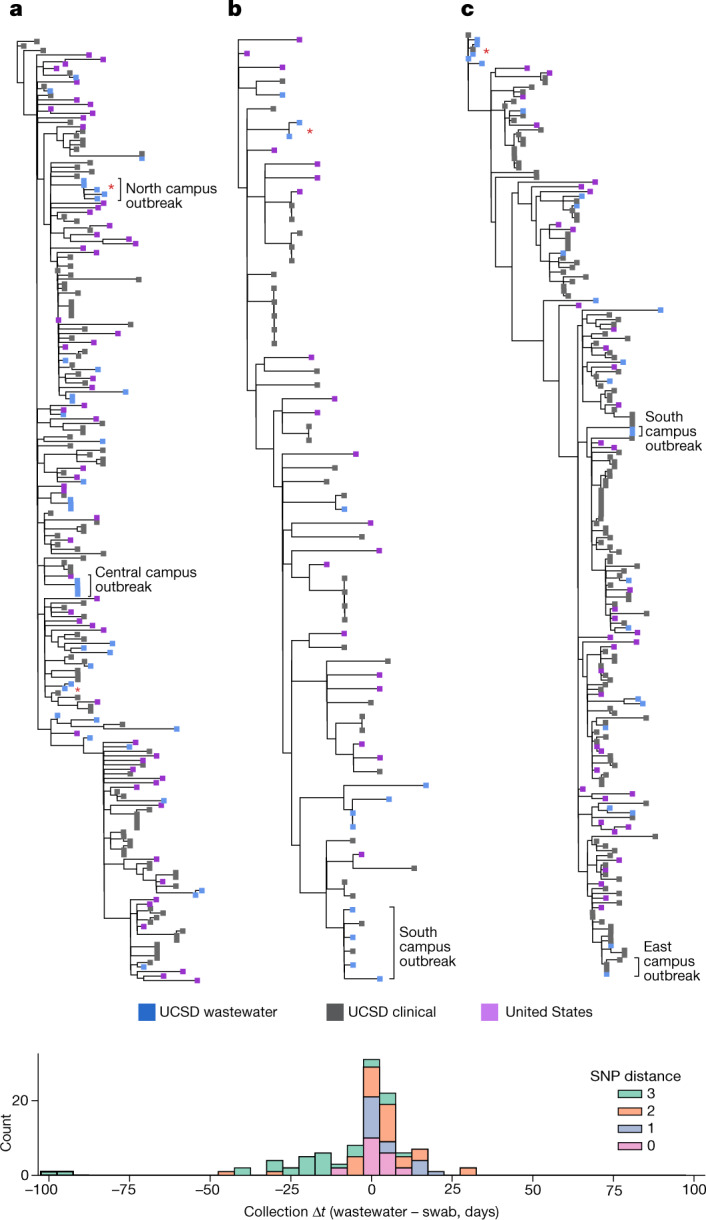
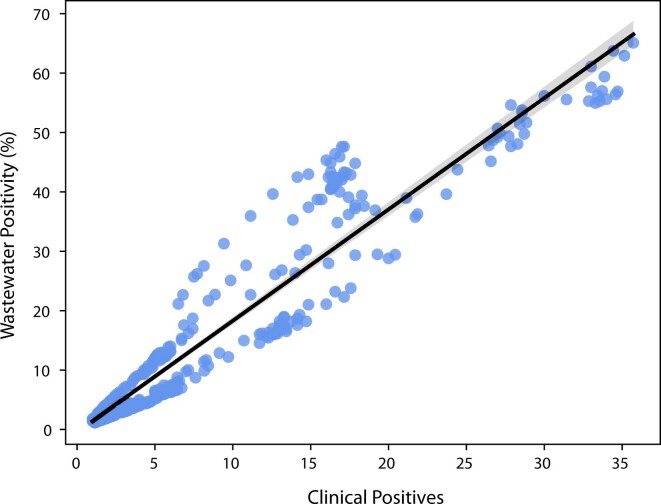
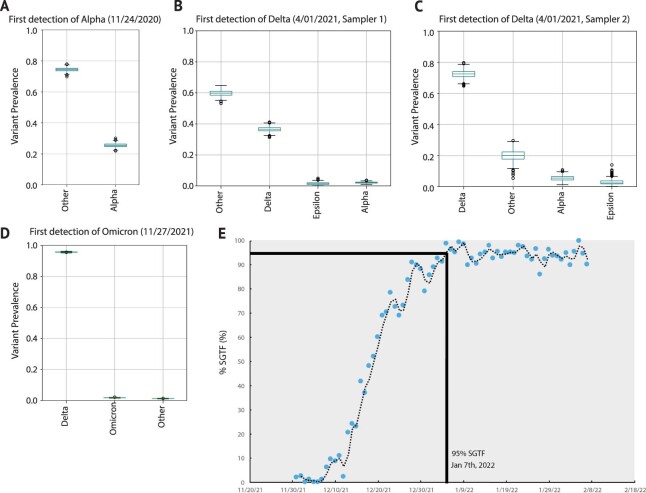
As SARS-CoV-2 continues to spread and evolve, detecting emerging variants early is critical for public health interventions. Inferring lineage prevalence by clinical testing is infeasible at scale, especially in areas with limited resources, participation, or testing and/or sequencing capacity, which can also introduce biases. SARS-CoV-2 RNA concentration in wastewater successfully tracks regional infection dynamics and provides less biased abundance estimates than clinical testing. Tracking virus genomic sequences in wastewater would improve community prevalence estimates and detect emerging variants. However, two factors limit wastewater-based genomic surveillance: low-quality sequence data and inability to estimate relative lineage abundance in mixed samples. Here we resolve these critical issues to perform a high-resolution, 295-day wastewater and clinical sequencing effort, in the controlled environment of a large university campus and the broader context of the surrounding county. We developed and deployed improved virus concentration protocols and deconvolution software that fully resolve multiple virus strains from wastewater. We detected emerging variants of concern up to 14 days earlier in wastewater samples, and identified multiple instances of virus spread not captured by clinical genomic surveillance. Our study provides a scalable solution for wastewater genomic surveillance that allows early detection of SARS-CoV-2 variants and identification of cryptic transmission.
随着 SARS-CoV-2 的持续传播和演变,早期发现新出现的变异体对于公共卫生干预至关重要。通过临床检测推断谱系流行率在大规模上是不可行的,特别是在资源有限、参与度低或检测和/或测序能力有限的地区,这也可能引入偏差。废水中的 SARS-CoV-2 RNA 浓度成功地跟踪了区域感染动态,并提供了比临床检测更少偏差的丰度估计。跟踪废水中的病毒基因组序列可以提高社区流行率估计,并检测新出现的变异体。然而,有两个因素限制了基于废水的基因组监测:低质量的序列数据和无法估计混合样本中相对谱系丰度。在这里,我们解决了这些关键问题,在一个大型大学校园的受控环境中和周边县的更广泛背景下,进行了为期 295 天的高分辨率废水和临床测序工作。我们开发并部署了改进的病毒浓缩方案和去卷积软件,可以从废水中完全解析出多种病毒株。我们在废水样本中提前 14 天检测到了令人关注的新出现变异体,并发现了临床基因组监测未捕捉到的多个病毒传播实例。我们的研究为废水基因组监测提供了一种可扩展的解决方案,允许早期检测 SARS-CoV-2 变异体并识别隐匿传播。