Computational Neuroscience and Cognitive Robotics Centre, University of Birmingham, Birmingham, UK.
MRC Cognition and Brain Sciences Unit, University of Cambridge, Cambridge, UK.
Nat Commun. 2022 Jul 7;13(1):3924. doi: 10.1038/s41467-022-31549-0.
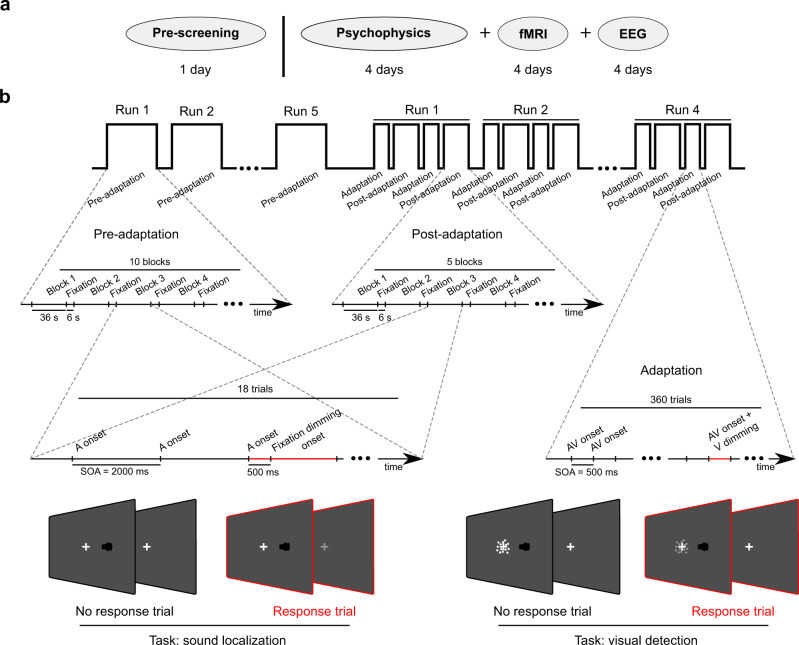
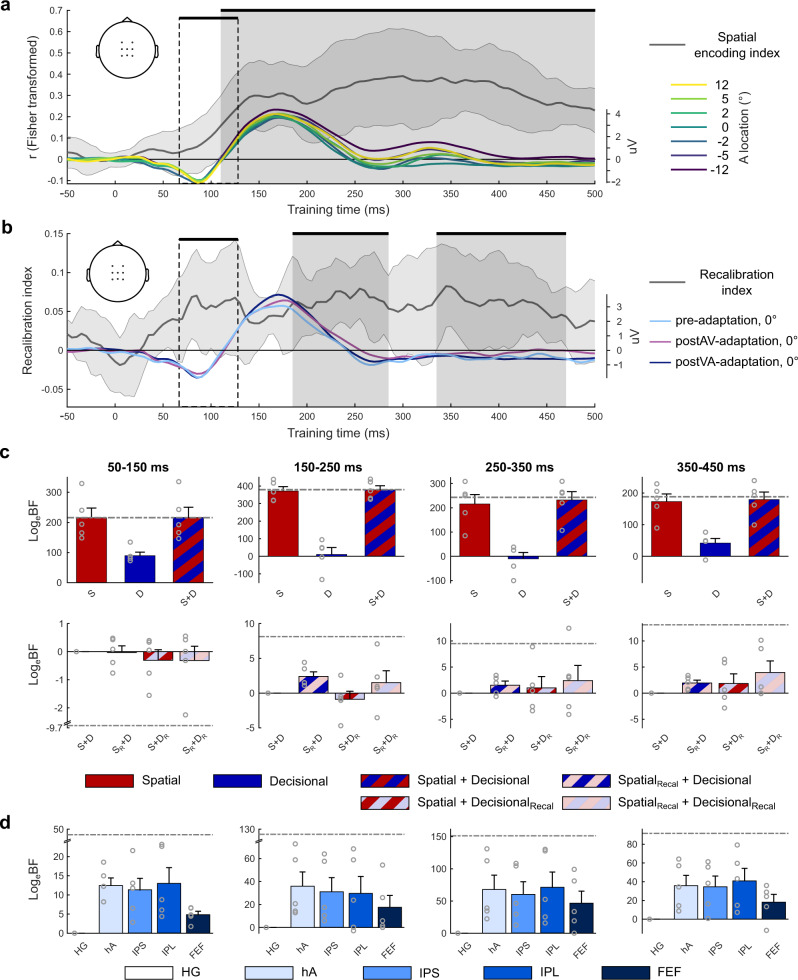
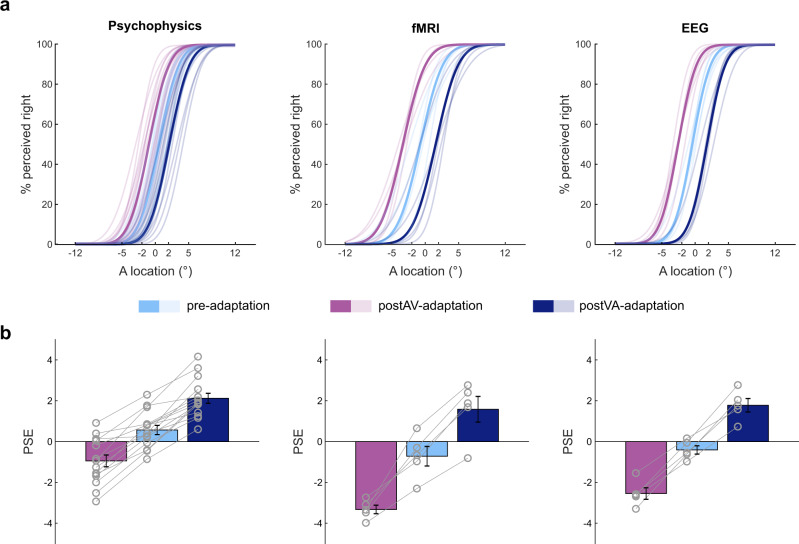
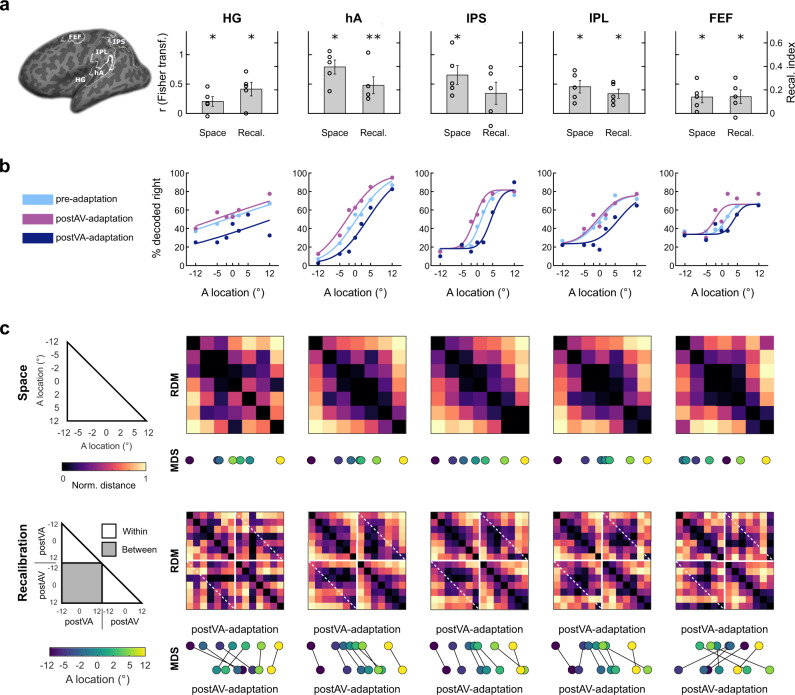
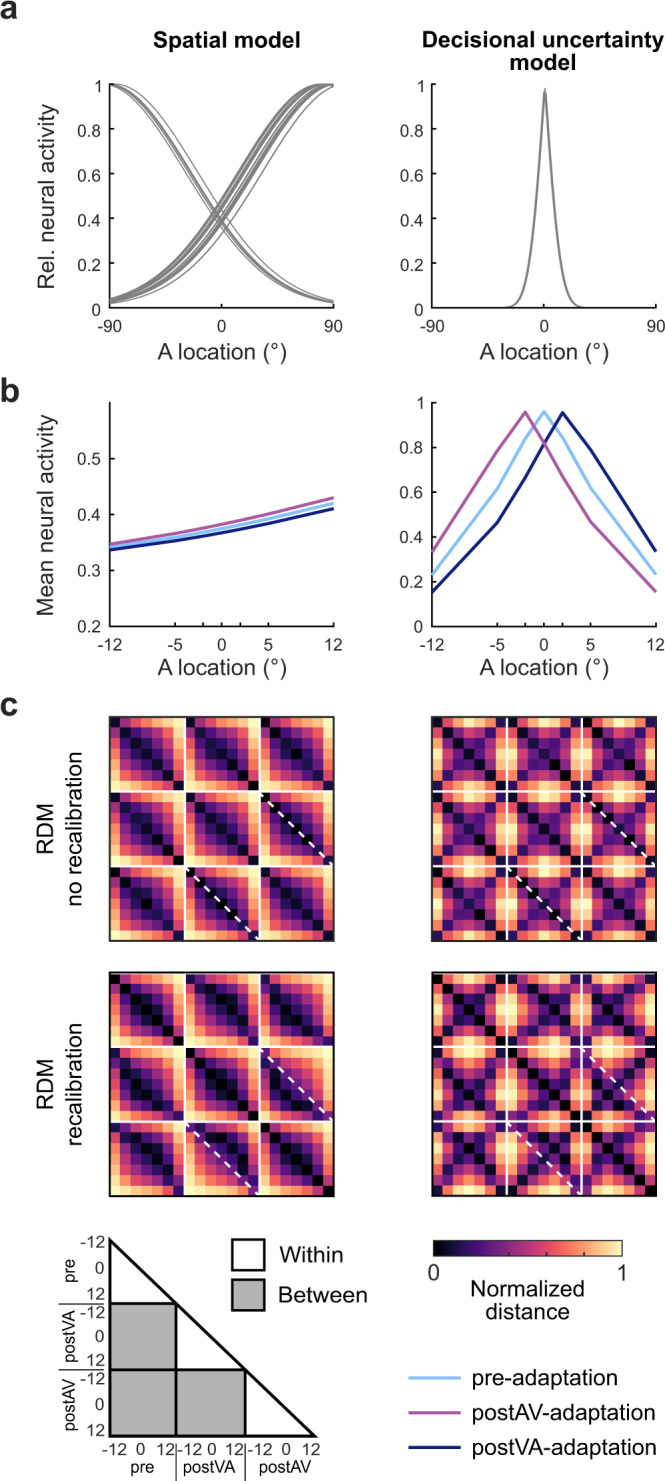
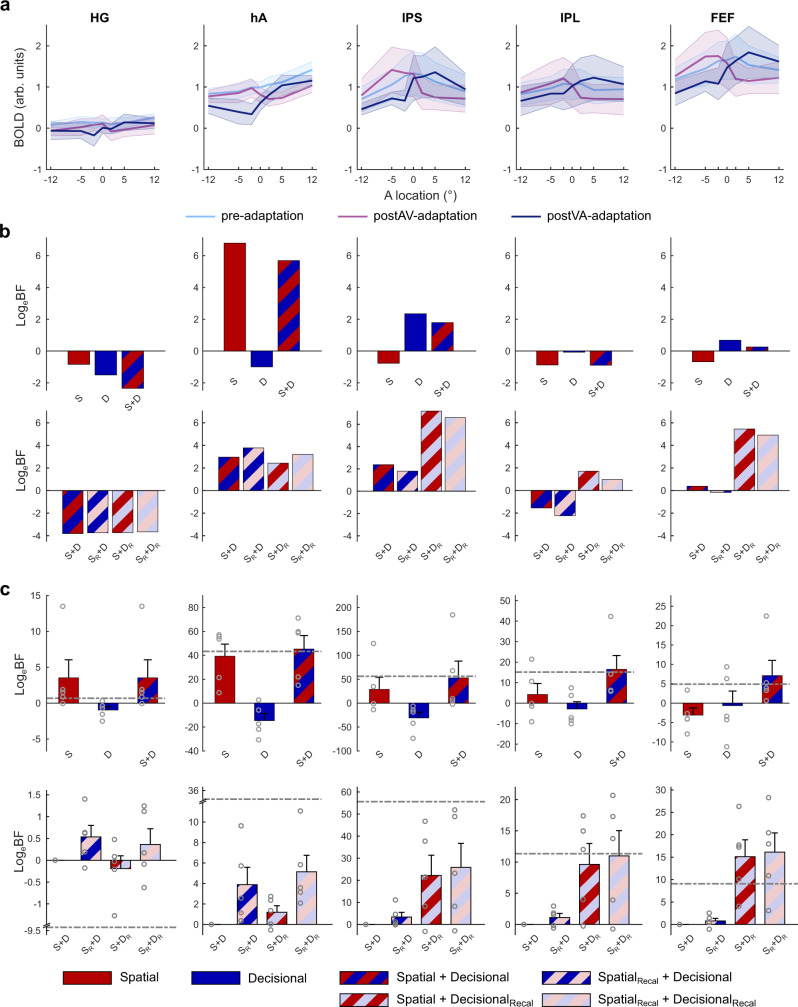
The brain adapts dynamically to the changing sensory statistics of its environment. Recent research has started to delineate the neural circuitries and representations that support this cross-sensory plasticity. Combining psychophysics and model-based representational fMRI and EEG we characterized how the adult human brain adapts to misaligned audiovisual signals. We show that audiovisual adaptation is associated with changes in regional BOLD-responses and fine-scale activity patterns in a widespread network from Heschl's gyrus to dorsolateral prefrontal cortices. Audiovisual recalibration relies on distinct spatial and decisional codes that are expressed with opposite gradients and time courses across the auditory processing hierarchy. Early activity patterns in auditory cortices encode sounds in a continuous space that flexibly adapts to misaligned visual inputs. Later activity patterns in frontoparietal cortices code decisional uncertainty consistent with these spatial transformations. Our findings suggest that regions within the auditory processing hierarchy multiplex spatial and decisional codes to adapt flexibly to the changing sensory statistics in the environment.
大脑会动态地适应其环境中不断变化的感觉统计数据。最近的研究开始描绘支持这种跨感觉可塑性的神经回路和表示。我们结合心理物理学和基于模型的代表性 fMRI 和 EEG,描述了成年人大脑如何适应视听信号的不对准。我们表明,视听适应与大脑中从赫氏回至背外侧前额叶皮质的广泛网络中的局部 BOLD 反应和精细活动模式的变化有关。视听重新校准依赖于不同的空间和决策代码,这些代码在听觉处理层次结构中以相反的梯度和时间进程表达。听觉皮质中的早期活动模式以连续的空间编码声音,该空间可灵活地适应视觉输入的不对准。顶叶-顶叶皮质中的后期活动模式以与这些空间转换一致的方式编码决策不确定性。我们的研究结果表明,听觉处理层次结构内的区域复用空间和决策代码,以灵活地适应环境中不断变化的感觉统计数据。