School of Behavioural and Health Sciences, Australian Catholic University, Fitzroy, VIC, Australia.
Sports Performance, Recovery, Injury and New Technologies (SPRINT) Research Centre, Australian Catholic University, Fitzroy, VIC, Australia.
Sci Rep. 2022 Jul 7;12(1):11486. doi: 10.1038/s41598-022-15024-w.
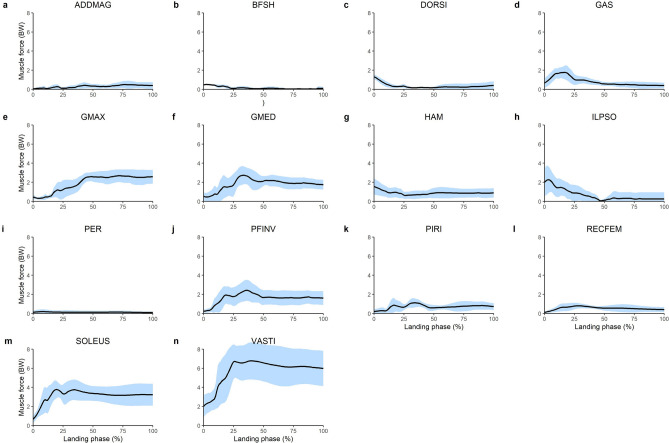
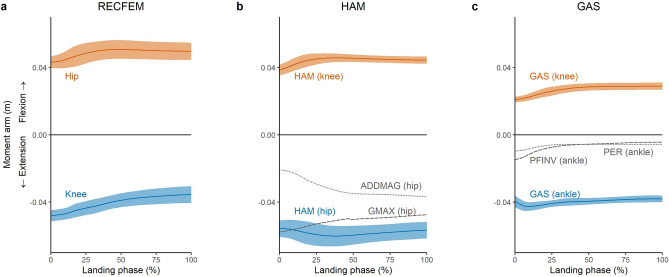
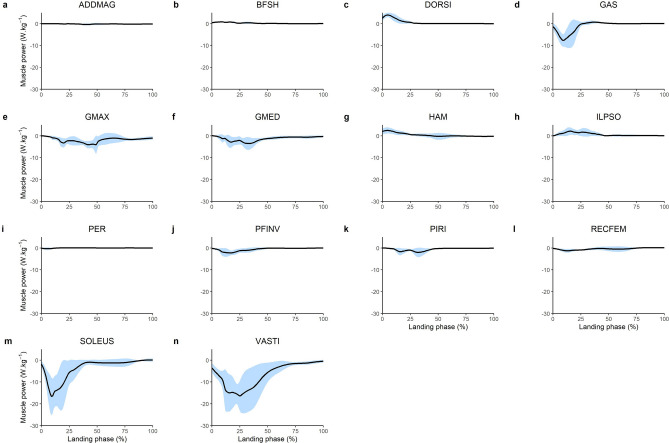
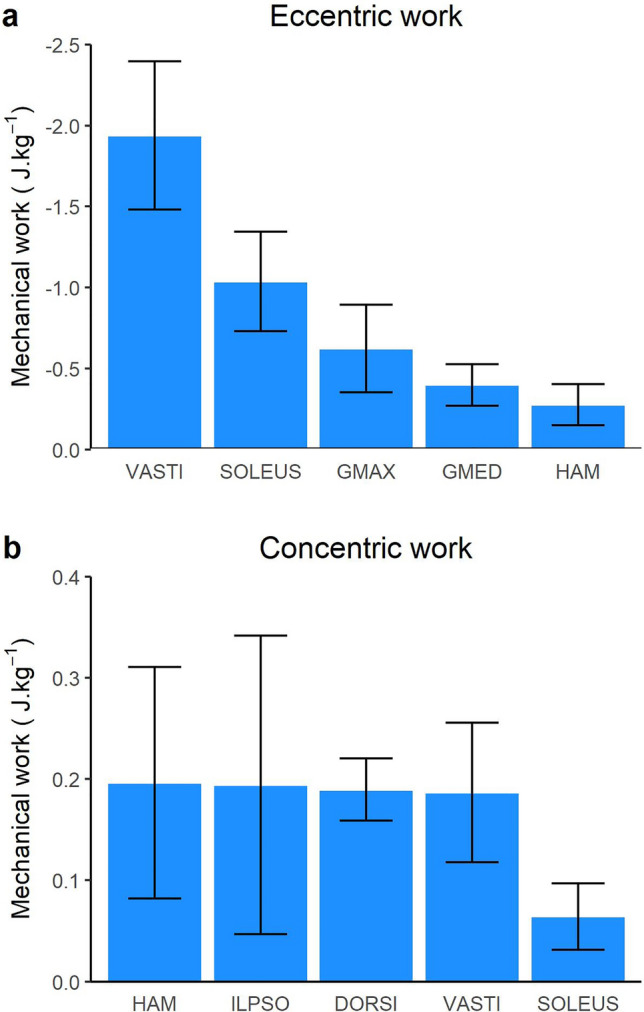
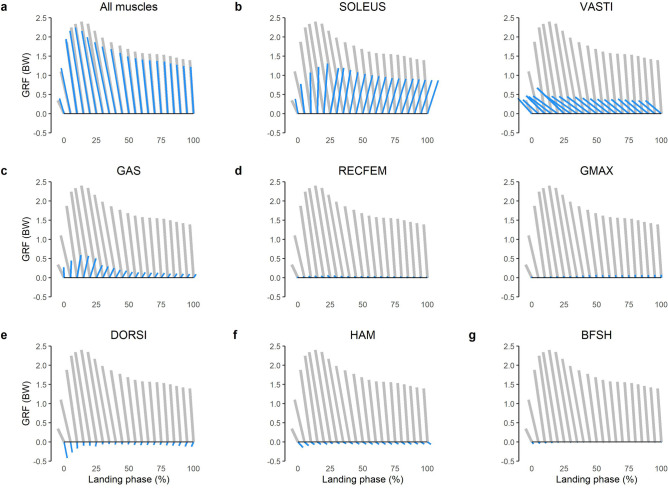
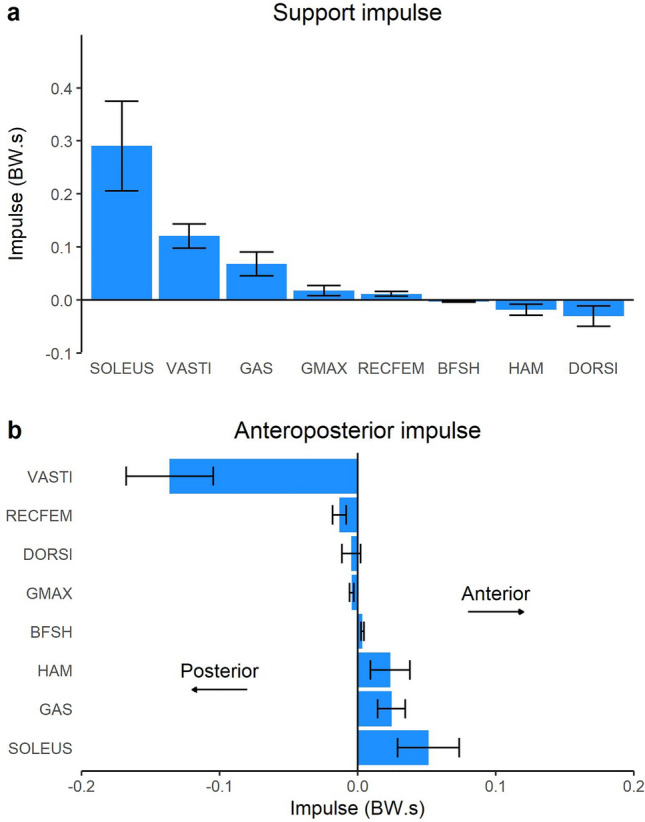
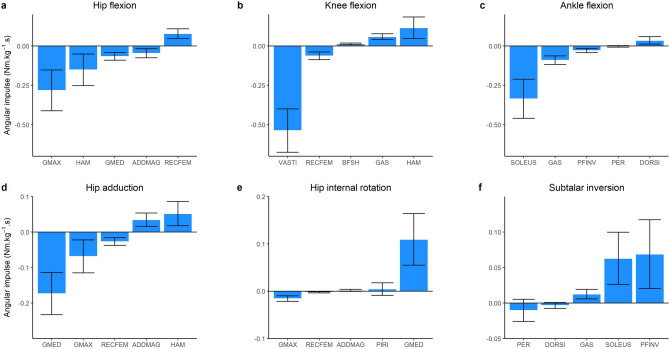
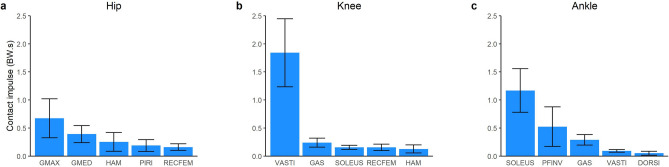
Landing manoeuvres are an integral task for humans, especially in the context of sporting activities. Such tasks often involve landing on one leg which requires the coordination of multiple muscles in order to effectively dissipate kinetic energy. However, no prior studies have provided a detailed description of the strategy used by the major lower limb muscles to perform single-leg landing. The purpose of the present study was to understand how humans coordinate their lower limb muscles during a single-leg landing task. Marker trajectories, ground reaction forces (GRFs), and surface electromyography (EMG) data were collected from healthy male participants performing a single-leg landing from a height of 0.31 m. An EMG-informed neuromusculoskeletal modelling approach was used to generate neuromechanical simulations of the single-leg landing task. The muscular strategy was determined by computing the magnitude and temporal characteristics of musculotendon forces and energetics. Muscle function was determined by computing muscle contributions to lower limb net joint moments, GRFs and lower limb joint contact forces. It was found that the vasti, soleus, gluteus maximus and gluteus medius produced the greatest muscle forces and negative (eccentric) mechanical work. Downward momentum of the centre-of-mass was resisted primarily by the soleus, vasti, gastrocnemius, rectus femoris, and gluteus maximus, whilst forward momentum was primarily resisted by the quadriceps (vasti and rectus femoris). Flexion of the lower limb joints was primarily resisted by the uni-articular gluteus maximus (hip), vasti (knee) and soleus (ankle). Overall, our findings provide a unique insight into the muscular strategy used by humans during a landing manoeuvre and have implications for the design of athletic training programs.
着陆动作是人类的一项基本任务,尤其是在体育活动中。此类任务通常涉及单腿着陆,这需要协调多条肌肉,以有效消耗动能。然而,以前的研究尚未详细描述主要下肢肌肉在单腿着陆中使用的策略。本研究的目的是了解人类在单腿着陆任务中如何协调其下肢肌肉。从健康的男性参与者从 0.31 米的高度单腿着陆中收集了标记轨迹、地面反作用力 (GRF) 和表面肌电图 (EMG) 数据。使用肌电图启发的神经肌肉骨骼建模方法生成单腿着陆任务的神经机械模拟。通过计算肌肌腱力和能量的幅度和时间特征来确定肌肉策略。通过计算肌肉对下肢净关节力矩、GRF 和下肢关节接触力的贡献来确定肌肉功能。结果发现,股四头肌、比目鱼肌、臀大肌和臀中肌产生的肌肉力和负(离心)机械功最大。质心的向下动量主要由比目鱼肌、股四头肌、腓肠肌、股直肌和臀大肌抵抗,而向前的动量主要由股四头肌(股四头肌和股直肌)抵抗。下肢关节的屈曲主要由单关节臀大肌(髋关节)、股四头肌(膝关节)和比目鱼肌(踝关节)抵抗。总的来说,我们的研究结果提供了对人类在着陆动作中使用的肌肉策略的独特见解,并对运动训练计划的设计具有重要意义。