Biao Yaning, Chen Jian, Liu Chenxu, Wang Ruilong, Han Xue, Li Li, Zhang Yixin
School of Basic Medicine, Hebei University of Chinese Medicine, Shijiazhuang, China.
International Joint Research Center on Resource Utilization and Quality Evaluation of Traditional Chinese Medicine of Hebei Province, Shijiazhuang, China.
Front Pharmacol. 2022 Jun 21;13:877924. doi: 10.3389/fphar.2022.877924. eCollection 2022.
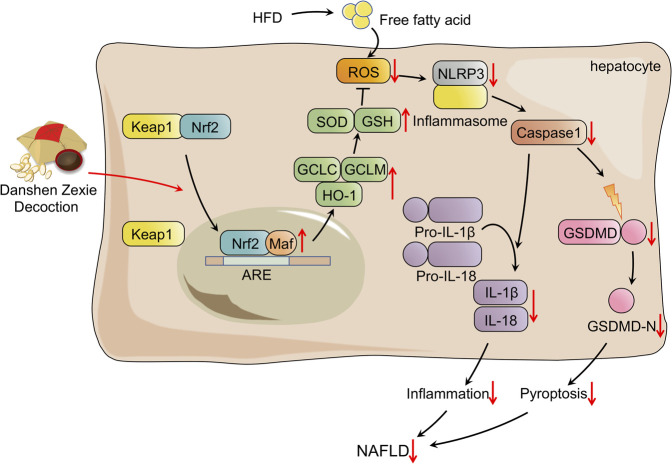
Lipid metabolism disorders are a prominent characteristic in the pathological development of non-alcoholic fatty liver disease (NAFLD). decoction (DZD) is a Chinese herbal medicine that is based on decoction and has an effect of regulating lipid mechanism. However, the anti-NAFLD effect and mechanism of DZD remain unclear. In this study, we observed the therapeutic effect of DZD on NAFLD rats and investigated its possible mechanisms. Sixty Sprague Dawley rats were randomly assigned to six groups: control group, model group, (polyene phosphatidylcholine) group, and low, medium and high-dose DZD groups. High-fat diet (HFD) was fed to the rats to establish an NAFLD model, and each treatment group was given corresponding drugs at the same time for eight consecutive weeks. The results revealed that the obvious lipid metabolism disorder and liver injury induced by HFD were alleviated by treatment with DZD, which was verified by decreased serum TC, TG, ALT, AST, liver TC, TG, and FFA, as well as the alleviation of hepatic steatosis. The production of ROS in rats was reduced after treatment with DZD. The SOD activity and GSH content were increased with DZD treatment, while the MDA level was decreased. The administration of DZD could decrease serum IL-1β and IL-18 contents. Moreover, DZD upregulated the expressions of Nrf2, HO-1, GCLC, and GCLM, while it suppressed the expressions of NLRP3, caspase-1, GSDMD, and GSDMD-N. In conclusion, the data showed that DZD can reduce lipid accumulation, alleviate oxidative stress and inflammation, and inhibit pyroptosis in NAFLD rats, which might be ascribed to suppression of the ROS/NLRP3/IL-1β signaling pathway by activation of Nrf2. Overall, these results indicated that DZD is expected to be a therapeutic drug for NAFLD.
脂质代谢紊乱是非酒精性脂肪性肝病(NAFLD)病理发展过程中的一个突出特征。[具体方剂名称]汤(DZD)是一种基于[基础方剂名称]汤的中药方剂,具有调节脂质代谢机制的作用。然而,DZD抗NAFLD的作用及机制尚不清楚。在本研究中,我们观察了DZD对NAFLD大鼠的治疗效果,并探讨了其可能的机制。将60只Sprague Dawley大鼠随机分为6组:对照组、模型组、[多烯磷脂酰胆碱]组以及低、中、高剂量DZD组。给大鼠喂食高脂饮食(HFD)以建立NAFLD模型,各治疗组同时给予相应药物,连续给药8周。结果显示,DZD治疗可减轻HFD诱导的明显脂质代谢紊乱和肝损伤,这通过血清总胆固醇(TC)、甘油三酯(TG)、谷丙转氨酶(ALT)、谷草转氨酶(AST)、肝脏TC、TG和游离脂肪酸(FFA)的降低以及肝脂肪变性的减轻得到证实。DZD治疗后大鼠体内活性氧(ROS)的产生减少。DZD治疗可使超氧化物歧化酶(SOD)活性和谷胱甘肽(GSH)含量升高,同时丙二醛(MDA)水平降低。给予DZD可降低血清白细胞介素-1β(IL-1β)和白细胞介素-18(IL-18)含量。此外,DZD上调核因子E2相关因子2(Nrf2)、血红素加氧酶-1(HO-1)、谷氨酸-半胱氨酸连接酶催化亚基(GCLC)和谷氨酸-半胱氨酸连接酶调节亚基(GCLM)的表达,同时抑制NLR家族含pyrin结构域蛋白3(NLRP3)、半胱天冬酶-1(caspase-1)、gasdermin D(GSDMD)和GSDMD-N的表达。总之,数据表明DZD可减少NAFLD大鼠的脂质蓄积,减轻氧化应激和炎症反应,并抑制细胞焦亡,这可能归因于通过激活Nrf2抑制ROS/NLRP3/IL-1β信号通路。总体而言,这些结果表明DZD有望成为治疗NAFLD的药物。