Velnar Tomaz, Bosnjak Roman
Department of Neurosurgery, University Medical Centre Ljubljana, Ljubljana 1000, Slovenia.
World J Clin Cases. 2022 May 26;10(15):4726-4736. doi: 10.12998/wjcc.v10.i15.4726.
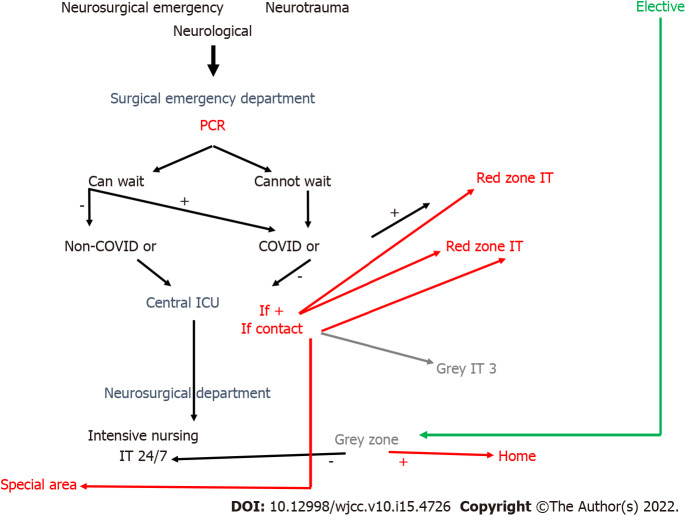
The novel coronavirus disease 2019 (COVID-19) is an emerging disease, caused by severe acute respiratory syndrome coronavirus-2. It bears unique biological characteristics, clinical symptoms and imaging manifestations, therefore presenting an important and urgent threat to global health. As a result, a new public health crisis arose, threatening the world with the spread of the 2019 novel coronavirus. Despite the maximal worldwide public health responses aimed at containing the disease and delaying its spread, many countries have been confronted with a critical care crisis, and even more, countries will almost certainly follow. In Slovenia, the COVID-19 has struck the health system immensely and among all the specialities, neurosurgery has also been experiencing difficulties in the service, not only in regular, elective surgeries but especially during emergencies. The management of these neurosurgical patients has become more difficult than ever. We describe our protocol in the management of neurosurgical patients in the University Medical Centre Ljubljana, Slovenia and how neurosurgical pathology was tackled during the pandemics.
2019年新型冠状病毒病(COVID-19)是一种由严重急性呼吸综合征冠状病毒2引起的新发疾病。它具有独特的生物学特征、临床症状和影像学表现,因此对全球健康构成了重大且紧迫的威胁。结果,一场新的公共卫生危机出现了,2019新型冠状病毒的传播给世界带来了威胁。尽管全球采取了最大程度的公共卫生应对措施以控制该疾病并延缓其传播,但许多国家仍面临重症监护危机,而且几乎可以肯定,更多国家也将面临这一情况。在斯洛文尼亚,COVID-19对卫生系统造成了巨大冲击,在所有专科中,神经外科在服务方面也遇到了困难,不仅在常规择期手术中,尤其是在紧急情况下。这些神经外科患者的管理变得比以往任何时候都更加困难。我们描述了斯洛文尼亚卢布尔雅那大学医学中心在管理神经外科患者方面的方案,以及在大流行期间如何应对神经外科病理学问题。