Department of Population and Public Health Sciences, University of Southern California, Los Angeles, United States.
Public Health Sciences, Fred Hutchinson Cancer Research Center, Seattle, United States.
Elife. 2022 Jul 8;11:e78304. doi: 10.7554/eLife.78304.
We recently developed a multi-ancestry polygenic risk score (PRS) that effectively stratifies prostate cancer risk across populations. In this study, we validated the performance of the PRS in the multi-ancestry Million Veteran Program and additional independent studies.
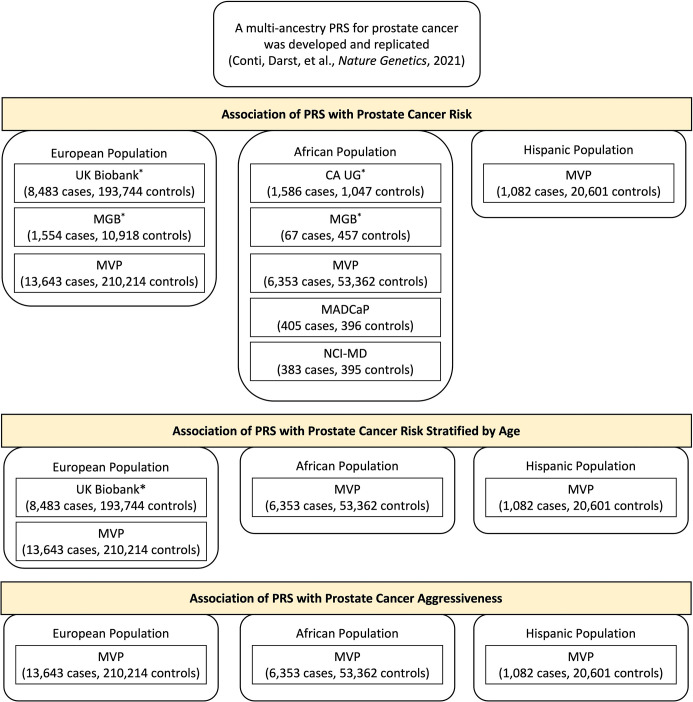
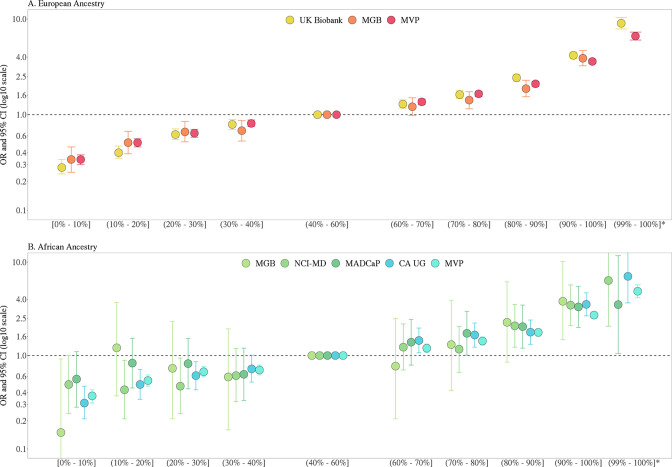
Within each ancestry population, the association of PRS with prostate cancer risk was evaluated separately in each case-control study and then combined in a fixed-effects inverse-variance-weighted meta-analysis. We further assessed the effect modification by age and estimated the age-specific absolute risk of prostate cancer for each ancestry population.
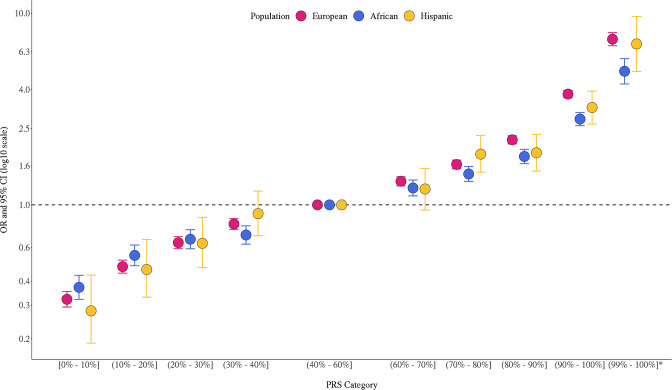
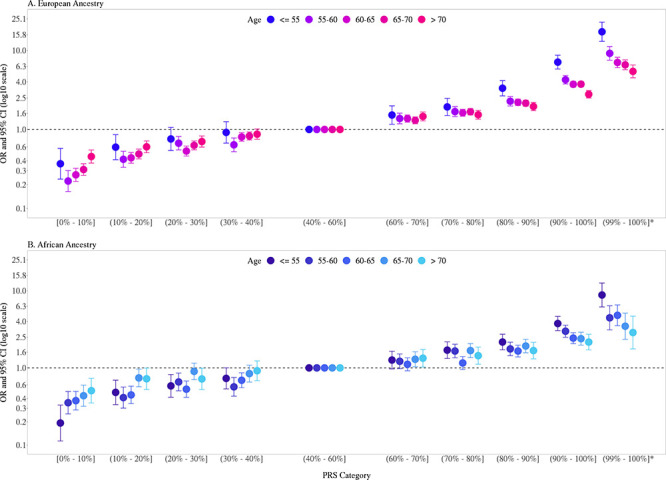
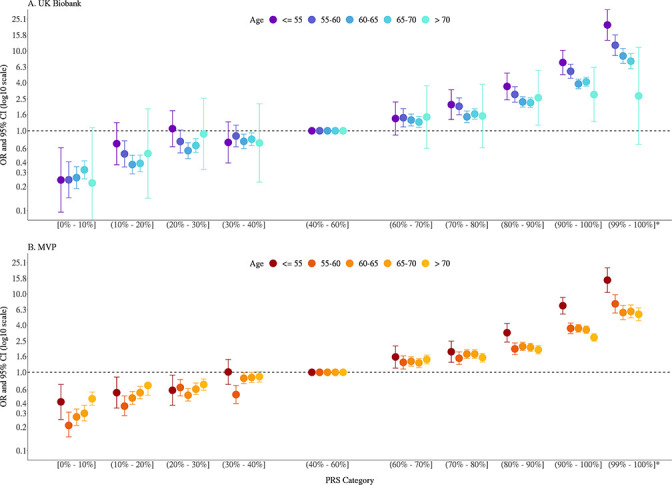
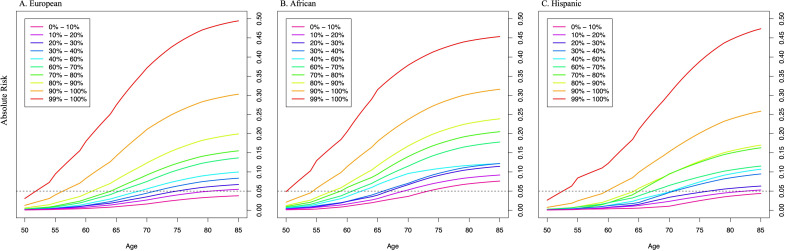
The PRS was evaluated in 31,925 cases and 490,507 controls, including men from European (22,049 cases, 414,249 controls), African (8794 cases, 55,657 controls), and Hispanic (1082 cases, 20,601 controls) populations. Comparing men in the top decile (90-100% of the PRS) to the average 40-60% PRS category, the prostate cancer odds ratio (OR) was 3.8-fold in European ancestry men (95% CI = 3.62-3.96), 2.8-fold in African ancestry men (95% CI = 2.59-3.03), and 3.2-fold in Hispanic men (95% CI = 2.64-3.92). The PRS did not discriminate risk of aggressive versus nonaggressive prostate cancer. However, the OR diminished with advancing age (European ancestry men in the top decile: ≤55 years, OR = 7.11; 55-60 years, OR = 4.26; >70 years, OR = 2.79). Men in the top PRS decile reached 5% absolute prostate cancer risk ~10 years younger than men in the 40-60% PRS category.
Our findings validate the multi-ancestry PRS as an effective prostate cancer risk stratification tool across populations. A clinical study of PRS is warranted to determine whether the PRS could be used for risk-stratified screening and early detection.
This work was supported by the National Cancer Institute at the National Institutes of Health (grant numbers U19 CA214253 to C.A.H., U01 CA257328 to C.A.H., U19 CA148537 to C.A.H., R01 CA165862 to C.A.H., K99 CA246063 to B.F.D, and T32CA229110 to F.C), the Prostate Cancer Foundation (grants 21YOUN11 to B.F.D. and 20CHAS03 to C.A.H.), the Achievement Rewards for College Scientists Foundation Los Angeles Founder Chapter to B.F.D, and the Million Veteran Program-MVP017. This research has been conducted using the UK Biobank Resource under application number 42195. This research is based on data from the Million Veteran Program, Office of Research and Development, and the Veterans Health Administration. This publication does not represent the views of the Department of Veteran Affairs or the United States Government.
我们最近开发了一种多民族多基因风险评分(PRS),可有效跨人群分层前列腺癌风险。在这项研究中,我们在多民族百万退伍军人计划和其他独立研究中验证了 PRS 的性能。
在每个祖先群体内,分别在每个病例对照研究中评估 PRS 与前列腺癌风险的关联,然后在固定效应逆方差加权荟萃分析中进行合并。我们进一步评估了年龄的效应修饰,并估计了每个祖先群体的特定年龄的前列腺癌绝对风险。
该 PRS 在 31925 例病例和 490507 例对照中进行了评估,包括来自欧洲(22049 例,414249 例对照)、非洲(8794 例,55657 例对照)和西班牙裔(1082 例,20601 例对照)人群的男性。将处于最高十分位数(PRS 的 90%-100%)的男性与平均 40%-60%PRS 类别的男性进行比较,欧洲裔男性的前列腺癌比值比(OR)为 3.8 倍(95%CI=3.62-3.96),非洲裔男性为 2.8 倍(95%CI=2.59-3.03),西班牙裔男性为 3.2 倍(95%CI=2.64-3.92)。PRS 不能区分侵袭性与非侵袭性前列腺癌的风险。然而,随着年龄的增长,OR 逐渐降低(欧洲裔男性处于最高十分位数:≤55 岁,OR=7.11;55-60 岁,OR=4.26;>70 岁,OR=2.79)。处于最高 PRS 十分位数的男性达到 5%的前列腺癌绝对风险的年龄比处于 40%-60%PRS 类别男性早约 10 年。
我们的研究结果验证了多民族 PRS 是一种有效的跨人群前列腺癌风险分层工具。需要进行 PRS 的临床研究,以确定 PRS 是否可用于风险分层筛查和早期检测。
这项工作得到了美国国立卫生研究院国家癌症研究所(CAH 博士的 U19 CA214253、U01 CA257328、U19 CA148537、R01 CA165862、BFD 博士的 K99 CA246063 和 FC 博士的 T32CA229110 等资助)、前列腺癌基金会(BFD 博士的 21YOUN11 和 CAH 博士的 20CHAS03 等资助)、成就奖励大学生科学基金会洛杉矶创始人分会(BFD 博士)和百万退伍军人计划-MVP017。这项研究是使用英国生物银行资源进行的,申请编号为 42195。这项研究基于百万退伍军人计划、研究与发展办公室和退伍军人健康管理局的数据。本出版物不代表退伍军人事务部或美国政府的观点。