• 文献检索
  • 文档翻译
  • 深度研究
  • 学术资讯
  • Suppr Zotero 插件Zotero 插件
  • 邀请有礼
  • 套餐&价格
  • 历史记录
应用&插件
Suppr Zotero 插件Zotero 插件浏览器插件Mac 客户端Windows 客户端微信小程序
定价
高级版会员购买积分包购买API积分包
服务
文献检索文档翻译深度研究API 文档MCP 服务
关于我们
关于 Suppr公司介绍联系我们用户协议隐私条款
关注我们

Suppr 超能文献

核心技术专利:CN118964589B侵权必究
粤ICP备2023148730 号-1Suppr @ 2026

文献检索

告别复杂PubMed语法,用中文像聊天一样搜索,搜遍4000万医学文献。AI智能推荐,让科研检索更轻松。

立即免费搜索

文件翻译

保留排版,准确专业,支持PDF/Word/PPT等文件格式,支持 12+语言互译。

免费翻译文档

深度研究

AI帮你快速写综述,25分钟生成高质量综述,智能提取关键信息,辅助科研写作。

立即免费体验

评估为非洲和欧洲血统男性构建前列腺癌多基因风险评分的方法。

Evaluating Approaches for Constructing Polygenic Risk Scores for Prostate Cancer in Men of African and European Ancestry.

作者信息

Darst Burcu F, Shen Jiayi, Madduri Ravi K, Rodriguez Alexis A, Xiao Yukai, Sheng Xin, Saunders Edward J, Dadaev Tokhir, Brook Mark N, Hoffmann Thomas J, Muir Kenneth, Wan Peggy, Le Marchand Loic, Wilkens Lynne, Wang Ying, Schleutker Johanna, MacInnis Robert J, Cybulski Cezary, Neal David E, Nordestgaard Børge G, Nielsen Sune F, Batra Jyotsna, Clements Judith A, Grönberg Henrik, Pashayan Nora, Travis Ruth C, Park Jong Y, Albanes Demetrius, Weinstein Stephanie, Mucci Lorelei A, Hunter David J, Penney Kathryn L, Tangen Catherine M, Hamilton Robert J, Parent Marie-Élise, Stanford Janet L, Koutros Stella, Wolk Alicja, Sørensen Karina D, Blot William J, Yeboah Edward D, Mensah James E, Lu Yong-Jie, Schaid Daniel J, Thibodeau Stephen N, West Catharine M, Maier Christiane, Kibel Adam S, Cancel-Tassin Géraldine, Menegaux Florence, John Esther M, Grindedal Eli Marie, Khaw Kay-Tee, Ingles Sue A, Vega Ana, Rosenstein Barry S, Teixeira Manuel R, Kogevinas Manolis, Cannon-Albright Lisa, Huff Chad, Multigner Luc, Kaneva Radka, Leach Robin J, Brenner Hermann, Hsing Ann W, Kittles Rick A, Murphy Adam B, Logothetis Christopher J, Neuhausen Susan L, Isaacs William B, Nemesure Barbara, Hennis Anselm J, Carpten John, Pandha Hardev, De Ruyck Kim, Xu Jianfeng, Razack Azad, Teo Soo-Hwang, Newcomb Lisa F, Fowke Jay H, Neslund-Dudas Christine, Rybicki Benjamin A, Gamulin Marija, Usmani Nawaid, Claessens Frank, GagoDominguez Manuela, Castelao Jose Esteban, Townsend Paul A, Crawford Dana C, Petrovics Gyorgy, Casey Graham, Roobol Monique J, Hu Jennifer F, Berndt Sonja I, Van Den Eeden Stephen K, Easton Douglas F, Chanock Stephen J, Cook Michael B, Wiklund Fredrik, Witte John S, Eeles Rosalind A, Kote-Jarai Zsofia, Watya Stephen, Gaziano John M, Justice Amy C, Conti David V, Haiman Christopher A

机构信息

Center for Genetic Epidemiology, Department of Population and Public Health Sciences, Keck School of Medicine, University of Southern California, Los Angeles, CA, USA.

Division of Public Health Sciences, Fred Hutchinson Cancer Center, Seattle, WA, USA.

出版信息

medRxiv. 2023 May 15:2023.05.12.23289860. doi: 10.1101/2023.05.12.23289860.

DOI:10.1101/2023.05.12.23289860
PMID:37292833
原文链接:https://pmc.ncbi.nlm.nih.gov/articles/PMC10246022/
Abstract

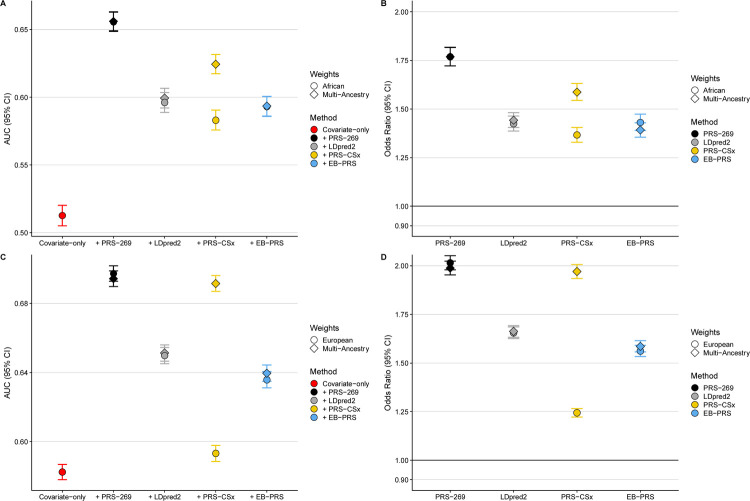
Genome-wide polygenic risk scores (GW-PRS) have been reported to have better predictive ability than PRS based on genome-wide significance thresholds across numerous traits. We compared the predictive ability of several GW-PRS approaches to a recently developed PRS of 269 established prostate cancer risk variants from multi-ancestry GWAS and fine-mapping studies (PRS ). GW-PRS models were trained using a large and diverse prostate cancer GWAS of 107,247 cases and 127,006 controls used to develop the multi-ancestry PRS . Resulting models were independently tested in 1,586 cases and 1,047 controls of African ancestry from the California/Uganda Study and 8,046 cases and 191,825 controls of European ancestry from the UK Biobank and further validated in 13,643 cases and 210,214 controls of European ancestry and 6,353 cases and 53,362 controls of African ancestry from the Million Veteran Program. In the testing data, the best performing GW-PRS approach had AUCs of 0.656 (95% CI=0.635-0.677) in African and 0.844 (95% CI=0.840-0.848) in European ancestry men and corresponding prostate cancer OR of 1.83 (95% CI=1.67-2.00) and 2.19 (95% CI=2.14-2.25), respectively, for each SD unit increase in the GW-PRS. However, compared to the GW-PRS, in African and European ancestry men, the PRS had larger or similar AUCs (AUC=0.679, 95% CI=0.659-0.700 and AUC=0.845, 95% CI=0.841-0.849, respectively) and comparable prostate cancer OR (OR=2.05, 95% CI=1.87-2.26 and OR=2.21, 95% CI=2.16-2.26, respectively). Findings were similar in the validation data. This investigation suggests that current GW-PRS approaches may not improve the ability to predict prostate cancer risk compared to the multi-ancestry PRS constructed with fine-mapping.

摘要

据报道,全基因组多基因风险评分(GW-PRS)在众多性状上比基于全基因组显著性阈值的风险评分(PRS)具有更好的预测能力。我们将几种GW-PRS方法的预测能力与最近开发的一种PRS进行了比较,该PRS基于多血统全基因组关联研究(GWAS)和精细定位研究确定的269个前列腺癌风险变异(PRS )。GW-PRS模型使用了一个包含107,247例病例和127,006例对照的大型多样化前列腺癌GWAS进行训练,该GWAS用于开发多血统PRS 。所得模型在加利福尼亚/乌干达研究中的1,586例非洲血统病例和1,047例对照以及英国生物银行中的8,046例欧洲血统病例和191,825例对照中进行了独立测试,并在百万退伍军人计划中的13,643例欧洲血统病例和210,214例对照以及6,353例非洲血统病例和53,362例对照中进一步验证。在测试数据中,表现最佳的GW-PRS方法在非洲血统男性中的曲线下面积(AUC)为0.656(95%置信区间=0.635-0.677),在欧洲血统男性中为0.844(95%置信区间=0.840-0.848),并且对于GW-PRS每增加一个标准差单位,相应的前列腺癌比值比(OR)分别为1.83(95%置信区间=1.67-2.00)和2.19(95%置信区间=2.14-2.25)。然而,与GW-PRS相比,在非洲和欧洲血统男性中,PRS 的AUC更大或相似(分别为AUC=0.679,95%置信区间=0.659-0.700和AUC=0.845,95%置信区间=0.841-0.849),前列腺癌OR相当(分别为OR=2.05,95%置信区间=1.87-2.26和OR=2.21,95%置信区间=2.16-2.26)。验证数据中的结果相似。这项调查表明,与通过精细定位构建的多血统PRS 相比,当前的GW-PRS方法可能无法提高预测前列腺癌风险的能力。

https://cdn.ncbi.nlm.nih.gov/pmc/blobs/dbdc/10246022/bc238716c70c/nihpp-2023.05.12.23289860v1-f0002.jpg
https://cdn.ncbi.nlm.nih.gov/pmc/blobs/dbdc/10246022/1819568149f4/nihpp-2023.05.12.23289860v1-f0001.jpg
https://cdn.ncbi.nlm.nih.gov/pmc/blobs/dbdc/10246022/bc238716c70c/nihpp-2023.05.12.23289860v1-f0002.jpg
https://cdn.ncbi.nlm.nih.gov/pmc/blobs/dbdc/10246022/1819568149f4/nihpp-2023.05.12.23289860v1-f0001.jpg
https://cdn.ncbi.nlm.nih.gov/pmc/blobs/dbdc/10246022/bc238716c70c/nihpp-2023.05.12.23289860v1-f0002.jpg

相似文献

1
Evaluating Approaches for Constructing Polygenic Risk Scores for Prostate Cancer in Men of African and European Ancestry.评估为非洲和欧洲血统男性构建前列腺癌多基因风险评分的方法。
medRxiv. 2023 May 15:2023.05.12.23289860. doi: 10.1101/2023.05.12.23289860.
2
Evaluating approaches for constructing polygenic risk scores for prostate cancer in men of African and European ancestry.评估构建非洲裔和欧洲裔男性前列腺癌多基因风险评分的方法。
Am J Hum Genet. 2023 Jul 6;110(7):1200-1206. doi: 10.1016/j.ajhg.2023.05.010. Epub 2023 Jun 12.
3
Validation of a multi-ancestry polygenic risk score and age-specific risks of prostate cancer: A meta-analysis within diverse populations.多血统多基因风险评分与前列腺癌特定年龄风险的验证:不同人群中的荟萃分析。
Elife. 2022 Jul 8;11:e78304. doi: 10.7554/eLife.78304.
4
Multi-ancestry polygenic risk scores for venous thromboembolism.多血统多基因静脉血栓栓塞症风险评分。
Hum Mol Genet. 2024 Sep 3;33(18):1584-1591. doi: 10.1093/hmg/ddae097.
5
Application of European-specific polygenic risk scores for predicting prostate cancer risk in different ancestry populations.欧洲特异性多基因风险评分在不同祖先人群中预测前列腺癌风险的应用。
Prostate. 2023 Jan;83(1):30-38. doi: 10.1002/pros.24431. Epub 2022 Aug 22.
6
Testing the generalizability of ancestry-specific polygenic risk scores to predict prostate cancer in sub-Saharan Africa.检测基于祖源的多基因风险评分在撒哈拉以南非洲预测前列腺癌的泛化能力。
Genome Biol. 2022 Sep 13;23(1):194. doi: 10.1186/s13059-022-02766-z.
7
PRState: Incorporating genetic ancestry in prostate cancer risk scores for men of African ancestry.PRState:将遗传血统纳入非洲裔男性前列腺癌风险评分中。
BMC Cancer. 2022 Dec 9;22(1):1289. doi: 10.1186/s12885-022-10258-3.
8
Polygenic risk scores for the prediction of common cancers in East Asians: A population-based prospective cohort study.基于人群的前瞻性队列研究:东亚常见癌症的多基因风险评分预测。
Elife. 2023 Mar 27;12:e82608. doi: 10.7554/eLife.82608.
9
On cross-ancestry cancer polygenic risk scores.基于多种族癌症多基因风险评分的研究。
PLoS Genet. 2021 Sep 16;17(9):e1009670. doi: 10.1371/journal.pgen.1009670. eCollection 2021 Sep.
10
Evidence of Novel Susceptibility Variants for Prostate Cancer and a Multiancestry Polygenic Risk Score Associated with Aggressive Disease in Men of African Ancestry.新型前列腺癌易感变异证据和多祖先种系多基因风险评分与非洲裔男性侵袭性疾病相关。
Eur Urol. 2023 Jul;84(1):13-21. doi: 10.1016/j.eururo.2023.01.022. Epub 2023 Mar 3.

本文引用的文献

1
Portability of 245 polygenic scores when derived from the UK Biobank and applied to 9 ancestry groups from the same cohort.245 个多基因评分在英国生物样本库中得出并应用于来自同一队列的 9 个祖先群体时的可转移性。
Am J Hum Genet. 2022 Jan 6;109(1):12-23. doi: 10.1016/j.ajhg.2021.11.008.
2
Evaluation of a Multiethnic Polygenic Risk Score Model for Prostate Cancer.多民族多基因风险评分模型评估前列腺癌。
J Natl Cancer Inst. 2022 May 9;114(5):771-774. doi: 10.1093/jnci/djab058.
3
Trans-ancestry genome-wide association meta-analysis of prostate cancer identifies new susceptibility loci and informs genetic risk prediction.
泛种族全基因组关联荟萃分析前列腺癌确定新的易感性位点并为遗传风险预测提供信息。
Nat Genet. 2021 Jan;53(1):65-75. doi: 10.1038/s41588-020-00748-0. Epub 2021 Jan 4.
4
LDpred2: better, faster, stronger.LDpred2:更优、更快、更强。
Bioinformatics. 2021 Apr 1;36(22-23):5424-5431. doi: 10.1093/bioinformatics/btaa1029.
5
Genome-wide Modeling of Polygenic Risk Score in Colorectal Cancer Risk.全基因组建模分析多基因风险评分在结直肠癌风险中的作用。
Am J Hum Genet. 2020 Sep 3;107(3):432-444. doi: 10.1016/j.ajhg.2020.07.006. Epub 2020 Aug 5.
6
Assessment of polygenic architecture and risk prediction based on common variants across fourteen cancers.基于 14 种癌症常见变异的多基因结构评估和风险预测。
Nat Commun. 2020 Jul 3;11(1):3353. doi: 10.1038/s41467-020-16483-3.
7
Predictive Utility of Polygenic Risk Scores for Coronary Heart Disease in Three Major Racial and Ethnic Groups.多基因风险评分对三大主要种族和族裔群体冠心病的预测效用。
Am J Hum Genet. 2020 May 7;106(5):707-716. doi: 10.1016/j.ajhg.2020.04.002.
8
Leveraging effect size distributions to improve polygenic risk scores derived from summary statistics of genome-wide association studies.利用效应大小分布来提高基于全基因组关联研究汇总统计数据的多基因风险评分。
PLoS Comput Biol. 2020 Feb 11;16(2):e1007565. doi: 10.1371/journal.pcbi.1007565. eCollection 2020 Feb.
9
Broad- and narrow-sense validity performance of three polygenic risk score methods for prostate cancer risk assessment.三种用于前列腺癌风险评估的多基因风险评分方法的广义和狭义有效性表现。
Prostate. 2020 Jan;80(1):83-87. doi: 10.1002/pros.23920. Epub 2019 Oct 21.
10
Genome-wide polygenic scores for common diseases identify individuals with risk equivalent to monogenic mutations.全基因组多基因疾病风险评分可识别出与单基因突变风险相当的个体。
Nat Genet. 2018 Sep;50(9):1219-1224. doi: 10.1038/s41588-018-0183-z. Epub 2018 Aug 13.