Lugger Sean J D, Verbroekken Ruth M C, Mulder Dirk J, Schenning Albert P H J
Laboratory of Stimuli-Responsive Functional Materials and Devices (SFD), Department of Chemical Engineering and Chemistry, Eindhoven University of Technology (TU/e), P.O. Box 513, 5600 MB Eindhoven, The Netherlands.
Institute for Complex Molecular Systems, Eindhoven University of Technology (TU/e), P.O. Box 513, 5600 MB Eindhoven, The Netherlands.
ACS Macro Lett. 2022 Jul 19;11(7):935-940. doi: 10.1021/acsmacrolett.2c00359. Epub 2022 Jul 8.
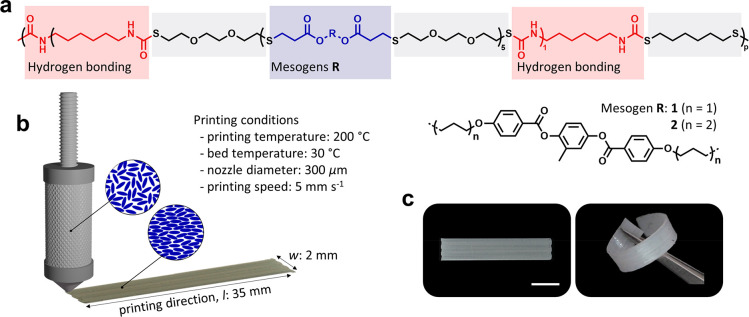
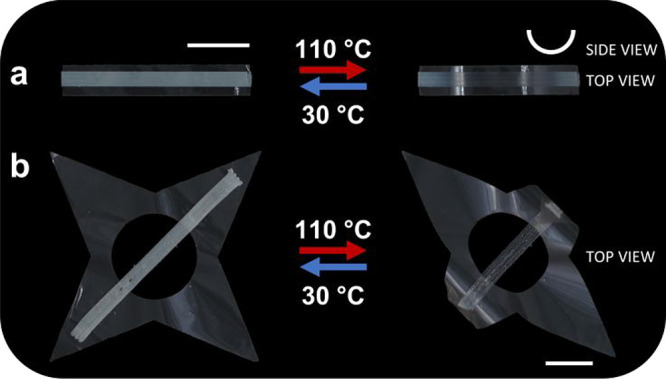
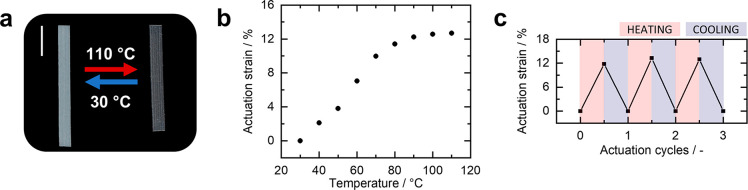
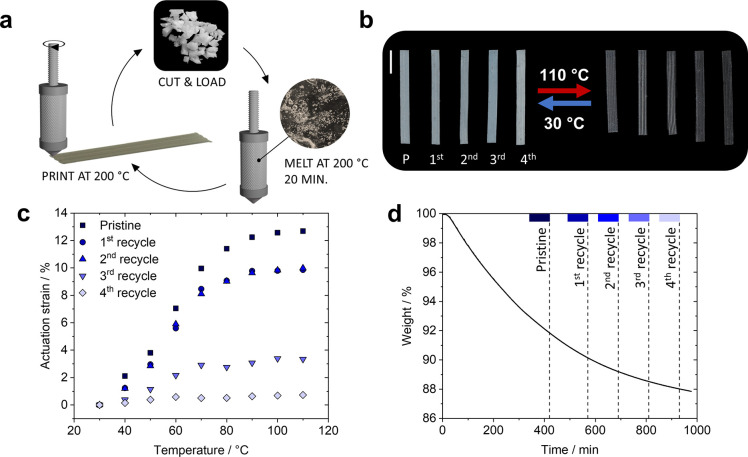
Direct ink writing (DIW) of liquid crystal elastomers (LCEs) has rapidly paved its way into the field of soft actuators and other stimuli-responsive devices. However, currently used LCE systems for DIW require postprinting (photo)polymerization, thereby forming a covalent network, making the process time-consuming and the material nonrecyclable. In this work, a DIW approach is developed for printing a supramolecular poly(thio)urethane LCE to overcome these drawbacks of permanent cross-linking. The thermo-reversible nature of the supramolecular cross-links enables the interplay between melt-processable behavior required for extrusion and formation of the network to fix the alignment. After printing, the actuators demonstrated a reversible contraction of 12.7% or bending and curling motions when printed on a passive substrate. The thermoplastic ink enables recyclability, as shown by cutting and printing the actuators five times. However, the actuation performance diminishes. This work highlights the potential of supramolecular LCE inks for DIW soft circular actuators and other devices.
液晶弹性体(LCE)的直接墨水书写(DIW)已迅速进入软致动器和其他刺激响应设备领域。然而,目前用于DIW的LCE系统需要进行后印刷(光)聚合,从而形成共价网络,这使得该过程耗时且材料不可回收。在这项工作中,开发了一种DIW方法来打印超分子聚(硫)氨酯LCE,以克服永久交联的这些缺点。超分子交联的热可逆性质使得挤出所需的可熔融加工行为与形成网络以固定取向之间能够相互作用。打印后,致动器在被动基板上打印时表现出12.7%的可逆收缩或弯曲和卷曲运动。热塑性墨水具有可回收性,如对致动器进行五次切割和打印所示。然而,致动性能会下降。这项工作突出了超分子LCE墨水用于DIW软圆形致动器和其他设备的潜力。