Karl Landsteiner University of Health Sciences, Dr. Karl-Dorrek-Straße 30, 3500, Krems, Austria.
Department of Neurology, University Hospital St. Pölten, Dunant-Platz 1, 3100, St. Pölten, Austria.
BMC Neurol. 2022 Jul 8;22(1):250. doi: 10.1186/s12883-022-02762-7.
In seizure-naive brain tumor patients, the efficacy of perioperative prophylactic antiepileptic drug treatment remains controversial. In case of administration, the common preferred drug is levetiracetam (LEV) because of its favorable pharmacological profile. Research to date has not sufficiently determined how LEV affects cognition in the short term, as is the case in the perioperative period. The objective of this prospective study was to examine the neurocognitive functioning of seizure-naive brain tumor patients after receiving LEV perioperatively.
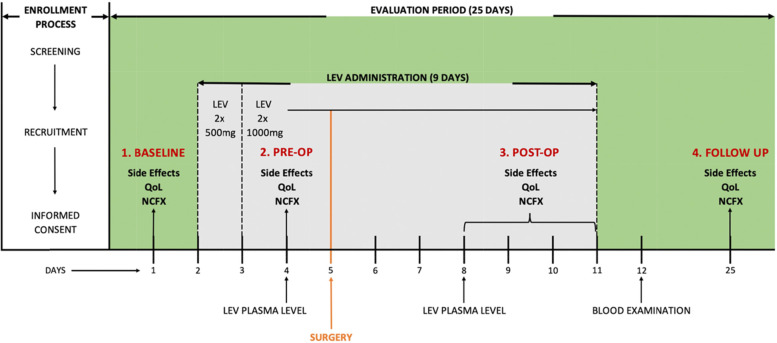
Fortythree patients with supratentorial brain tumor scheduled for surgery received LEV three days before until six days after surgery as seizure prophylaxis. Cognitive functioning (NeuroCogFX), LEV plasma-levels, hematotoxicity, side-effects, as well as health-related quality of life (HRQoL, Qolie31), were recorded preoperatively before (Baseline) and after onset of LEV (Pre-Op), 4-6 days postoperatively (Post-Op) and 21 days postoperatively (Follow-Up).
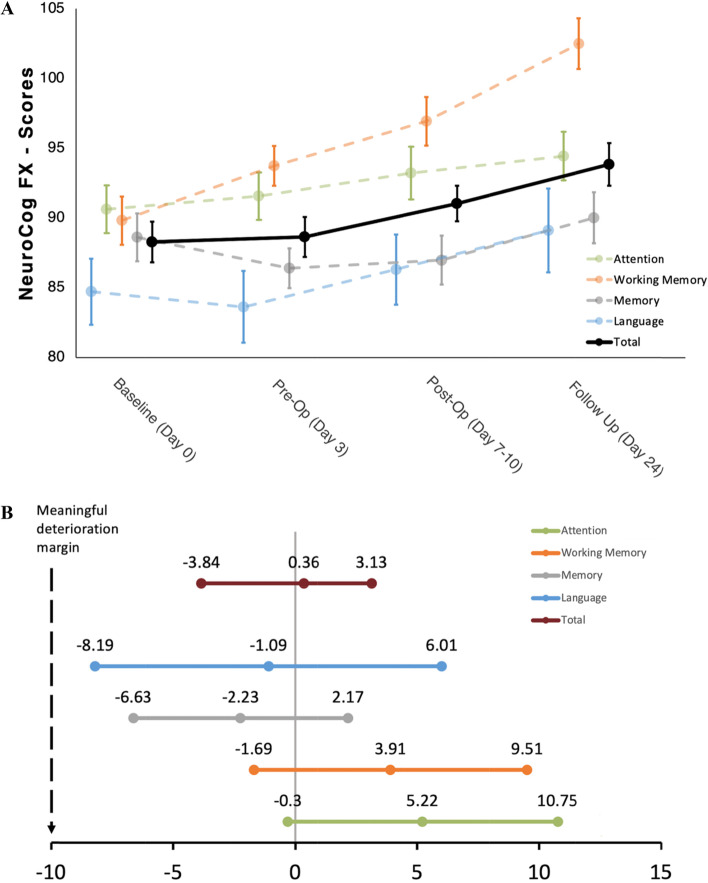
No significant changes in cognitive functioning and HRQoL were seen after onset of preoperative LEV. There was a significant improvement of NeuroCogFX total-score at Follow-Up (p = 0.004) compared to Baseline. The overall-score Qolie31 showed simultaneous improvement patterns as cognitive functioning (p < 0.001). The most frequent side effect related to study drug was somnolence (in 28.6% of patients).
A significant improvement of cognitive functioning, as well as an improvement in HRQoL, were detected postoperatively. This is presumably due to the debulking effect of the surgery. Nevertheless, LEV has no detrimental effect on cognitive functioning in the perioperative phase in seizure-naive brain tumor patients.
This study was registered prospectively (Date: 25/11/2015; EudraCT: 2015-003,916-19).
在无癫痫发作的脑肿瘤患者中,围手术期预防性使用抗癫痫药物的疗效仍存在争议。如果使用药物,通常首选左乙拉西坦(LEV),因为它具有良好的药理学特性。迄今为止的研究还没有充分确定 LEV 在短期内如何影响认知,就像围手术期一样。本前瞻性研究的目的是检查接受 LEV 围手术期治疗的无癫痫发作脑肿瘤患者的神经认知功能。
43 例拟行手术治疗的幕上脑肿瘤患者,在术前 3 天至术后 6 天内接受 LEV 作为预防性抗癫痫治疗。记录认知功能(NeuroCogFX)、LEV 血药浓度、血液毒性、副作用以及健康相关生活质量(HRQoL,Qolie31),分别在术前(基线)、LEV 开始前(术前)、术后 4-6 天(术后)和术后 21 天(随访)。
LEV 术前开始后,认知功能和 HRQoL 无明显变化。与基线相比,随访时 NeuroCogFX 总分显著改善(p=0.004)。Qolie31 的总分也同时表现出改善模式,与认知功能相似(p<0.001)。与研究药物相关的最常见副作用是嗜睡(28.6%的患者)。
术后发现认知功能显著改善,HRQoL 也有所改善。这可能是由于手术的减瘤效应。然而,LEV 在无癫痫发作的脑肿瘤患者围手术期内对认知功能没有不良影响。
本研究前瞻性注册(日期:2015 年 11 月 25 日;EudraCT:2015-003,916-19)。